Why the fiscal policies of PSD-PNL governments led to economic recession. The explanations of the vice-governor of the BNR


The vice-governor of the BNR, Cosmin Marinescu, warns that “there is no alternative to the need for fiscal consolidation” and calls for the continuation of the public budget consolidation policy, “in a balanced way”.
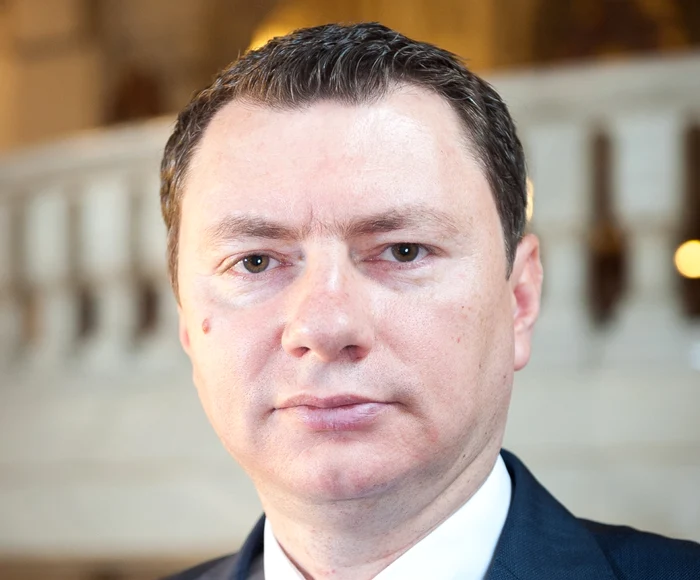
Cosmin Marinescu, BNR deputy governor PHOTO: Presidential Administration
Cosmin Marinescu, vice-governor of the BNR, writes on his blog why the fiscal policies of the PSD-PNL governments in 2023 and 2024 led to the economic decline, which “became visible from 2024”and showed that the record budget deficit in the EU led to an increase in consumption that “supported the growth of production in other countries'.
“The case of Romania is not a singular one in the economic space of the European Union. Ten other member states (Denmark, Germany, Estonia, Latvia, Luxembourg, the Netherlands, Austria, Hungary and, more recently, Finland and Ireland) have gone through episodes of technical recession in the last three years. Among these states, only Germany, Austria and Estonia have registered deep economic recessions, with two consecutive years of real GDP contraction, mainly against the background of the shocks of the energy crisis that broke out with the war in Ukraine“, the vice-governor writes on his blog.
He warns that the negative economic performance may be prolonged and showed that “the political stability of the government and the confidence of the investment environment are key priorities for economic recovery”.
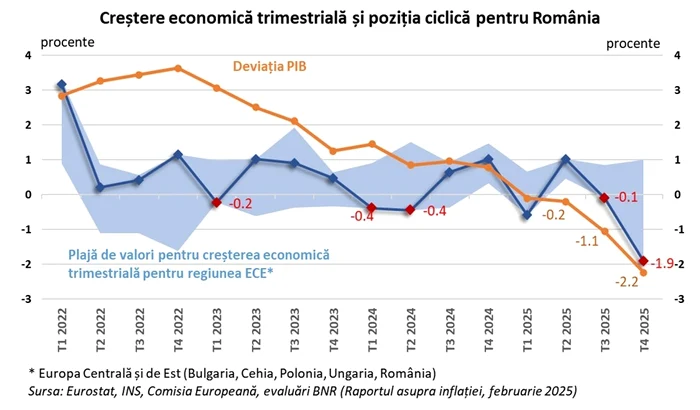
“Although economic growth has been modest since the beginning of 2025, this year can be considered important in terms of the necessary transition of the sources of economic growth. The sustainable change in the growth model means the transition from a dynamic based mainly on consumption to an economic growth based on investments, as can be seen from the graph above. Favorable dynamics were recorded both in the case of investments in machinery and means of transport, as well as for new constructions”Cosmin Marinescu also claims.
The budget deficit, a burden
The vice-governor says that these developments were also supported by bank loans granted to companies to finance equipment, loans whose share exceeded 30% at the end of 2025, from around 27% in December 2024.
“We must continue to strengthen public finances, but in a balanced way, ensuring as much as possible a certain social cohesion, as well as the necessary political consensus in such fragile times, dominated by multiple external, economic and security challenges. At the same time, it is particularly important to support the factors of economic growth, so that the economy returns to positive territory. The adjustment efforts will be all the more sustainable as the economy accelerates its annual growth rate. Otherwise, in the absence of a more consistent economic growth, the public deficit remains a burden”, argues Cosmin Marinescu.
He claims that in 2026, efforts to support the entrepreneurial environment and attract major investments in the economy require adaptation to the vulnerable context, but also prudent dosing.
“There are inherent risks that the negative dynamics will extend beyond the two quarters of “technical recession”. That is precisely why the political stability of the government and the confidence of the investment environment are key priorities for economic recovery. The 2026 budget, although delayed, is a test of economic maturity. Reforms and adjustments managed in a balanced and responsible manner will strengthen the confidence of investors and financial markets, and the economy will be able to return to a healthier footing.” is the opinion of the vice-governor.
His conclusion is that by accessing European funds, especially through PNRR, Romania is implementing the most important reform program undertaken after joining the European Union.