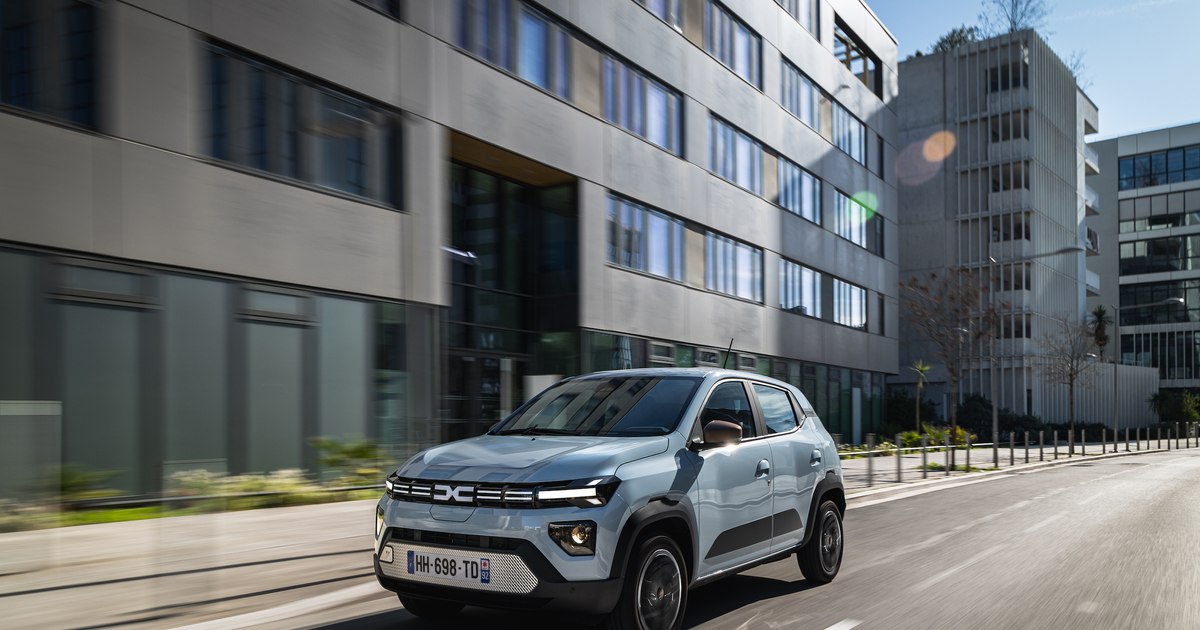
The summary of the commercial performance achieved by Dacia Spring in 2025 sounds like this: the model recorded 35,034 units sold, an increase of 53%. It ranks first in the A-segment electric vehicle segment – a position that forces new things, one of which is the Spring 100.
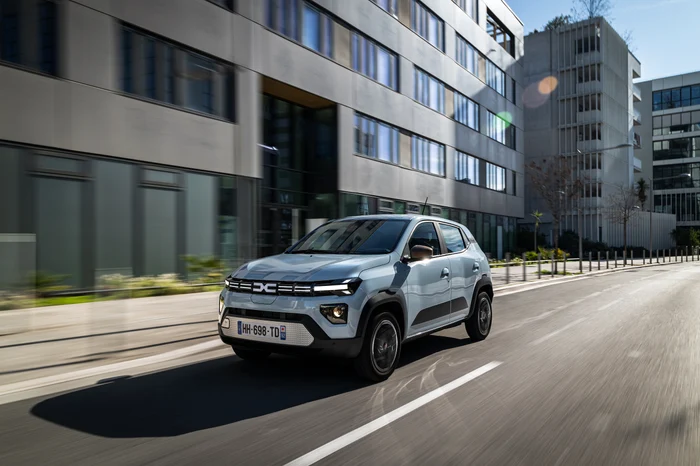
Other exterior, other technical improvements. PHOTO: Dacia
I discovered the new model last fall, when I met the Dacia 2026 range in Paris during Dacia Product Days, so we're going straight into the details. Externally, the changes are between non-existent and minimal. 4mm lower ground clearance I don't think will be noticed, between 146mm now and 150mm before – I think the difference would be made by two buckets of water in the back seat. The car has been polished, but through the less visible parts, to help it slide through the air more easily. Yes, there are aerodynamic optimizations at floor level, the only visible detail of this kind being at the tailgate where two side appendages have appeared to complement the aileron placed on the tailgate to reduce turbulence. In terms of aerodynamic efficiency we are talking about an aerodynamic coefficient Cd that has decreased from 0.743 to 0.665 for the version equipped with 15-inch rims.
As a rule, an update does not rewrite the technical data sheet of the car, but in the case of Spring, that's how things are. We are talking about an evolved chassis, one that integrates the new Lithium-Iron Phosphate (LFP) type battery. The old battery was a concentrated package in the rear seat area, but the new battery, with a capacity of 24.3 kWh, is spread over the entire floor area, ensuring better mass distribution.
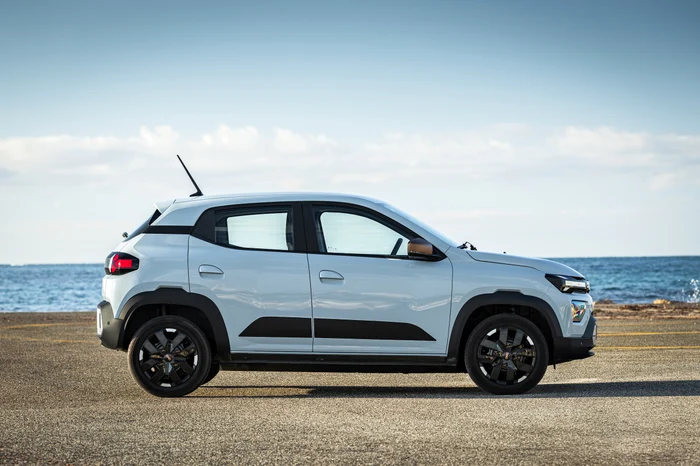
Other exterior, other technical improvements. PHOTO: Dacia
It also integrates a thermal management system that will allow it to perform better in the cold season, whether we are talking about charging or the autonomy offered. And because I mentioned charging, at DC stations this can be done with up to 40 kW, an extra 10 kW, and at AC stations with up to 7 kW. So the loading times are much better compared to the currently marketed version.
We also have new engines. The Spring 70 is the base version, the one that offers 52 kW/70 hp and 137 Nm. The Spring 100 version, with the engine in this test, offers 75 kW/100 HP and a torque of 137 Nm. The declared average consumption of both versions is 12.4 kWh/100 km, and the range is also 225 km.
First contact with Spring 100
For me, Spring was and will remain an urban model that can have the courage to attack the pre-urban area as well – the old model was already raising my pulse after 70 km/h. The surprise offered by the 100 HP and 137 Nm is significant. From a model that in the basic version (45 HP) needed 19.1 seconds to reach 100 km/h or 13.7 seconds for the 65 HP version, this time has now been reduced to 9.6 seconds. From the perspective of laps in traffic, the new Spring 100 almost gives you the impression of a mini-class hot hatch – we're basically talking about a 100 HP model with a mass of 1,069 kg.
Other exterior, other technical improvements. PHOTO: Dacia
I might even say I'm surprised by the consistency with which the car sends power to the ground, here a helping hand given the better mass distribution and small track. The latter helps that in tight turns there are no big differences in rotation between the wheels and hence the tendency to break the grip on the inside. If you have hooligan grips, yes, you will be able to easily make the front axle scream.
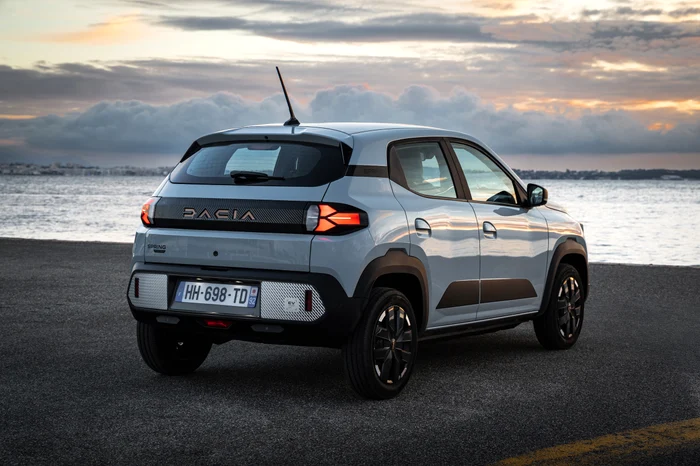
Other exterior, other technical improvements. PHOTO: Dacia
The second thing I quickly noticed behind the wheel was the significant dilution of the feeling of being in a pram from the sprung suspension. The roll has decreased, the car's reactions to the change of direction are much more composed, more coherent, in line with nature. The new suspension setup and the fact that the battery is located in the floor, covering almost the entire surface of the passenger compartment, feel positively. The car has gained a nice feeling of confidence behind the wheel, and much of that comes from the feedback you get from the chassis. Something has been preserved, however: the vertical movement of the occupants when going over bumps, but it is a natural detail for models in this segment.
Another Mary, another hat
The laps are truly delicious, and I mean the ones in the 70-100 km/h range. Now Spring can also travel extra-urban segments without any problems without having to worry about merging into traffic. It has a more powerful engine, obviously, and the possibility of healthier regenerative braking. In mode B I can talk about a driving regime close to “one pedal”, it will certainly be appreciated by those who prefer such a setting. At the end of the test loop, not very long, I had an average consumption of 12.4 kWh displayed.
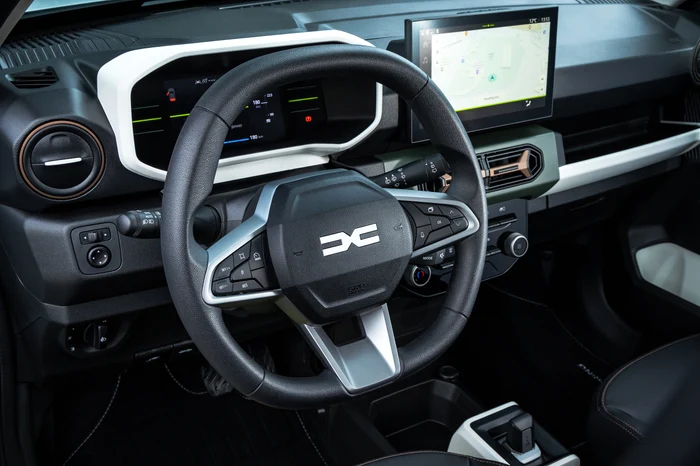
Other exterior, other technical improvements. PHOTO: Dacia
Dacia is talking about an update, a facelift in the case of Spring, but the technical innovations are so important that it can be considered a new version. Somewhere this step is natural, taking into account that we are talking about the best-selling BEV at European level in this segment. For the moment, the prices for the new version have not been announced.
Technical sheet
Dacia Spring 100
Engine – electric, 100 HP, 137 Nm
Transmission – automatic box with mode B, front wheel drive
Performance – 125 km/h v. max., 0-100 km/h in 9.6 seconds
Trunk – 288 liters
Battery – useful capacity of 23.4 kWh
DC load – 40 kW, AC load – 7 kW
Dimensions – L/W/H (mm): 3,701/1,583/1,519, wheelbase – 2,423
Declared average consumption – 12.4 l/100 km
Autonomy – 225 km