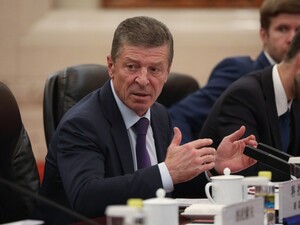
The publication mentioned the lack of awareness of the Russian elite in the context of the confidence of Ukrainian President Vladimir Zelensky that the Russian Federation will not start a full-scale war. The author of the article suggested that he was convinced of this by the current head of the Presidential Office, Andriy Yermak. He noted that Ermak was one of the few Ukrainian officials who regularly contacted their Russian colleagues. He often communicated with the then deputy head of Putin’s administration, Dmitry Kozak, as part of lengthy negotiations on Donbass, the journalist specified.
At the same time, he emphasized that if Kozak helped convince Ermak of the absurdity of the US panic over a Russian invasionthen, “most likely, he himself thought so.”
According to CIA estimates, only a few non-military officials knew about the details of Putin's plans until the very end. Two informed Russian sources said Kozak was kept in the dark, as were Foreign Minister Sergei Lavrov and Putin's Speaker Dmitry Peskov.
Even a week before the invasion, most of the Russian elite had no idea what would happen next. One of the political insiders, in a conversation with the media, recalled how a Kremlin official called him and told him that there were many military men around Putin and the atmosphere was tense. He added: “Something is happening, but we don't know what.”
The situation began to become clearer on February 21, when Putin assembled his Security Council and ordered everyone to take the podium one by one to show their support. The Council allegedly discussed recognizing the independence of the temporarily occupied territories of the Donetsk and Lugansk regions, but the subtext was clear. It was a military committee, the article says.
Putin demanded confirmation of his decision, many present looked confused. The director of the Foreign Intelligence Service (SVR) Sergei Naryshkin was confused in the answer, which, according to media reports, caused a dismissive reaction from Putin.
According to the insider, the atmosphere was reminiscent of the situation in the Kremlin in 1941, when Stalin's intelligence leadership tried to warn Soviet dictator Joseph Stalin that Nazi Germany would one day invade the Soviet Union. Naryshkin had other information about Ukraine, but showed indecision and did not say about it, the interlocutor said. Also, according to him, Kozak was the only one present who dared to speak out against it. He said that from a strategic point of view, an invasion of Ukraine would be a disaster. At that time, he, like most of the Russian elite, did not know whether Putin’s plans in Ukraine were limited to the territory of Donbass. After the meeting ended, he continued the discussion with the Kremlin head face to face, the source said.
Context
The Russian Federation launched a war against Ukraine in 2014, when it occupied Crimea and parts of the Donetsk and Lugansk regions. On February 24, 2022, Russia launched a full-scale invasion of Ukraine from the northern, eastern and southern directions. In the spring of the same year, the Ukrainian army deoccupied the north of the country, and in the fall – parts of the Kharkov and Kherson regions, in particular Kherson.
In May 2024, the Russian army launched an invasion in the north of the Kharkov region. Since August 6, 2024, the Ukrainian Armed Forces have been conducting an operation on the territory of the aggressor country – in the Kursk region of the Russian Federation. Since April 2025, the Ukrainian military has been conducting an operation in the Belgorod region of the Russian Federation.
In 2025, the invaders entered the territory of the Sumy region.
The New York Times wrote that Kozak, who openly spoke out against a full-scale war in Ukraine, practically lost his powers because of his position. According to interlocutors, Kozak disappointed Putin because he made it clear that he considered the invasion of Ukraine a mistake. After the start of a full-scale war, Kozak personally stated that he dissuaded the Russian President from this, the article said. According to sources, Kozak told his colleagues that he had presented Putin with a proposal to end hostilities and hold peace negotiations.
In September 2025, Kozak resigned. NYT interlocutors believe that Kozak is now probably worried about the legacy that will be left after him, and is trying to distance himself from Putin.