Tariffs have been canceled, but there is no euphoria on Wall Street. However, there is a reflection on big tech


2026-02-20 22:10
publication
2026-02-20 22:10
Friday's ruling by the Supreme Court introduced even more chaos into the already chaotic customs policy of the United States administration. Stock prices on Wall Street were generally rising. Shares of large technology companies, which had fallen out of favor with investors over the previous months, were most eagerly purchased.
The U.S. Supreme Court found on Friday that U.S. President Donald Trump did not have the authority to impose tariffs under IEEPA. Trump himself responded by announcing the introduction of 10 percent tariffs based on other regulations. However, it is not known whether the US government will have to refund importers the collected customs duties, whose value is estimated at USD 175 billion.
The Supreme Court's decision increased volatility in financial markets, but it was a far cry from what happened in April 2025, when President Trump introduced these tariffs. Finally, the S&P500 index gained 0.69% on Friday, ending the week at 6,905.51 points. The Dow Jones industrial average rose by 0.47%, finishing with 49,625.97 points. The Nasdaq Composite gained 0.90% and reached 22,886.07 points.
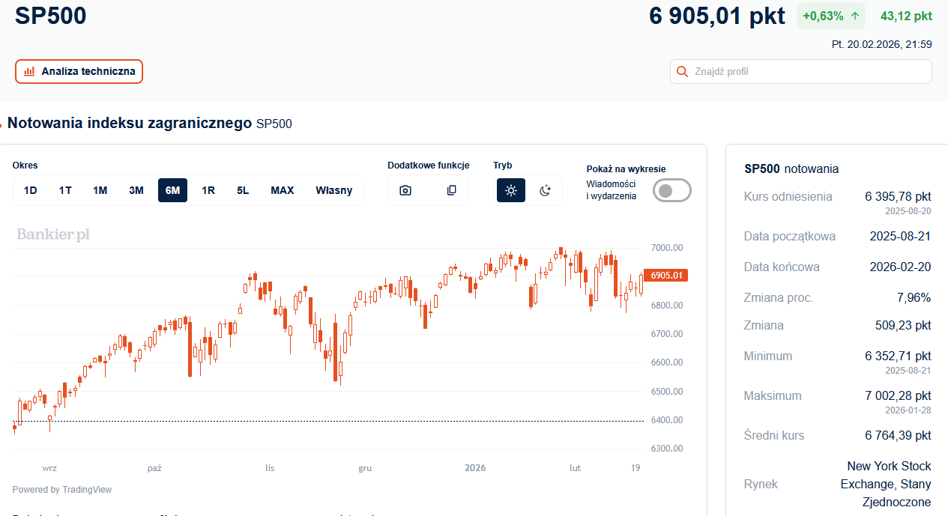
It was certainly not a session that would change the not very impressive (at least this year) picture of the US stock market. After a series of hurricane-force increases since autumn, there is stagnation on Wall Street, and investors turn up their noses at the absurdly high valuations of companies related to generative AI.
But on Friday, these stocks saw the strongest increases. The shares of Alphabet (i.e. former Google) increased by over 4%, Amazon by over 2%, and the shares of Meta (i.e. Facebook), Apple and Nvidia increased by over 1% each.
However, negative information came from the macroeconomic sector. Economists apparently failed to estimate the economic costs of the fall shutdown and clearly missed forecasts for US GDP in the fourth quarter. US GDP grew at an annualized rate of just 1.4%, while it was expected to grow by 3%.
Moreover, the data on consumer inflation was very bad. The Federal Reserve management's preferred core consumer spending deflator (PCE core) accelerated to 3.0% y-o-y in December from 2.8% in November, beating the market consensus of 2.9%. So we have a situation where in December the Fed significantly loosened its monetary policy (cutting rates and resuming QE) with 3% inflation!
Add to this that Americans' inflation expectations remain far too high in both the medium and long term. In a February study by the University of Michigan, the expected increase in consumer goods prices over the next 12 months is 3.4% (in January it was as much as 4%). Over the next 5 years, the expected average annual CPI inflation is 3.3%.
K.K