Just a week ago Monday, investors were still hoping that the attack on Iran would be a short and quick maneuver, which was visible in the market's slight reaction to the attack carried out over the weekend. But already on Tuesday, i.e. on the fourth day of the conflict, hopes for a quick resolution dropped, which, given the significant increase in uncertainty, resulted in an outflow of capital to safe havens, so the dollar and American bonds gained, and stock markets lost. The poor mood deepened on Friday, when a wave of sell-offs swept across the world's stock exchanges.
On Monday, March 9, investors' risk aversion was increasing. The yield on Polish 10-year treasury bonds jumped in the morning by as much as 30 basis points (bps), or 0.3 percentage points, to 5.869%. This is a very large one-day increase for this asset class. This means a decline in the price of our bonds (the yield goes in the opposite direction to the price). Before the attack, the yield on these securities reached 4.95%, so in just over a week it jumped by as much as 92 basis points. The decline in bond prices means that to achieve the same goals, the Ministry of Finance must issue more bonds.
“It should be noted, however, that a similar fate befell Hungarian, Czech and Romanian bonds. Foreign investors, who have recently been eagerly visiting our region, have started to play out a scenario analogous to 2022, assuming the high sensitivity of Central and Eastern European countries to price spikes of energy raw materials,” wrote Patryk Pyka, director of the analysis and investment advisory team at DI Xelion.
However, he assessed that the reaction was too strong. “Although the current situation on the energy raw materials market has changed the balance of risks to the detriment, the prospect of interest rate increases in Poland is distant. It is worth noting that in 2022, inflation in Poland was already at an increased level after the period of Covid stimulation, and interest rates were much lower than now. It should also be noted that Poland currently has a much more diversified range of sources of energy raw materials supply compared to the situation four years ago,” he added.
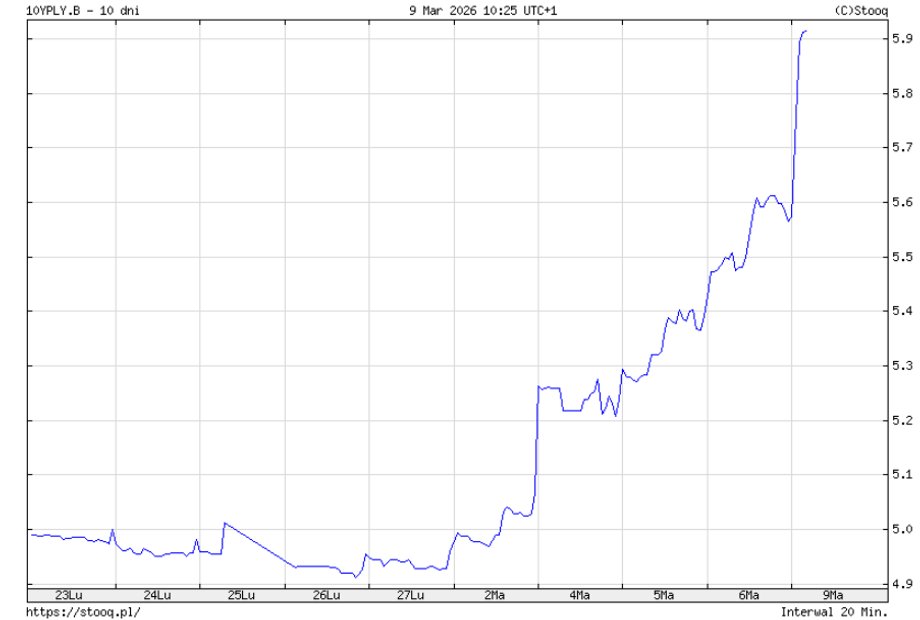
The yield on 10-year Polish treasury bonds – despite the interest rate cut a week ago – has increased dramatically.
|
Stooq, own study
On Monday morning, the price of crude oil was around $103. per barrel, on Friday it reached over USD 90, and in the first days after the attack it was quoted at around USD 70-75. Before the bombings, it was in the range of $60-65. Over the weekend, there were no expected signals from the Middle East suggesting de-escalation of the conflict. On the contrary: the Strait of Hormuz has been virtually closed, and the US is threatening to deepen the conflict with Iran. The appointment of the son of Ayatollah Ali Khamenei as the leader of Iran is perceived by the market as an act of intransigence by the regime. In a comment published by Donald Trump, the American president stated that “short-term increases in oil prices are a small price to pay for the security of the United States and the world.”
Have the SAFE 0 percent proposals harmed Polish bonds?
Bank Pekao economists wrote that the announcement of the SAFE 0 percent program may be partly responsible for investors' reluctance towards Polish treasury bonds. “Although this program in itself should not involve an increase in the supply of bonds, investors may be afraid that ultimately the implementation of any of the alternative SAFEs may be delayed, which would mean that the modernization of the Polish Armed Forces would have to be financed with standard wholesale issues. Perhaps, however, it is not about SAFE at all, the increase in profitability in the Vistula region does not differ significantly from the situation in the region: for example, the yield of the Czech 10-year bond has increased by approximately 14 percent since the end of February. , which is basically the same as Polish paper with a 10-year-old tenor,” they pointed out.
They did not rule out that the Ministry of Finance would intervene (at least verbally) to stop the sale of Treasury securities. “Investors will also have to rethink the path of interest rates in Poland. While the path of economic growth in Poland is rather unthreatened (domestic growth engines, including investments, remain strong), the increase in the cost of living may inhibit the dynamics of private consumption, while the price impulse coming from the oil market may prompt the Monetary Policy Council to end monetary easing earlier,” wrote Pekao economists, adding that this is not a general economic crisis, but a raw material crisis.
See also: Oil prices suddenly skyrocketed. Donald Trump reacts: Only fools think otherwise!
“Monday's increase in oil prices and the escalation of the global risk-off mode worsen the negative environment for risky assets. In our opinion, the oil market is already showing signs of panic, which, after an increase of over 66% (Brent) since the end of February this year, may suggest at least a temporary crisis,” wrote PKO BP economists.
“Further developments in the situation in Iran remain crucial for further market quotations, although an additional local factor will be the publication of inflation data for February on Friday, along with the recalculation of the January result according to the new CPI basket weights,” added Santander analysts.