Experts warn that while continued reliance on America's “extended nuclear deterrent” remains the most sensible solution in the short term, Europe can no longer place all responsibility for strategic deterrence thinking on Washington. What is at stake is avoiding a major strategic failure in the future.
“While this debate may be politically uncomfortable, the new security environment forces European decision-makers to directly and immediately address the role of nuclear weapons in the continent's defense – and to allocate adequate resources to do so professionally. Serious reflection today is the price to pay to avoid strategic failure tomorrow,” the report's authors emphasize.
In recent years, Russia has reintroduced an element of nuclear blackmail and the threat of nuclear escalation into European security policy. This makes credible deterrence crucial again. At the same time, the political stability of America's security guarantees appears more fragile than at any time since the end of the Cold War.
These two factors taken together are forcing Europe to think more seriously about its options.
The report analyzes five policy options that have been discussed in European defense circles over the last two years:
Option A — continued reliance on the US nuclear umbrella.
Option B — strengthening the role of British and French nuclear forces in the European deterrence system.
Option C — creation of a common European nuclear deterrence mechanism.
Option D — development of new, independent national nuclear capabilities.
Option E — investing only in conventional deterrence, without a nuclear component.
Each of these paths implies a different distribution of costs and risks between the United States, existing European nuclear powers, and non-nuclear states. Each also involves specific trade-offs—between credibility, feasibility, legal constraints, and political risk.
There is no “nuclear deus ex machina” that will solve the problem without costs and risks
— the authors of the report leave no doubt.
In the short term, continued reliance on the US remains the most viable and credible option – it is based on unprecedented military capabilities, deep integration within NATO and decades of shared operational experience.
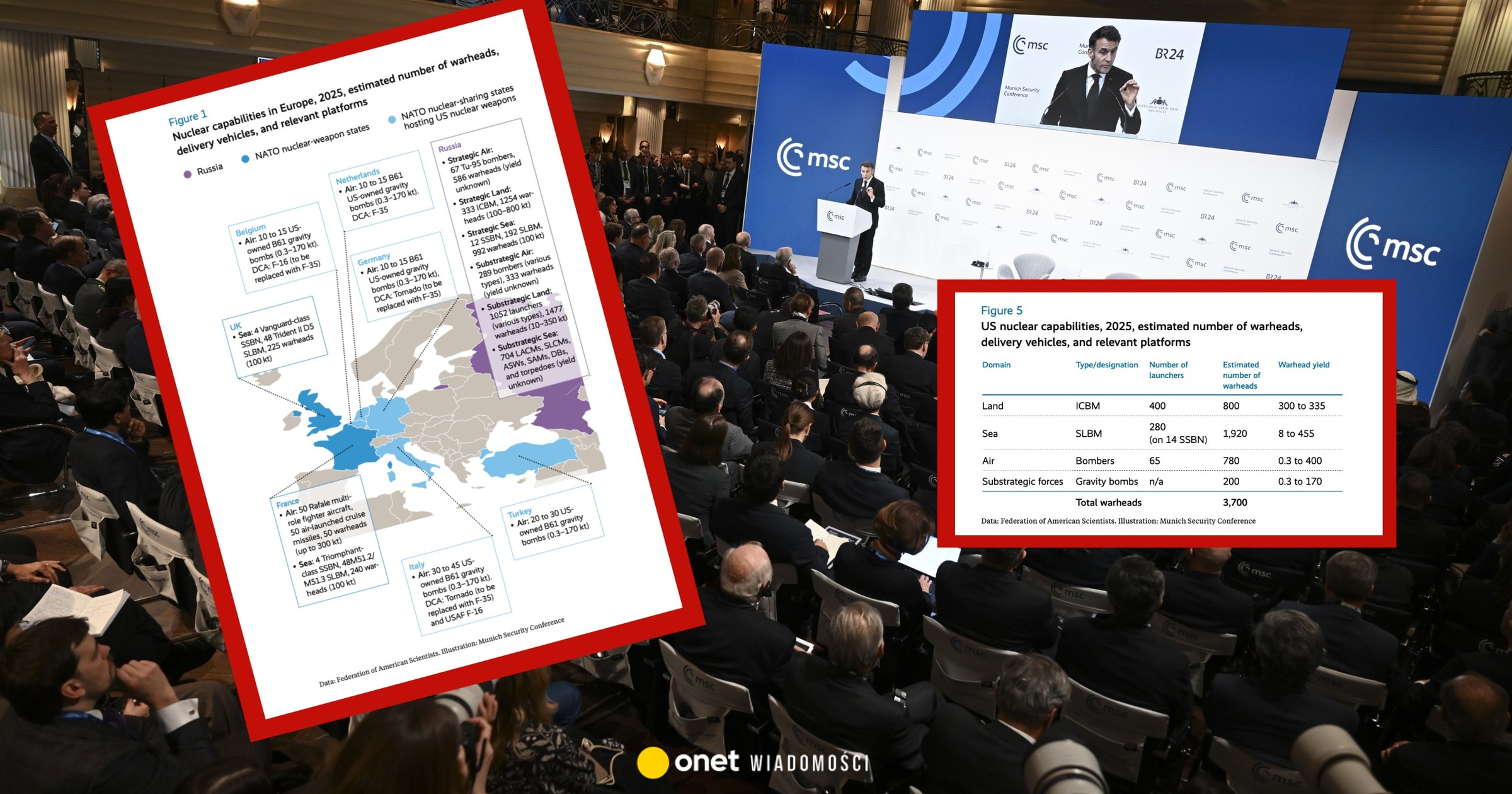
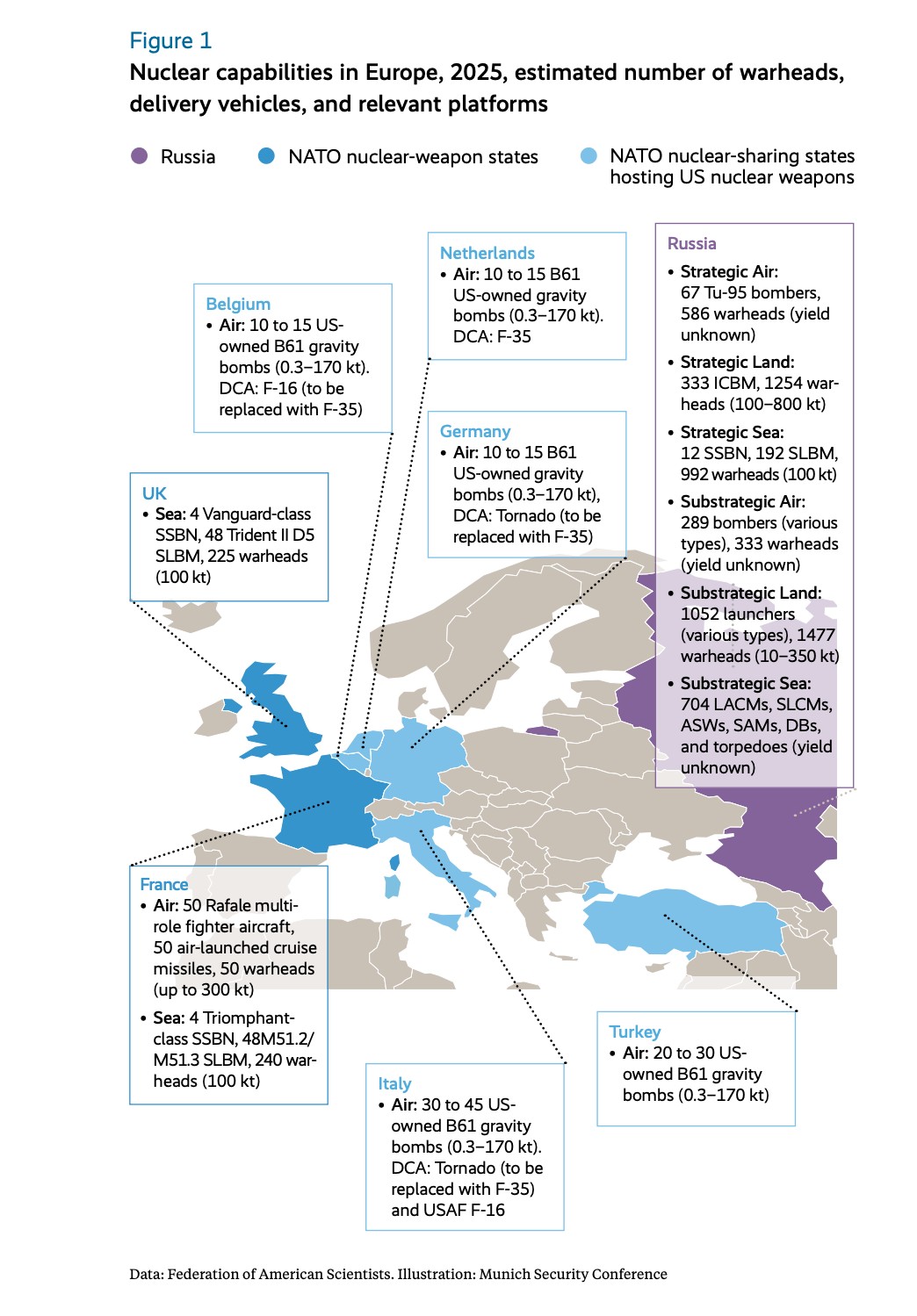
Graphics from a report presented at the Munich Security Conference. It presents the estimated nuclear capabilities in Europe in 2025 – the number of warheads, delivery systems and key platforms in NATO countries and Russia.securityconference.org / securityconference.org
However, Europe cannot treat this option as guaranteed forever. There may come a time when the United States will not be willing or able to provide nuclear deterrence.
Can the US withdraw its security guarantee for Europe?
Experts emphasize that Europe can no longer “outsource” its strategic thinking to Washington.
Russia's full-scale invasion of Ukraine in 2022 overturned the belief that European security could be maintained with relatively low defense spending and minimal dependence on nuclear deterrence. At the same time, Donald Trump's re-election has increased uncertainty about the long-term durability of American guarantees.
The Trump administration's relations with European allies were tense, and declarations on conditional treatment of alliance commitments raised questions about whether Washington would continue to be the foundation of Europe's nuclear and conventional deterrence.
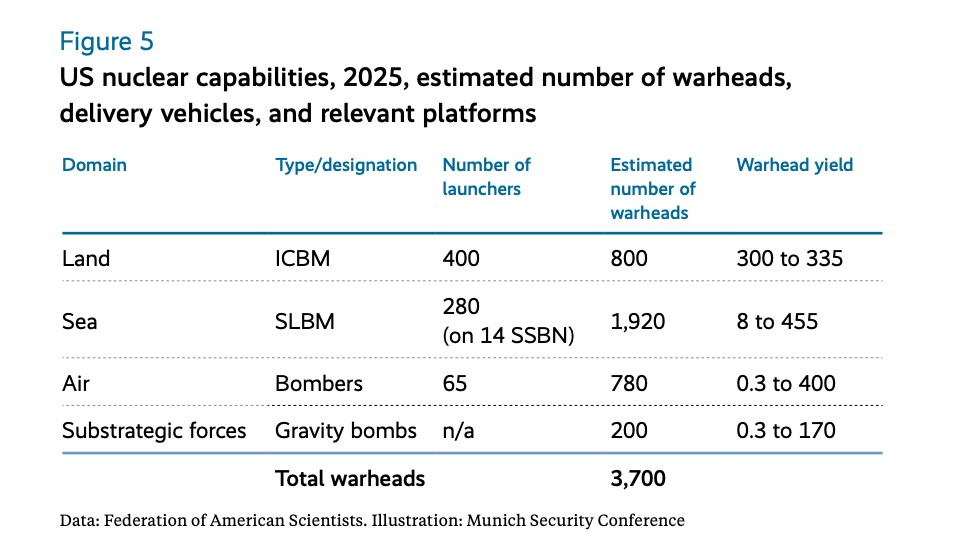
Graphics from a report presented at the Munich Security Conference. It presents the estimated nuclear capabilities of the United States in 2025 – the number of launchers, warheads and their power in individual domains: land (ICBM), sea (SLBM on submarines), air (bombers) and sub-strategic forces (gravity bombs).securityconference.org / securityconference.org
The situation is further complicated by the dynamic development of China's nuclear arsenal in the Indo-Pacific region. The United States must consider the possibility of simultaneous crises involving Russia, China and North Korea — as well as the increasingly closer cooperation between these countries. This raises concerns about the overload of American forces and forces a revision of strategic priorities.
The threat of a “deterrence gap”
In such a situation, Europe may face a serious threat – the “deterrence gap”. This would mean a situation in which opponents believe that there is a discrepancy between Europe's interests and its ability or will to defend them.
Such a gap could arise not only as a result of the US formally withdrawing from the guarantee or the collapse of NATO. Equally dangerous would be a gradual erosion of credibility through ambiguous signals, decision delays and lack of coherence, especially in times of crisis when the stakes are highest.
The article continues below the video
“Deterrence is based not only on military capabilities but also on shared perceptions.
If Russia believes that the US may be reluctant to use nuclear weapons to defend Europe, and Europe itself lacks political unity or appropriate institutional and military mechanisms, then nuclear blackmail will become a more tempting option.
Even limited doubts as to who will respond, how and at what cost may provoke testing of boundaries – especially in the “gray zone” – or lead to limited use of force to break the unity of the Alliance,” the authors of the report emphasize.
Therefore, the “deterrence gap” would be a political, institutional and military problem at the same time. If Europe wants to avoid it, it must ensure that no adversary could assume that the continent would remain strategically defenseless — whether because of Washington's distraction, its internal divisions, the overload of its forces, or because of the European states' own impotence.
I’m Ashley Davis as an editor, I’m committed to upholding the highest standards of integrity and accuracy in every piece we publish. My work is driven by curiosity, a passion for truth, and a belief that journalism plays a crucial role in shaping public discourse. I strive to tell stories that not only inform but also inspire action and conversation.