Vitaly Buterin, better known as Vitalik Buterin, is a Russian-Canadian computer programmer, best known for co-creating the decentralized Ethereum platform. Buterin became involved in cryptocurrencies at an early stage of their development, co-founding Bitcoin Magazine in 2011.
Considering this topic today can be morally uncomfortable – because modern Russia kills at least a hundred Ukrainians every day and deprives thirty million people of a normal future.
However, in the long term, the most lasting security guarantee for Ukraine and Europe would be for the Russian Federation itself to transform into a state that does not pose a threat to its neighbors. I will divide my answer into two parts:
1. my personal thoughts on what a peaceful Russia could bring to the world;
2. the role of the idea of ”decentralized politics” – both in the structure of the ideal, peaceful Russia of the future and in the activities of today's opposition.
I know that many people like to cite Dostoyevsky as an example of “great Russian culture.” However, I have never been particularly attracted to this literature and I have the impression that there is far too much talk about Dostoyevsky (as well as Tchaikovsky and other classics).
My favorite 19th century writer is Jules Verne.
When I think about what the most valuable Russians bring to the world, I rather think about mathematics, computer science or biology. I once asked Aubrey de Grey, a renowned researcher in the field of radical human life extension, which country the scientists doing the best work in this field come from. He answered without hesitation: from Russia.
Cosmism has been part of Russian culture for over a century. Tsiolkovsky created the famous “rocket equation”. In the 21st century, when the world is thinking about artificial intelligence, Mars or biotechnology that can dramatically improve the health care system, it is worth focusing on such topics – on areas where global cooperation is possible – instead of concepts such as “Foundations of geopolitics”.
The article continues below the video
Part two
We often talk about “decentralized management” and “radical democracy” in a very general and idealistic way, and specific problems that such solutions could actually solve are far too rarely indicated. Meanwhile, in my opinion, these ideas have two very practical and important applications.
First: how to reconcile the interests of the two groups that make up this 70 percent? societies that are most difficult to convince?
Those who focus solely on the security of Ukraine and Europe often dream of Russia breaking into twenty pieces. However, such a scenario does not appeal to the second group – it raises fear among most Russians of another deep economic crisis.
Therefore, unless there is a plan to completely destroy the Russian army and enter Moscow with tanks, the scenario of the collapse of the state remains unrealistic.
In turn, those who want economic success – both ordinary people from small towns and large entrepreneurs – want Russia to develop and become richer.
However, if you think solely in these terms, there is no guarantee that the Russian government will not remain “evil.” Even from peaceful sectors of the economy, 13 percent income goes to the Kremlin in the form of taxes.
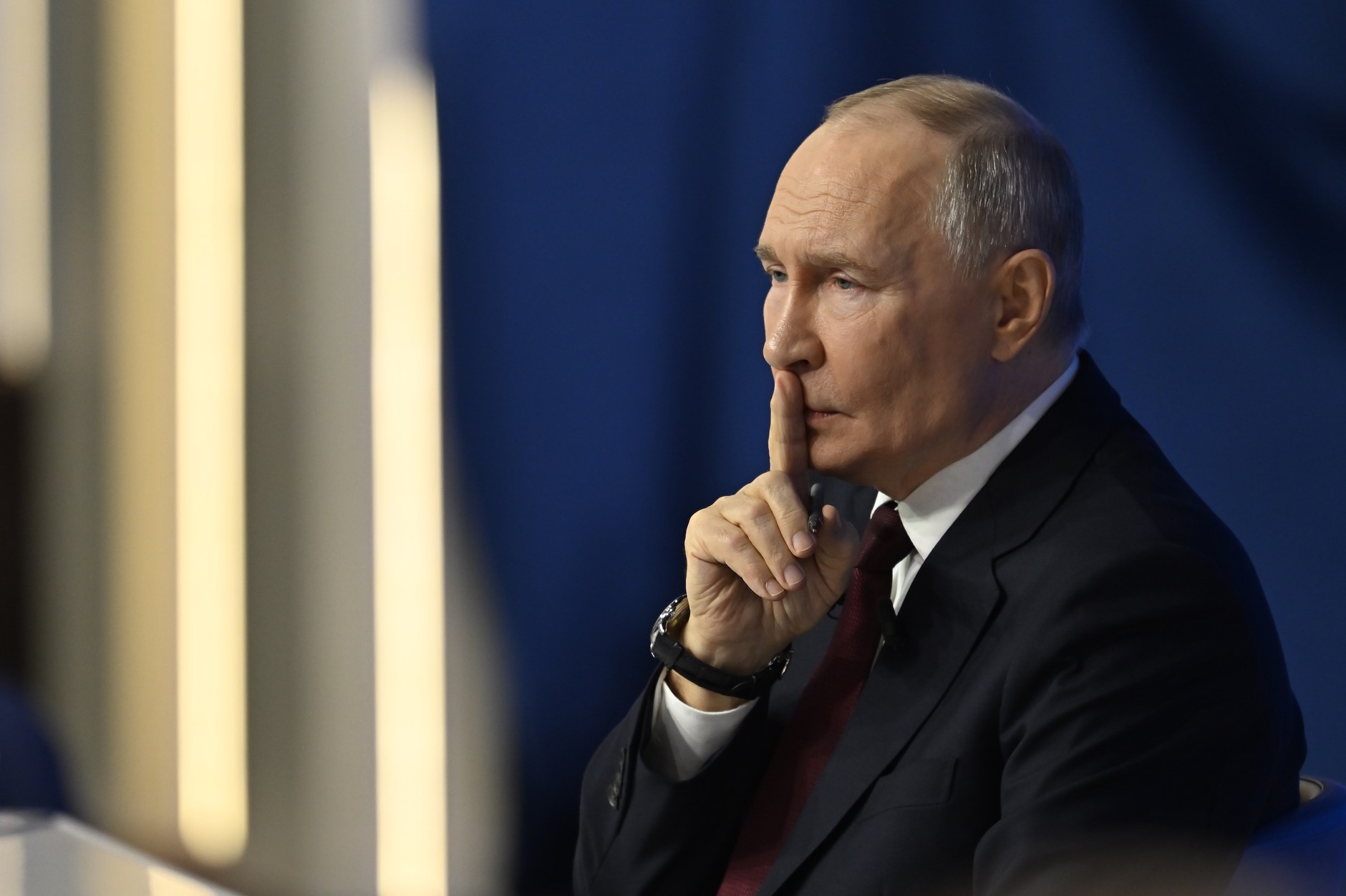
Russian President Vladimir Putin during his annual year-end press conference, Moscow, Russia, December 19, 2025.Sefa Karacan/Anadolu via Getty Images / Getty Images
And if Russia's centralized technology platforms are successful, the Kremlin could at any time take more control over them than that 13 percent. and transform it into a political tool or even a weapon.
In such a situation, Ukraine, Europe and even “Trump's America” would have reasons to oppose every step towards Russian economic success.
So what is the point of all these lofty concepts of “decentralized politics”? It can be put as follows: how to build a state that, when the goal is to improve the quality of life of citizens, works efficiently and effectively, but when someone tries to use it to oppress minorities or aggression against neighbors – it becomes uncoordinated and weak?
In other words: how to use the potential of a large country without putting its own citizens or neighbors at risk?
In the cryptocurrency world, it is often said that we need to move from “don't be evil” to “can't be evil”. In a real society, achieving such a guarantee is 100 percent. is unrealistic. But if you manage to achieve at least 25%. this goal – this is already a very good result.
This distinction is crucial for two reasons.
Firstlywhen planning any political reform, we need to clearly define what its specific optimization goal is – what we actually want to maximize.
SecondlyRussian society (as well as that part of the political elite with which it will be necessary to cooperate for any changes to have a chance of success) must have reasons to want to listen to all these ideas and take them seriously.
I’m Ashley Davis as an editor, I’m committed to upholding the highest standards of integrity and accuracy in every piece we publish. My work is driven by curiosity, a passion for truth, and a belief that journalism plays a crucial role in shaping public discourse. I strive to tell stories that not only inform but also inspire action and conversation.