Trump is ending the era of comfortable alliance. It's time for Europe to come back down to earth. “In 2026, we must fasten our seat belts and prepare for the worst.” [ANALIZA]
Europe still wants and needs to cooperate with President Trump. However, this year has made it clear that she is more and more alone.
This year has dispelled any last illusions among European leaders that Donald Trump could be sorted out or tamed.
His open hostility toward the European Union has strained transatlantic ties that have endured since the end of World War II and deepened divisions both among Europe's national leaders and within the bloc. This, in turn, weakens the continent's ability to respond to Trump's threats and taunts with the unity and strength that he respects.
As a result, in the context of the upcoming 2026, the fate of Ukraine still remains uncertain. Existential questions still remain unanswered questions about European security — at a time when many fear that Russian President Vladimir Putin's territorial ambitions may reach further west than just Ukraine.
But in many respects, Europe has survived this emotional roller coaster – at least for now.
— Europeans cannot afford to cut ties and hand over divorce papers because they are still too dependent, especially when it comes to U.S. security and military involvement in the defense of Europe, says Jana Puglierin, senior researcher at the European Council on Foreign Relations.
However, he adds, the leaders' efforts to maintain solid relations with the US based on short-term interests do not mean that the past year has not made us realize that long-term interests are not currently aligned.
We have to face the truth. In the old days, there was a clear, common understanding of the value of the old transatlantic relationship – based on Western values, norms and principles of a rules-based international order. Now we see a competing design emerging
– says.
The Trump administration is also taking a realistic look at the coming year.
She sees the continent as losing its values and identity, succumbing to liberal ideals, which – according to her – pose a greater threat to Europe's security than any message from the White House. The White House argues that the real act of friendship is urging Europe to spend more on its own defense, limit immigration and end the war in Ukraine.
“President Trump has good relationships with many European leaders, but he is never afraid to tell difficult truths,” White House spokeswoman Anna Kelly said. — The devastating effects of uncontrolled migration and the inability of migrants to assimilate are not only a problem for Trump, but also for Europeans themselves, who increasingly point to immigration as one of their biggest challenges. The open border policy has led to numerous cases of violence, increased crime and other effects that negatively impact the financial stability of social support systems.
The price of cooperation with Trump
After a violent start to the year, when Vice President JD Vance publicly lectured Europe on freedom of speech in Munich and then joined Trump in criticizing Ukrainian President Volodymyr Zelensky in the Oval Office, Europeans began to shift to Trump's worldview. A transition that Romanian politician Nicușor Dan described as moving “from moral action to a very pragmatic and economic approach” — and they succeeded in bringing the White House back to cooperation on several fronts.
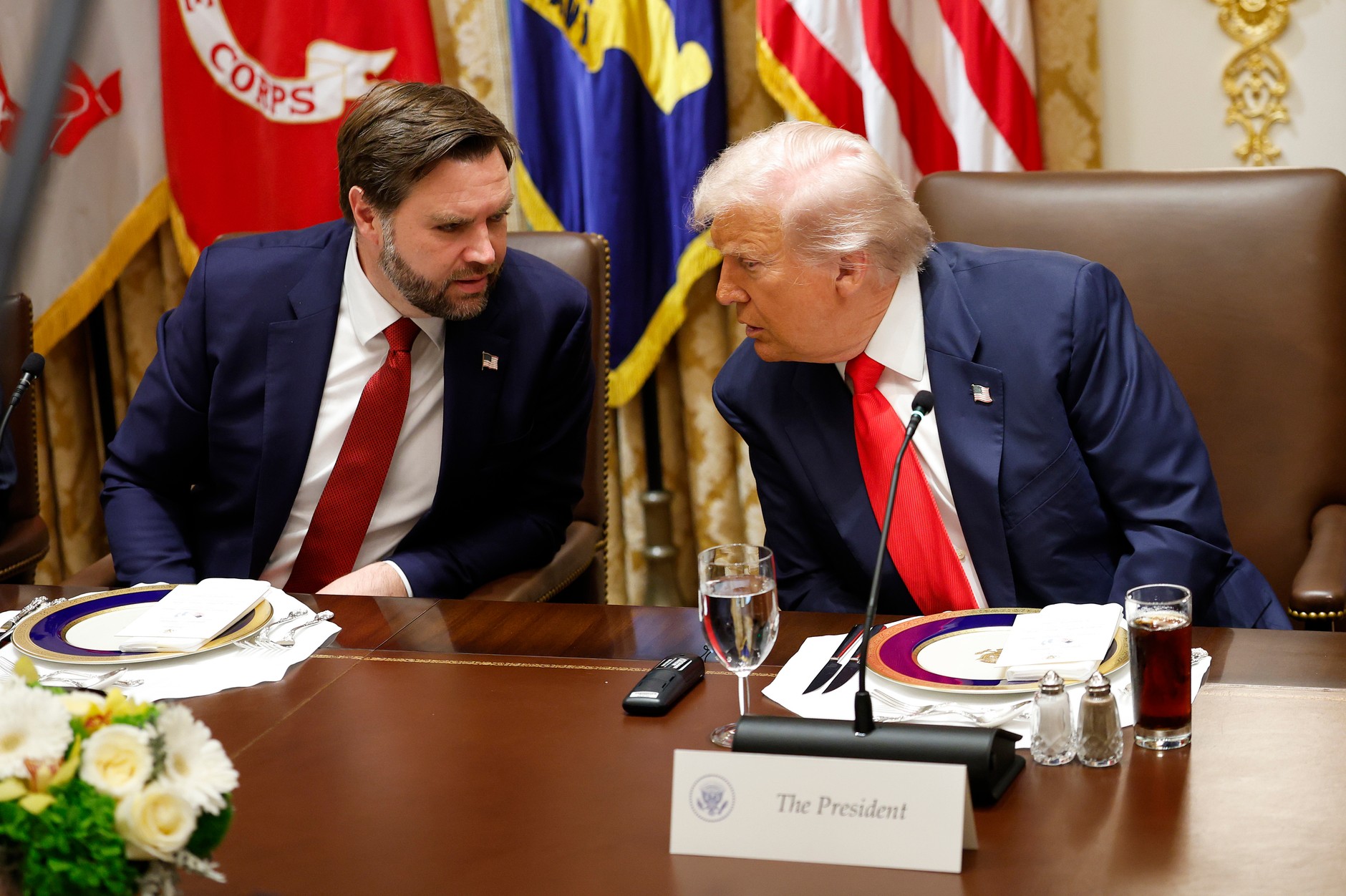
U.S. Vice President J.D. Vance and President Donald Trump at the White House in Washington, D.C., October 14, 2025.Kevin Dietsch/Getty Images/Getty Images
The European Union relented in trade negotiations, agreeing to a new 15% tariff, limiting the short-term damage to the economy. NATO calmed Trump down with a promise to increase defense spending by 5%. over the next decade, which was solidified at the June summit – largely by recognizing past non-defense spending as part of that commitment.
Instead of abandoning Ukraine, Trump in July agreed to additional defense aid for its fight against Russia — provided Europe finances it. Europeans were also able to cope with Trump's meeting with Putin in August in Alaska and the secret 28-point peace plan prepared by the administration with the participation of the Kremlin, which was then revised together with the US and Ukraine.
In an interview with POLITICO earlier this month, Trump blasted European leaders as “weak,” saying they don't know what to do, especially on immigration. He even suggested that their alliance relationship could end if policies are not changed, and that he would not hesitate to intervene in the European elections to support far-right parties that challenge the coalitions and leaders he currently works with.
This coincided with the publication of the new US National Security Strategy, which calls for “building resistance” against European centrism, accusing it of committing “civilizational suicide”, and expresses contempt for the European Union, which the administration described as “contrary” to US economic interests.
Constanze Stelzenmuller from the Brookings Institution think tank named the European chapters of this strategy “game-changing“which “permanently changed” the long-term strategy with the US. – It should not be underestimated how much of a shock it was for European leaders and the public to read that this administration considers Europe, and especially centrist European politicians, as unreliable allies and pursues such a confrontational policy towards them.
In 2026, we must buckle up and prepare for the worst. We have obvious weaknesses that will be exploited
– she added.
An ally in the crosshairs
Trump ends the year by reminding Europe of his ruthless ambition — outlined in his first term and again ahead of his second term — to wrest control of Greenland from Denmark. A country that is a reliable NATO ally and has one of the highest per capita defense spending among member states.
On Saturday, he named Louisiana Gov. Jeff Landry as special envoy for Greenland. The position, Landry said, will focus on efforts to “make Greenland part of the United States.”
Trump's plane in the autonomous Danish territory of Greenland (illustrative photo)Emil Stach / PAP
This is devastating for many countries that thought their bilateral relationship with the US gave them absolute security, Stelzenmuller said.
The administration, while openly threatening Denmark, is also trying to create a wedge between European Union members by suggesting that the countries would get better trade deals by splitting from the 27-nation bloc and negotiating directly with the White House.
At the end of the year, the fundamental question facing Europeans is whether they believe that tactical victories will be enough to win the strategic war – that is, to maintain the transatlantic alliance that has lasted for eight decades.
– says Ivo Daalder, former US ambassador to NATO.
Safe Mode Strategy
German Chancellor Friedrich Merz, who earlier this month declared that “Pax Americana is dead,” said last week that it had become “obvious” that Trump “can't relate” to the EU but that “at least there are individual member states — above all Germany — with which such cooperation can continue.”
Merz tried to push through a plan to redirect $200 billion in Brussels. [ok. 718 mld zł] for a loan to Ukraine, but the proposal fell through after opposition from Belgium, Italy and others. Ultimately, however, the reserve plan was adopted – USD 90 billion. [ok. 323 mld zł] loan to keep its forces on the battlefield for the next two years. Three pro-Trump leaders — from Hungary, Slovakia and the Czech Republic — withdrew but did not block its adoption.
Although Trump has secretly opposed EU efforts to shore up Ukraine's war budget, Europeans have largely supported his diplomatic efforts to end the war, pushing for stronger security guarantees. This is all to ensure that Ukraine survives in the long term.
Finnish President Alexander Stubb declared on Fox News on Sunday, December 21, that Trump's efforts are “closer to peace talks than at any time since the beginning of this war” — a comment apparently aimed at an American audience and only partially consistent with what most European leaders believe.
I’m Ashley Davis as an editor, I’m committed to upholding the highest standards of integrity and accuracy in every piece we publish. My work is driven by curiosity, a passion for truth, and a belief that journalism plays a crucial role in shaping public discourse. I strive to tell stories that not only inform but also inspire action and conversation.