In all five countries surveyed – the United States, Canada, the United Kingdom, France and Germany – the vast majority of respondents believe that the world is becoming less safe. Americans, Canadians, French and British more often than not recognize that World War III may break out in the next five years.
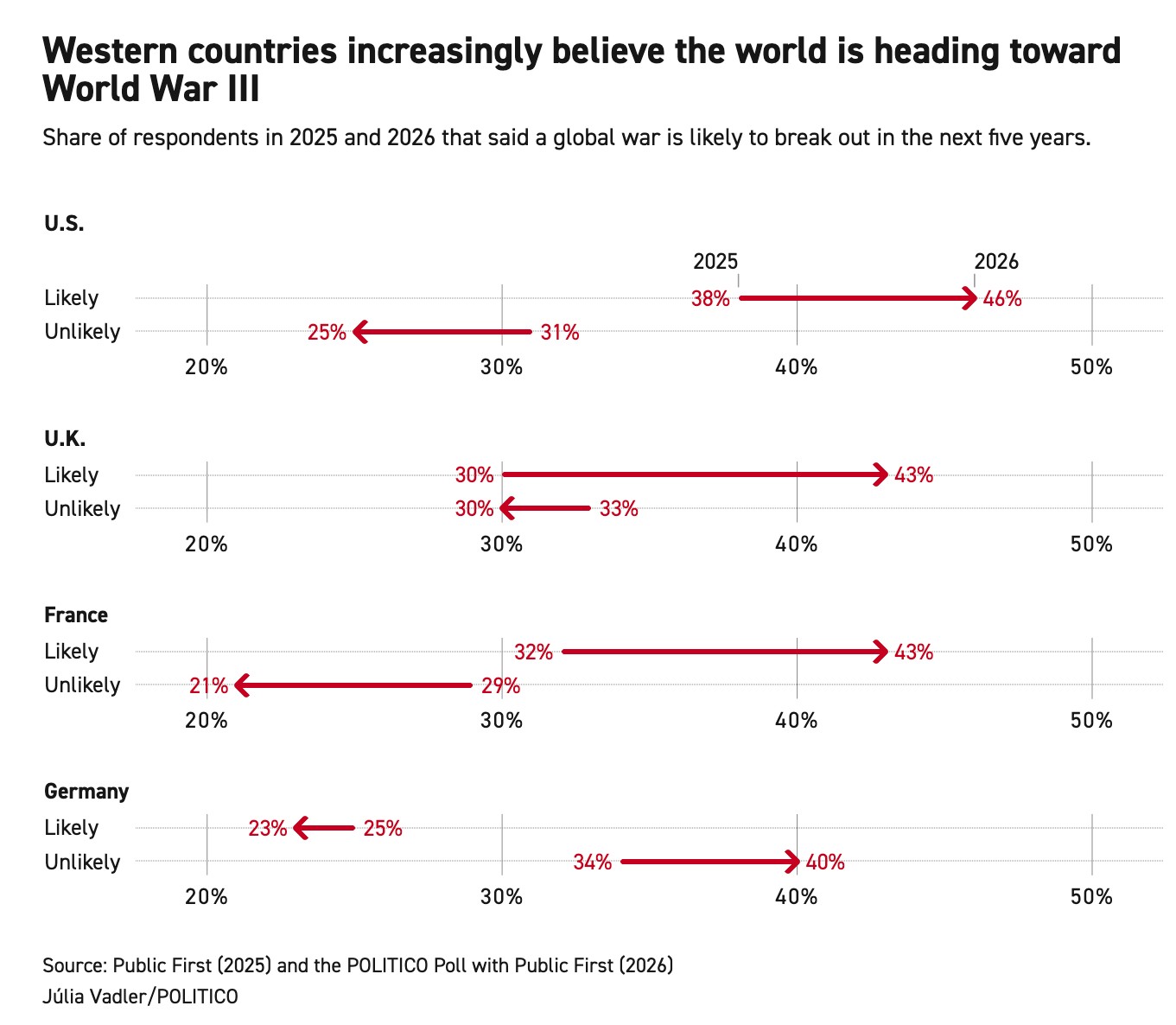
Since March 2025, when the independent studio Public First first asked this question, the percentage of people predicting a new global conflict has increased significantly.
said Seb Wride, director of research at Public First.
The survey was conducted between February 6 and 9 on a sample of over 2,000 voters in each of the five countries. Its results show what a serious challenge NATO leaders face today – they must strengthen security in a situation when state budgets are stretched to the limit.
At the same time, the POLITICO survey reveals societies' limited willingness to bear the costs of increased military spending. There is broad support in Britain, France, Germany and Canada for increasing defense budgets — at least in theory. However, when respondents learned that this would mean greater government debt, cuts in other areas of the budget or tax increases, support decreased rapidly.
“Our research shows that the growing fear of war does not give politicians a free hand to increase defense spending indefinitely,” Wride noted. — Moreover, voters today are less willing to accept the difficult trade-offs that would be necessary to improve military security. European leaders therefore find themselves in a bind: they cannot fully rely on the United States, nor can they use it as an argument to increase domestic spending without opposition, and at the same time they are under increasing pressure to find a solution quickly in a world where the specter of conflict seems closer than ever before.
These dilemmas will be one of the main topics of discussion at the annual Munich Security Conference in Germany, which starts on Friday, February 13 and brings together politicians from around the world.
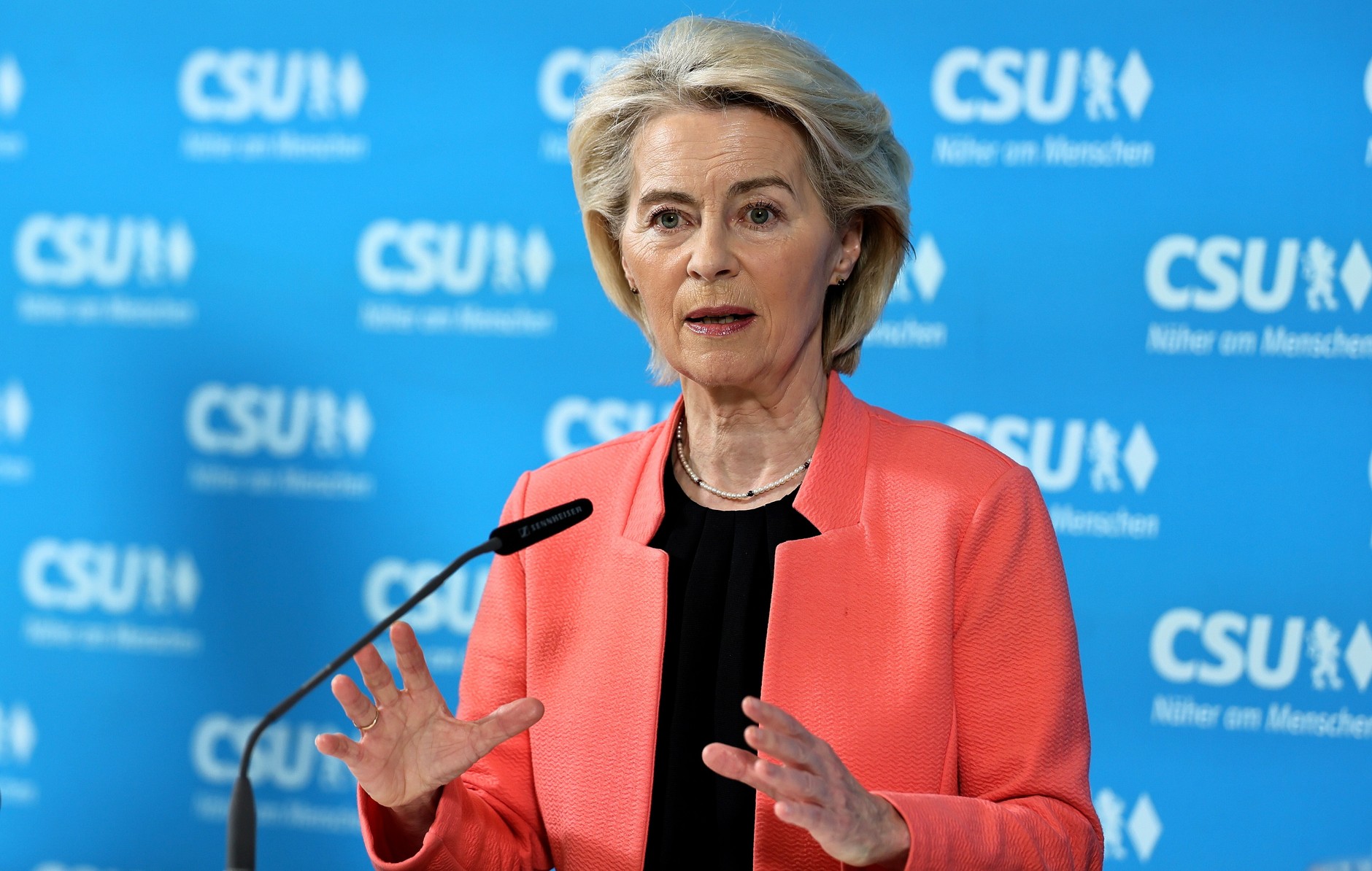
European Commission President Ursula von der Leyen issues a press statement at the 62nd Security Conference in Munich, Germany, February 13, 2026.PAP/EPA/RONALD WITTEK / PAP
With no prospects for a quick end to Russia's four-year, full-scale war against Ukraine and the military actions undertaken by the United States under President Donald Trump's leadership – in Iran, Syria, Venezuela and Africa – many voters see a growing risk of global confrontation.
Nuclear fears of the West
This is particularly clear in Great Britain, where 43 percent respondents believe that the outbreak of a new world war by 2031 is “likely” or “very likely” – in March 2025, 30 percent held this opinion.
In the United States, 46 percent of respondents think similarly (a year earlier it was 38 percent). Of the five countries surveyed only Germans mostly believe that World War III is unlikely in the next five years.
The graphic shows the results of a survey showing how the percentage of people in the US, UK, France and Germany who believe that a global war could break out in the next five years has changed between 2025 and 2026POLITICO POOL / Politico
When it comes to the possibility of direct military involvement of their own country, Americans most often expect that their country may find itself in a state of war within five years. Right behind them are the British and the French.
This may suggest that NATO countries with nuclear weapons are mentally preparing more for conflict than other countries. The image of Donald Trump as the “president of peace” does not fully convince American voters.
At least one-third of respondents in the US, UK, France and Canada believe that nuclear weapons may be used in a conflict in the next five years.
Russia is perceived as the greatest threat to peace in Europe.
Canadians, on the other hand, consider Donald Trump's America to be the greatest threat to security.
In France, Germany and the United Kingdom, the United States ranks second among the threats – indicated much more often than Chinay.
The article continues below the video
How much will it cost?
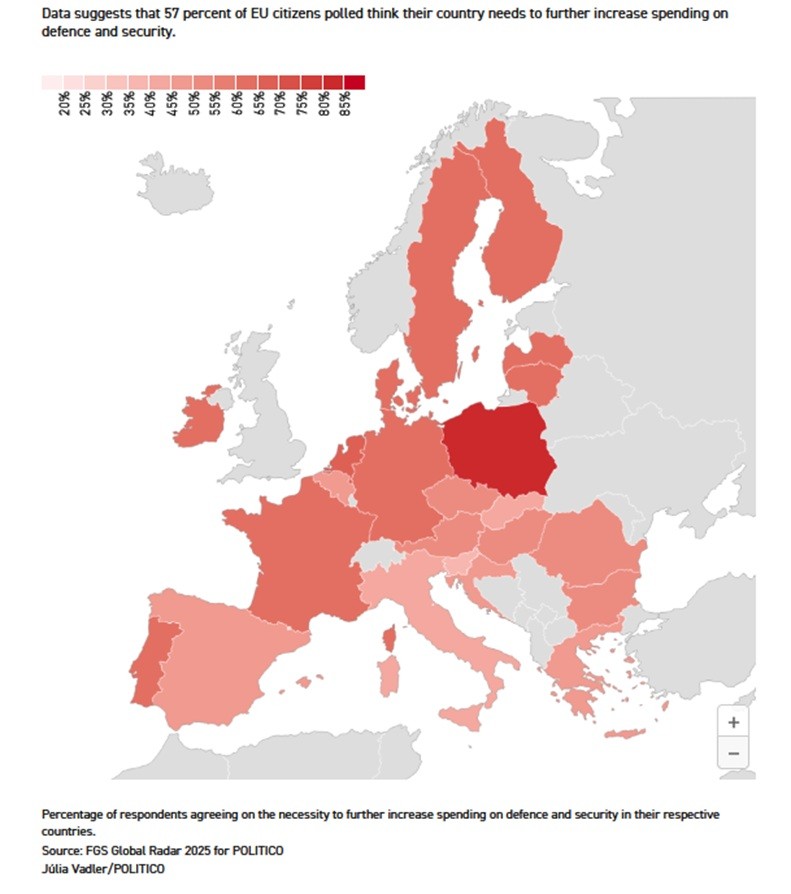
Most respondents in France, Germany, the UK and Canada believe their country should spend more on defense. The strongest support for this solution was recorded in Great Britain and Canada.
The key question, however, is: where to get the money?
The POLITICO survey shows that support for increased defense spending declines significantly when respondents have to decide whether the funds would come from cuts in other areas of the budget, increasing the national debt or raising taxes.
According to the survey results, the French and Germans are less willing to support higher military spending when such compromises are necessary today than a year ago.
In Germany, defense spending is one of the least popular ways of allocating public money – ahead only of foreign aid.
Map of Europe with the percentage of respondents agreeing with the need to further increase spending on defense and security in their countries (in Poland it is 82%), January 28, 2026.Julia Vadler/POLITICO / Politico
In 2025, 40 percent French and 37 percent Germans declared support for increasing defense spending when the need to bear the costs was mentioned. This year, this percentage dropped to 28%. in France and 24 percent in Germany.
Both societies are now more likely to oppose increasing defense spending when they realize the real cost of such decisions.
The poll also showed clear skepticism towards the idea of creating a standing European Union army under a unified command – an idea mentioned by the European Commission. In Germany, only 22 percent support it. respondents, and in France 17 percent
Compulsory military service enjoys the greatest support in Germany and France, with around half of respondents in these countries supporting its introduction.
I’m Ashley Davis as an editor, I’m committed to upholding the highest standards of integrity and accuracy in every piece we publish. My work is driven by curiosity, a passion for truth, and a belief that journalism plays a crucial role in shaping public discourse. I strive to tell stories that not only inform but also inspire action and conversation.