Merz, stark warning at Munich Security Conference: Not even the US will be strong enough to act alone / “The world order as we know it no longer exists”

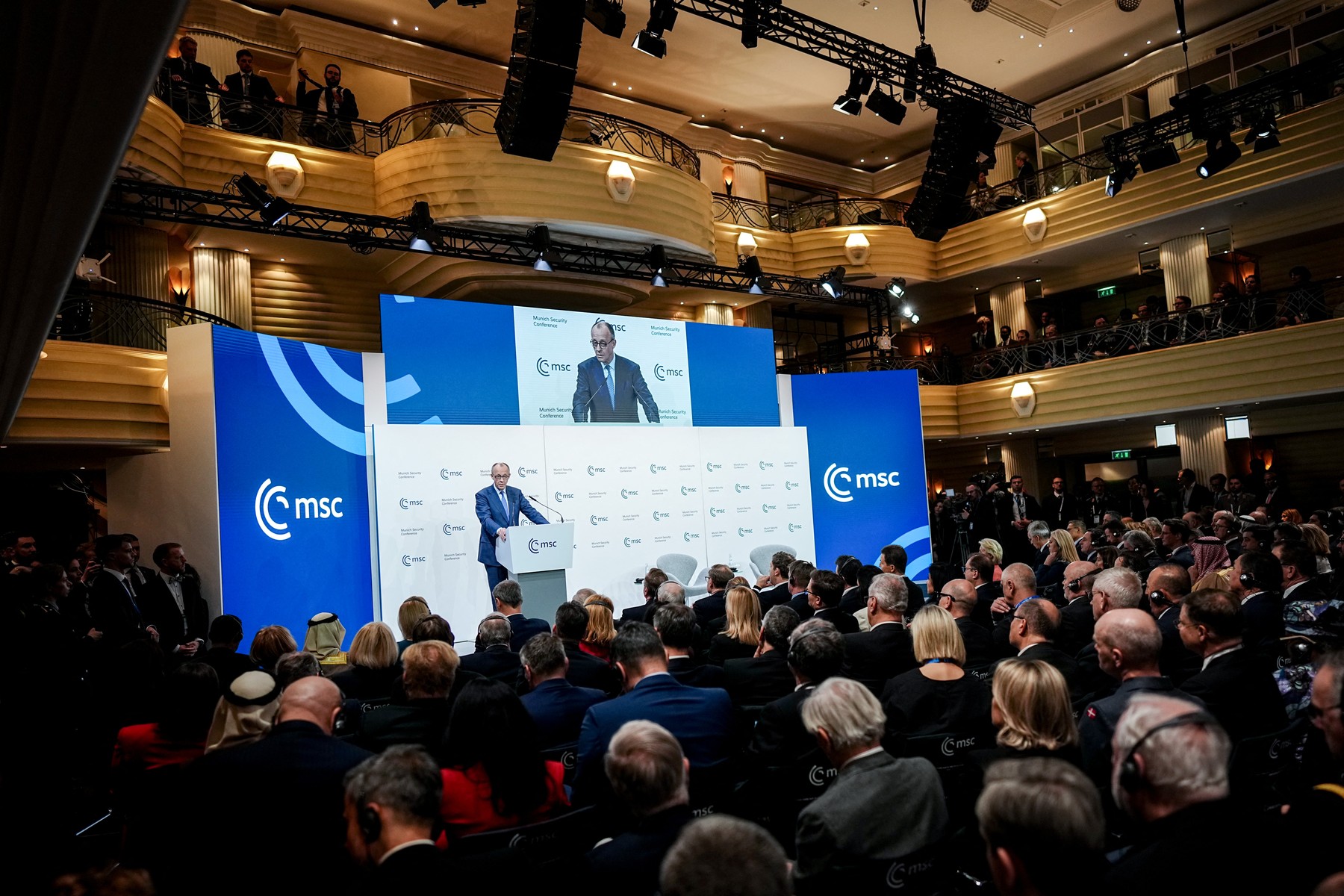
At the opening of the Munich Security Conference, German Chancellor Friedrich Merz on Friday called for a stronger Europe to reset relations with the United States, wanting Washington to “repair and revive trust” in a dangerous new era of great power politics amid the collapse of the old world order, Reuters and The Guardian write.
In his speech, Merz warned that the US cannot act alone, but also said that Europe must strengthen its own defense systems and noted that it is holding confidential talks with France on nuclear deterrence.
The chancellor's speech underscored how European leaders are increasingly seeking to carve out an independent path after a year of unprecedented turmoil in transatlantic relations, while trying to maintain the alliance with Washington.
Drawing on warnings that the rules-based international order was about to be destroyed, Merz declared: “I'm afraid we have to say it even more bluntly: this order as we knew it, imperfect as it was even in its best form, no longer exists in this form.”
Speaking in English at the end of his speech, Merz said: “In the age of great power rivalry, even the United States will not be strong enough to act alone. Dear friends, NATO membership is not only a competitive advantage for Europe. It is also a competitive advantage for the United States.”
“So let's repair and renew transatlantic trust together,” Merz added.
A year after Vance's exit, Rubio is taking a softer tone
US Secretary of State Marco Rubio also said transatlantic relations are at a “decisive moment” in a rapidly changing world, but took a more conciliatory tone, in contrast to Vice President JD Vance's remarks in 2025.
At the same meeting of senior security officials last year, Vance attacked European allies in a speech that marked the beginning of a series of confrontations with Washington's partners. European allies face a myriad of threats, from Russia's war in Ukraine to massive disruptions in global trade.
“I think it's a watershed moment … the world is changing very quickly right before our eyes,” Rubio said before leaving for Munich.
“Honestly, the old world is gone, the world we grew up in, and we're living in a new geopolitical era that will force us all to reexamine what that looks like and what our role will be,” the US diplomat said.
The US is “deeply tied to Europe, and our future has always been tied and will continue to be,” said Rubio, who is a potential rival to Vance in the 2028 US presidential race. “So we need to talk about what that future is going to look like,” the secretary of state pointed out.
Merz rejected Vance's speech
This year's meeting takes place against the backdrop of several conflicts, including the wars in Ukraine, Gaza and Sudan.
Transatlantic relations have long been at the center of the Munich Security Conference, which began as a Cold War forum for Western defense debate. But the unchallenged assumption of cooperation that underpinned it was overturned.
Underscoring the blow to transatlantic relations, a YouGov poll of the six largest European countries on Friday showed favorability towards the US in Europe had hit its lowest level since monitoring began in 2016.
The latest figures are broadly comparable to – and in some cases greater than – the perceived threat from China, Iran or North Korea, although they rank behind Russia, YouGov said.
US President Donald Trump has ousted Venezuela's leader, threatened other Latin American countries with similar military action, imposed tariffs on friends and foes alike and talked openly about annexing Greenland from NATO member Denmark – a move that could effectively end the alliance.
“No one in Europe or the United States stands to gain from any kind of conflict between old allies,” said Danish Prime Minister Mette Frederiksen, who said she would meet Rubio in Munich.
“So we have to do everything we can to keep the Americans close to us, but we live in a new world order,” she added.
In his speech last year, JD Vance accused European leaders of censoring free speech and failing to control immigration, which Merz has now explicitly rejected.
“A rift has been created between Europe and the United States. Vice President JD Vance said this very openly here in Munich a year ago,” the federal chancellor said.
“He was right. The culture war of the MAGA movement is not ours. Freedom of speech stops here, with us, when that speech goes against human dignity and the constitution. We do not believe in tariffs and protectionism, but in free trade,” he added, drawing applause from the room.
Merz and Macron 'confidential talks' on European nuclear deterrence
Also in his speech on Friday, delivered as world leaders gathered for the opening of the Security Conference in Germany, Friedrich Merz confirmed that he was holding talks with French President Emmanuel Macron on the subject of European nuclear deterrence.
“We have started confidential discussions with the French president on the topic of European nuclear deterrence,” Merz said in the Bavarian capital.
“We are not doing this by giving up NATO. We are doing it by building a strong and autonomous European pillar within the alliance”, he stated.
The chancellor said Berlin would honor its legal commitments, referring to the 1990 international agreement on German reunification.
The treaty, known as the Two Plus Four Agreement, committed a reunified Germany to giving up the manufacture, possession and control of nuclear, biological and chemical weapons, according to the AFP, DPA and Agerpres agencies.
Under NATO's existing nuclear sharing agreement, US nuclear weapons stationed in Europe can be deployed by aircraft from allied countries in an emergency.
US B61 nuclear bombs are believed to be stored in northern Italy, Belgium, the Netherlands and western Germany.
However, calls for a European nuclear umbrella have gained new momentum following Russia's invasion of Ukraine and the shift in US foreign policy under President Donald Trump.
Following the United Kingdom's exit from the European Union following Brexit, France is the only EU member state with nuclear weapons.
Macron initially proposed holding talks with Germany and other EU member states on expanding France's nuclear deterrent capability in 2020, but these were rejected by former Chancellor Angela Merkel and her successor, Olaf Scholz.
However, Merz appeared more open to discussing the issue with Macron, seeing the French offer as a supplement to NATO's nuclear weapons sharing.
Emmanuel Macron is due to give a speech in the coming weeks on the French doctrine of nuclear deterrence.
“EU mutual assistance” clause
Curiously, The Guardian notes, Merz also called for further discussion on Article 42 of the EU treaties, which refers to “mutual assistance” in the event of an armed attack on Europe.
The chancellor said he wanted the EU to “specify” how this should work.
In this context, Merz announced that he had started the “first discussions” with Macron about a European nuclear deterrence program “to be integrated into nuclear sharing within NATO”.
“Let's change the mentality to make Europe a superpower and face the chaos of the new world order,” urged Merz.