MAP How much of Ukraine's territory did Putin's army conquer in 2025 / 83 dead or injured per km. square


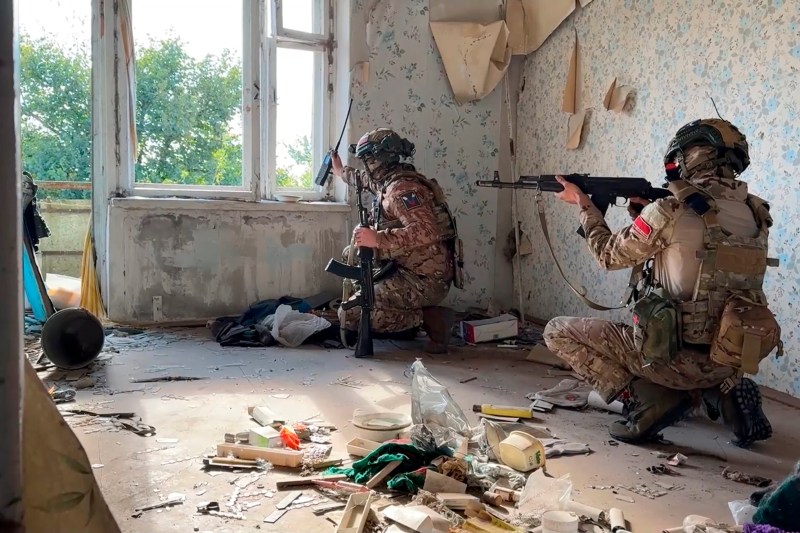
Russian soldiers from Ukraine. PHOTO: Russian Defense Ministry Press Service / AP / Profimedia
The invasion forces sent by Vladimir Putin have captured a very small percentage of Ukraine's territory this year, at the cost of hundreds of thousands of Russians killed or wounded, the US think tank Institute for the Study of War (ISW) notes in its latest assessment of the war.
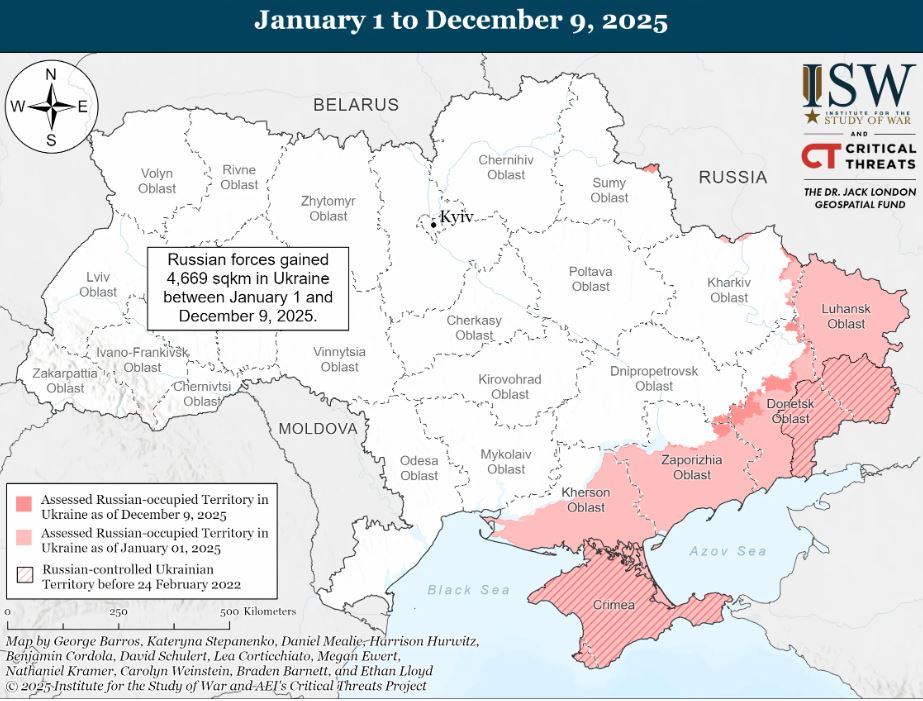
Russian troops have gained 0.77% of Ukrainian territory since early 2025, while suffering disproportionately high personnel losses.
According to data analyzed by ISW, Moscow's forces have captured about 4,669 square kilometers since January 1, 2025.
83 Russians dead or wounded for one square kilometer
Data provided by the Ukrainian General Staff indicates that Russian forces suffered a total of 391,270 casualties (dead wounded) during this period, or about 83 casualties per square kilometer.
The pace of Russian advance has not been major even in areas where Russian forces have recently made relatively faster gains, such as in the Hulyaipole and Pokrovsk directions.
The Russian advance is unlikely to increase its speed in the short to medium term, according to the cited source, as the drone-dominated battlefield prevents them from conducting military operations at the scale required for rapid operational advances that would restore maneuverability to the battlefield.
Ukrainian drone-based defenses have some vulnerabilities (e.g., weather factors) that Russian forces have been able to exploit to make significant tactical advances, but Ukrainian drone defenses have generally prevented Russian forces from using armored vehicles and mechanized maneuvers and forced them to engage in heavy-casualty infantry missions.
This balance is unlikely to change quickly, barring sudden changes in the fundamental technologies and operational concepts that underlie the current war in Ukraine.
ISW: Difficult decisions ahead for Putin
Russia's resources are not unlimited, as Putin tries to claim, and he appears to be currently facing difficult decisions regarding the strategic sustainment of Russian force generation, says ISW, which said in February 2025 that Russia will likely face a number of material, personnel and economic problems in the next 12-18 months as the costs of the war worsen over time.
The main recruitment system of the Russian armed forces, which uses high financial incentives to attract personnel, appears to be experiencing diminishing returns and negatively affecting the Russian economy.
Russia's dwindling recruitment efforts could not indefinitely replace the number of Russian casualties without a mandatory mobilization of reserves.
It is highly likely that Putin will prepare to offset the near-total exhaustion of voluntary recruitment in 2026 by mobilizing elements of Russia's strategic reserve to support combat operations in Ukraine.
However, the Kremlin is unlikely to undertake a large-scale mobilization at this time and is very likely to constantly recruit reservists in a continuous flow, the Institute for the Study of War also assessed.