Can Surucu remembers this day 21 years ago very well divided his life into “before” and “after”.
— I hear a loud bang and see seven policemen enter our apartment, guns drawn at the ready, checking every room thoroughly. At the end two women came in, came straight to me and said I had to go with them, we had to pack my things. I sat on the bed and criedI didn't know what was going on, who these people were. From that day on, my whole life changed forever.
At that time, 5-year-old Can did not yet know that his mother, Hatun Surucu, she was murdered by her own brother at a bus stop in Berlin's Tempelhof district. The so-called his mother's honor killing shocked Germany at the time. The cruel crime became a symbol of patriarchal violence and the desperate fight of young women for an independent life, and Hatun Surucu became its embodiment.
Born in 1982 in Berlin into a Turkish-Kurdish family, at the age of 16, she was forced to marry her cousin in Istanbul. When she became pregnant, she left him, returned to Berlin, gave birth to her son Can, took off her scarf and began training as an electrician.
The trial was later told that she was killed for her “Western lifestyle”. “Because she lived her life the way she thought was right.” Brother Ayhan Surucu, who committed this crime “in the name of honor” and was supported by two other brothers, was sentenced to death for praise from some community members.
For a long time it was not known what happened to the little boy who lost his mother on February 7, 2005. A few weeks ago, the now adult, now 26-year-old Can, raised by an adoptive family in southern Germany, decided to tell his story publicly in a series of videos on YouTube.
— First of all, I want to take a stand as a son and not let my mother be forgotten, says Can Surucu. In his films, he talks about, among others: about the playground he went to with his mother, the kindergarten he attended, or the apartment where they lived together.
“Can's story is also our story.”
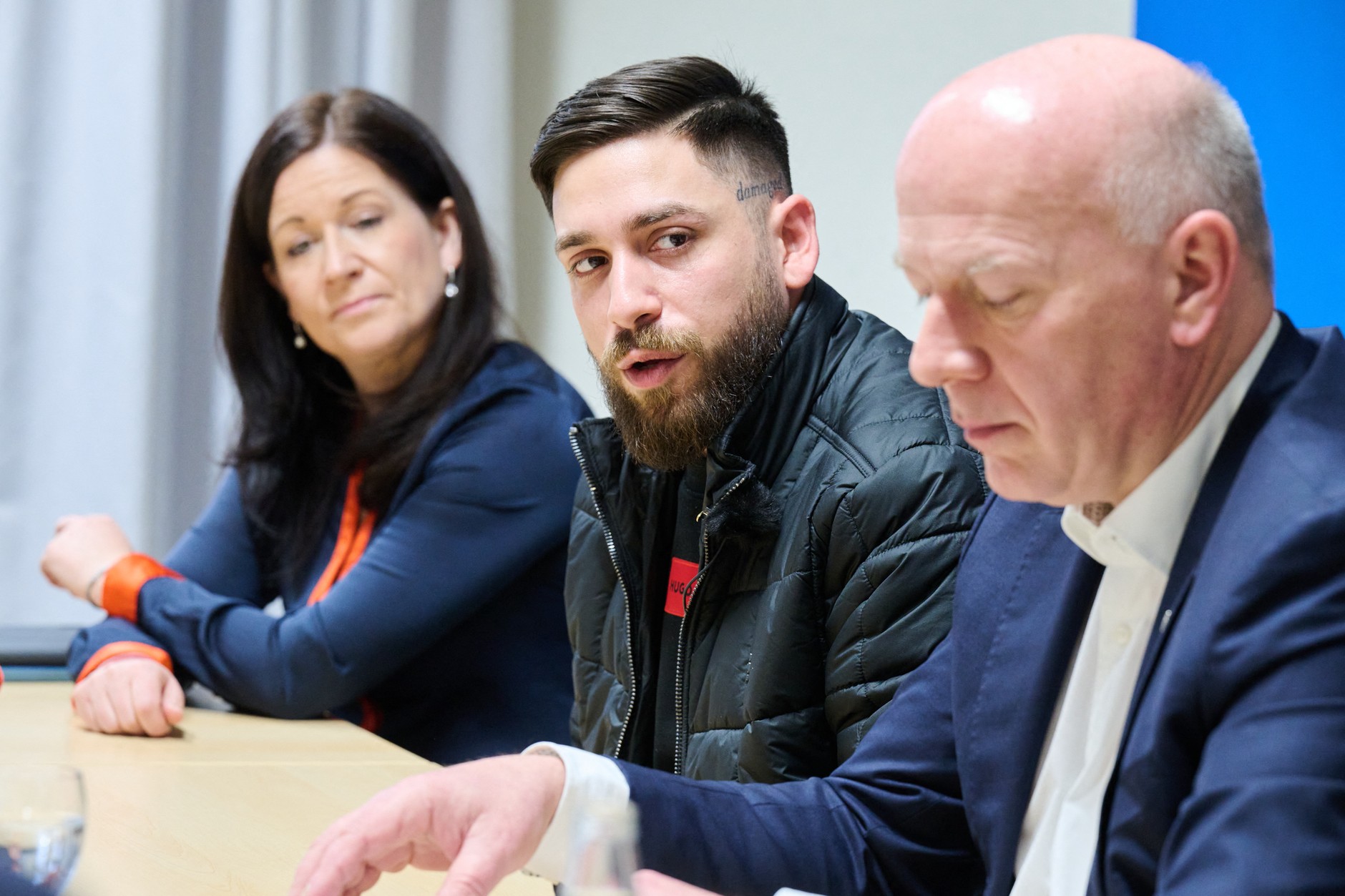
On Monday, at the invitation of Berlin's mayor, Kai Wegner, Can sits in the Red City Hall and seems a bit intimidated by the amount of attention he has received.
— Can's story is also our story, because when his mother was murdered by her brother 21 years ago, this shocked us – says Guner Balci, integration representative in the Neukoelln district of Berlin.
Like many others, she had often wondered what happened to that little boy. When he suddenly appeared on social media, it moved her again – to see this young man, so sensitive and yet strong.
Katharina Gunther-Wunsch, Berlin senator, Can Surucu, son of the murdered woman, and Mayor Kai Wegner. Berlin, February 9, 2026Annette Riedl / DPA / dpa Picture-Alliance / AFP
— Your mother's story showed how serious a problem we have in Germanywhen women are not allowed to live their own way and have to pay for it with their lives, says Balci. — Today, these women's children are increasingly coming out of the shadows and telling their stories anew. You are a very important role model for them.
Wegner also does not hide his emotion, but at the same time appeals to “call problems by their name, without immediately resorting to the argument of racism”. Men who refer to the so-called honor, are in fact cowardly and devoid of honor, argues the mayor. At the same time, it emphasizes that even 21 years after Surucu's death, threats and violence against women and girls in the name of “honor” still occur.
The article continues below the video
According to official statistics, in 2024 in Berlin, eight women were murdered by a partner or ex-partner, and another two by a family member or relative. All perpetrators are men. “These are issues that we need to address and that we can no longer sweep under the rug,” Wegner says. — I want all girls, all young women in Berlin, the city of freedom, to be able to grow up in this freedom.
“The word 'feminicide' does not reflect the gravity of this problem”
For many girls and young women, however, this is still just a dream, as Sevil Yildirim from the MaDonna women's center tells us. He says 99 percent. visitors to their center is in some way at risk of arranged or forced marriage.
Especially During the holidays, many young girls are taken to their parents' home countries and married there — just like Hatun Surucu once did. And many of them still today live in fear of an “honor killing”, argues Yildirim. – You have to call it by its name. The word “femicide” does not convey the seriousness of what is happening. In such cases, it is not a case of murder for which only one person is responsible. The whole family makes the decision to kill someone, he says.
Can Sururcu says that the reaction to his films was huge, volalso from people affected by patriarchal family structures. “I got a lot of messages from young women who wanted to talk to me and just tell me their stories,” he says. He also talked to some of them on the phone. — The reactions are really only positive. For me, at the end of the day, it confirms that I am doing something good.
In one of the videos recorded with Ramo's friend and YouTuber Said Ibrahim, Can Surucu says that social workers They didn't tell him exactly what happened to his mother until he was 14. — Then my world collapsed. Then my life derailed, I did things that I regret today. It took me a while to pull myself out of the morass of grief, depression, violence and drugs, Surucu says.
“Murder is never the solution”
Even today, Can still struggles with the past. But now he has decided to tell this story and also give other women “a light of hope”, as she puts it. — I'm trying to show what happened to me and many other people in the world. Murder is never the answer.
On his Instagram, Surucu posted a photo of himself as a baby with his smiling mother Hatun. “21 years ago my mother passed away, a death that shouldn't have happened, like so many others. She will always be a symbol, she will never be forgotten. I will always have you with me.”
Mayor Wegner promises that Berlin will also remember Hatun Surucu. — We will never forget your mother. She would be very proud of you.
On the corner of the family's former home in Berlin-Tempelhof a year after her death, a memorial stone was placed. “Here Hatun Surucu (born 1982) was murdered on February 7, 2005, because she did not submit to the coercion and oppression of her family, but led an independent life,” the plaque reads in German and Turkish. “In memory of her and other victims of violence against women in this city.”
I’m Ashley Davis as an editor, I’m committed to upholding the highest standards of integrity and accuracy in every piece we publish. My work is driven by curiosity, a passion for truth, and a belief that journalism plays a crucial role in shaping public discourse. I strive to tell stories that not only inform but also inspire action and conversation.