How Romania ended up in Hitler's hands. What options did Antonescu have outside the alliance with Nazi Germany

In just two years, Romania's leaders made a controversial decision, considered by many to be decisive for the country's fate: joining the Axis alongside Nazi Germany. According to some specialists, this choice would have been, in fact, the only possible option in that context.
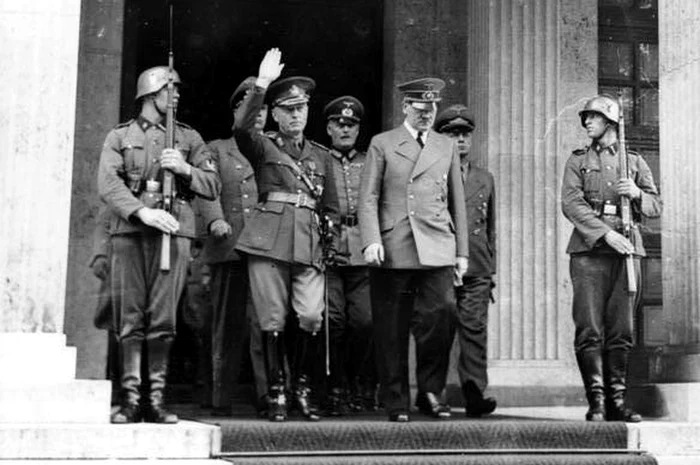
Marshal Antonescu with Adolf Hitler PHOTO Bundesarchiv Bild
On November 23, 1940, in Berlin, Marshal Antonescu, the de facto leader of the Romanian state, signed, in the presence of Hitler, the accession to the Tripartite Pact, committing Romania alongside the Axis Powers against the United Nations. That is, Romania became an ally of Nazi Germany against the country's traditional allies, namely France and England. It was one of the most controversial decisions in Romanian history. However, experts say that at that time, in that situation, Romania had too few options or, as some suggest, no option at all. Especially since the country was one step away from sharing the fate of Poland, effectively torn into pieces between Germany and the USSR.
“We will go to the lowest of the low”
On September 1, 1939, Nazi Germany invaded Poland. Although it was Poland's ally, Romania did not lift a finger. And that's because Romanian politicians knew about the Ribbentrop-Molotov Pact signed on August 23, 1939 between Nazi Germany and the Soviet Union. This was a non-aggression treaty that included a secret protocol to divide spheres of influence in Eastern Europe. And Romania was targeted. Actually, through that German-Soviet non-aggression pact, the Romanians found themselves trapped as if in a pincer. To the west were the Hungarians, allies of the Germans, and to the east was the Soviet Union. To the south were the Bulgarians, who in turn were allies of Nazi Germany. When on September 3, 1939, England and France, the Romanians' traditional allies, declared war on Nazi Germany, the Romanians decided to play the card of neutrality. He would not have had a choice.
“We will go to the lowest of the low to maintain our neutrality”stated Constantin Argetoianu. “We are making a different policy today than the one we have in our hearts. We can only do it today”also specified Nicolae Iorga regarding Romania's situation.
Even when the USSR invaded Poland, tearing it in two alongside the Nazis, the Romanians did not go to battle, as required by the 1921 alliance treaty. “For us it is fortunate that it happened this way, because this dissolution of the Polish state saves us from somewhat far-fetched arguments, our reaction and our non-intervention towards the USSR. It is practical cowardice”stated Charles II after the dismemberment of Poland.
But Stalin's plans for our country were clear. Even neutrality would not have saved us. Our good fortune was the prolongation of the war with the Finns and their stubborn resistance. And then, Hitler wanted Romania not to be fully occupied by the Russians and Hungarians, in order to keep a base of operations within the Barbarossa Plan and at the same time he wanted to take advantage of Romanian resources, especially oil.
The blackest summer in our history
Nazi Germany's runaway successes in western Europe, especially the rapid conquest of the Netherlands and France, deeply alarmed Stalin. He was aware that after Hitler “pacified” the West he would turn with all his forces to the East, despite the non-aggression pact concluded in the summer of 1939. So the Soviet dictator decided not to waste time and claim all the desired territories. Including Bessarabia and Northern Bucovina. On June 26, 1940, the Soviets sent an ultimatum to Romania. It was accepted on the spot by the Crown Council meeting on the night of June 27-28, 1940. Bessarabia and Northern Bucovina were lost. Encouraged by the success of Nazi Germany but especially by what the Russians had done on June 26, 1940, the Hungarians also asked for their share. More precisely, they wanted Transylvania. Hitler offered them northwestern Transylvania.
On August 30, 1940, the Vienna Dictator took place, through which Romania lost 43,492 square kilometers and a population of over 2.6 million people. In addition to territorial losses, it also ceded important resources, including 38.5% of the country's gold, 87.6% of its silver, and 64.7% of its copper production. The disaster was completed by the Craiova treaty of September 7, 1940, by which Romania ceded the Quadrilateral to Bulgaria. The fact that the king and the Government accepted these territorial amputations without a fight scandalized public opinion. Argetoianu had been right, the Romanians went to the lowest of the low to preserve their neutrality. However, the situation was so complicated from a geopolitical point of view that, say some specialists, Romania had to choose.
Charles II clung desperately to Hitler, the only one who could guarantee the security of what was left of Greater Romania. And this in the conditions in which, master over most of central and western Europe, Hitler was preparing to attack Russia. And Romania had suddenly become an important pawn in this whole story. “In the perspective of the confrontation in the east, Romania was acquiring an increase in significance: it was no longer just a supplier of oil and grain, but also becoming a base of attack against the USSR. To protect it, the Fuhrer announced his intention to grant it a guarantee, as soon as the demands of Hungary and Bulgaria were satisfied”specified the historian Florin Constantiniu in “A sincere history of the Romanian people”.
At that time, Hitler was the only one who offered any guarantee to Romania, obviously through the prism of the interests stated above. France was occupied and England had its major problems, being occupied with the defense of the national territory from German raids. Others were gone. Either they had been “swallowed” by the Germans or the Russians. And the rest couldn't wait to take part in the territory of Romania. Charles II, in July 1940, showed his friendship towards Nazi Germany by installing the Government of Ion Gigurtu, a pro-German industrialist. Moreover, Carol asked Hitler for a German mission in Romania. Hitler, however, did not sympathize with Charles II, mainly because he felt that he wanted to play a double-edged sword, seeking the attention of Germany, but still keeping the door open to England and France, should the war take another turn.
“Romania will go to victory”
Unfazed by the Germans, extremely unpopular in the country, Carol II, responsible for the collapse of Greater Romania, was removed by Marshal Antonescu on September 6, 1940. Carol was forced to abdicate and left the country. Mihai, his son, becomes king, but only in name. Marshal Ion Antonescu became the real leader of Romania. The national-legionary state will come into existence, through an alliance imposed by the situation with the Iron Guard. Antonescu starts the real negotiations with Nazi Germany as soon as he takes over the leadership of the state.
This time the Romanians give Hitler the impression of seriousness. The leader of Nazi Germany sympathized with Antonescu, especially since Marshal Constantin Prezan had vouched for him. As soon as he took over the reins of power, Marshal Antonescu wrote to Hitler assuring him of the “faithful testimony” of the Romanian people, but also of the desire to enjoy the protection of Nazi Germany. Hitler accepts. A visit of the Romanian delegation, led by Antonescu, to Berlin is being prepared. The marshal arrived in the capital of Nazi Germany on November 21, 1940.
The schedule for the meeting with the Fuhrer was prepared. On November 22, Antonescu met, for the first time, with Joachim von Ribbentrop, the foreign minister of Germany. It was only on November 23 that Antonescu met Hitler. During the meeting, the Fuhrer openly declared that he is interested in the alliance with Romania, first of all, from an economic point of view. On the occasion of the meeting, Romania's accession to the Tripartite Pact was also signed, as well as a whole series of commercial agreements for 20 years, whereby Germany had priority over Romanian exports, at fixed prices, established over a long period. For his part, Antonescu requested the revision of the Vienna dictation. “The general's sincerity and firmness made a good impression on the Fuhrer, establishing a personal relationship between the two leaders, based on trust and mutual respect, a relationship that lasted until the end of the Romanian-German collaboration. Hitler would confess his esteem for Antonescu, placing him next to Mussolini, among the leaders he respected the most”specified the historian Florin Constantiniu.
After the meeting with Hitler, Antonescu also met Field Marshal Wilhelm Keitel and Clodius, the German ambassador specializing in economic issues. Field Marshal Wilhelm Keitel assured Antonescu that Nazi Germany would support Romania both economically and politically. Back in Romania, Antonescu declared: “I can assure you today that I am returning with the confidence of the Führer and the German people. Romania will go to victory. Romania will have its rights“.
Moreover, Hitler will give Antonescu a free hand to get rid of the legionnaires. Later, after the coup d'état of August 23, 1944, Antonescu would motivate the decisive step of entering into an alliance with Nazi Germany. “If I had found understanding and could have found understanding to secure the lives, liberties and historical community of this wretched people, I would not have hesitated to get out of the war, not now, but from the very beginning of the world conflict, when Germany was strong(…) I had no other way out. Romania was totally isolated. To all the foreign ministers I approached, they all refused me any support”Marshal Antonescu testified in a letter, just before he was executed.
“Antonescu saw in the Third Reich the shield of hope against Soviet expansionism”specified Florin Constantiniu in the mentioned work.
“The humiliation suffered would have fatal consequences for the soul of the nation”
Contemporaries of the events, writers, politicians and officers were of the opinion that Romania had to fight and not give in to the pressures of Russia or Germany. Even if it would have disappeared as a state at that time. That is, he had to stick with traditional allies.
“Greater Romania had gone astray. If such things had happened after a lost war, the situation would not have been so terrible. The humiliation suffered would have fatal consequences for the nation's soul. Not having fought either in the East or in the West, at the moment when what is heroic and tragic must necessarily have its say, we would have paid dearly for generations.”said Ion Negoiţescu, a Transylvanian writer.
At the same time, it is also stated that Romanian politicians in the summer of 1940 did not understand Nazi Germany's interest in Romanian oil. Hitler wanted to please his allies, but prevented them from dismembering Romania. It is possible that, if Romania had opposed armed resistance to the Soviet Union, Hitler would have intervened to prevent the occupation of the country by Soviet troops.