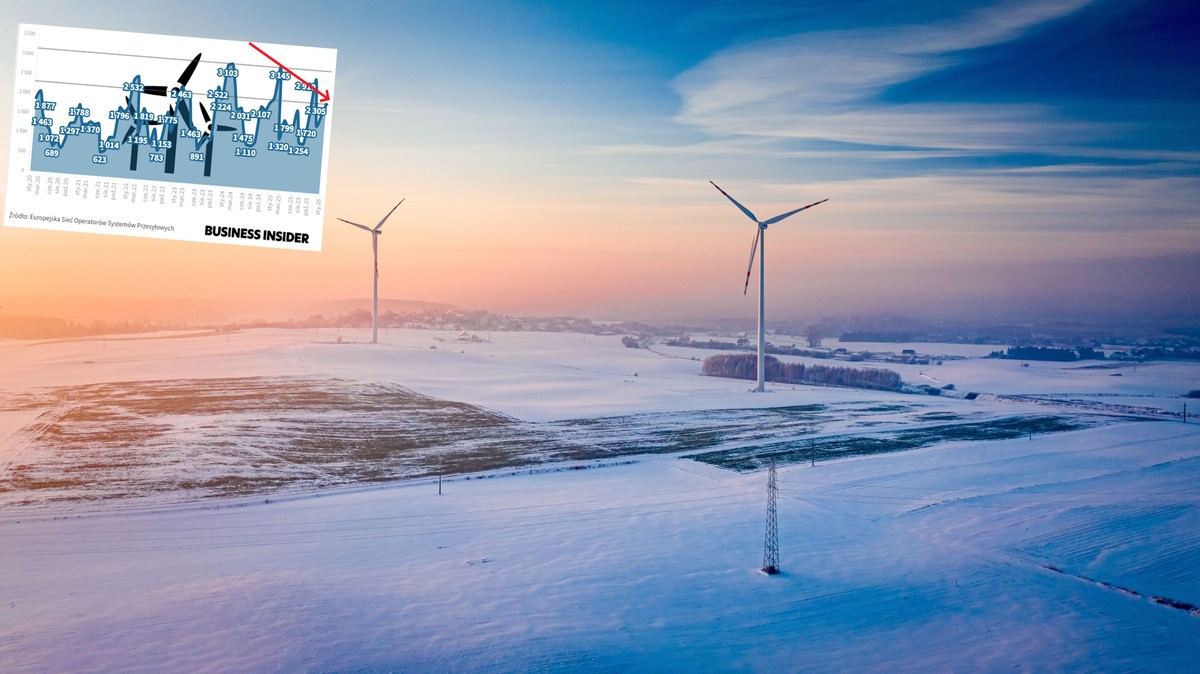
In January last year, an average windmill in Poland produced 310 MWh of electricity per unit of installed power of 1 MW, i.e. it effectively produced electricity for 310 hours. At that time, its efficiency was inferior only to lignite-fired power plants, whose production, calculated according to efficiency, was 100 percent. (the average efficiency of lignite power plants in Poland is 39.3% according to the Energy Market Agency) was 370 hours. Windmills in Poland gave back then as much as 20 percent energy in the system, equal to lignite power plants (20.8%).
Read also: Milestones in the energy sector have been exceeded. New PSE data
A year earlier, in January, it was even better, because 1 MW of windmill power accounted for 333 MWh of electricity produced, and the share in the system was 21.2%. And these were not exceptional two years. In January 2023, 295 MWh per 1 MW of power, in 2022 – as much as 366 MWh, i.e. a record. January 2021 was weak with 203 MWh, but the year before in 2020 it brought 318 MWh.
Those building a wind farm are rightly counting on the highest return on the sale of energy produced in January; December and February were also good. But this winter, the owners of such farms were severely disappointed. Because the winter turned out to be harsh this time and, as it turns out, it means much less wind.
The harsh winter brought less wind
Although within 12 months (from November 2024 to November 2025), according to ARE data, it increased by 2.3%. wind power in the Polish energy sector, instead of 20 percent energy in the system as in 2025 windmills generated only 14.2% in January. And February is not any better, or even worse, because by February 6, the share of wind in the Polish energy mix is only 13.1%. December 2025 was also weak with 13.9%. It looks like this winter will be a loss, which will affect the results for the whole year. Unless this time spring turns out to be record-breaking.
For every 1 MW of power of an average windmill in January this year. only 219 MWh of electricity generatedand here only gas power plants with 118 MWh and, of course, solar power plants with 23 MWh had a worse result. Gas engines serve as reserve power in the system, supplementing, among others, RES shortages or enabling the system to place surpluses from RES (then they are turned off), so they usually do not work according to their capabilities, and the solar panels have too little light in winter.
It was shining slightly better in January than a year ago, but this means only 3.5%. electricity in the system compared to 2.7 percent a year earlier. It is necessary to take into account the as much as 18% increase in photovoltaic capacity in Poland in 2025 (November to November).
Sweden is a negative example
The example of Sweden shows how difficult the windmill business is. In 2024–2025, there were a number of reports of problems and restructuring of wind farms. Too low electricity prices in long-term contracts turned out to be unsustainable for wind farms.
Read also: Poland is breaking new records. The first such situation in history
Last year, the small Kalix Wind farm with eight turbines with a total capacity of 11 MW and the larger Aldermyrberget Park with 17 turbines with a capacity of 72 MW went bankrupt. However, the largest farm in Sweden, Markbygden Ett, located on a windy plateau south of the Arctic Circle, with 179 windmills whose construction cost EUR 800 million, was also close to bankruptcy.
The problem was that when the wind wasn't blowing, the park still had a legal obligation to provide power because it had entered into long-term contracts – describes the Energyconnects website. These, in turn, were a guarantee for banks to obtain financing. As a result, after the increase in electricity prices after Russia's invasion of Ukraine, the fluctuating production of windmills resulted in the need to purchase additional energy on the market to fulfill the contract (supply of a specific amount of energy). Market energy was expensive and the contract stipulated low prices. Costs were rising, but revenues were not. Aldermyrberget Park, which signed a long-term contract with the mining company Boliden AB, had a similar problem.
Reports (including Bloomberg's) confirm that the farm is still operating, but the operator plans to sell the assets in the future. Historical losses are counted in hundreds of millions of euros in 2021–2023, but after the restructuring, the company continues operations with a stabilized capital structure.
In 2024, the entire Swedish renewable energy sector had total losses equivalent to PLN 2.6 billion. The wind sector in Sweden has proven to be resistant to normal market conditions without subsidies. Many companies indicated that the production assumed in their business plans was not achieved. The wind is not susceptible to investors' wishes.
29% less electricity. on the windmill
Also in Poland, this January shows how uncertain the windmill business is. Production per unit of power is 29% lower. y/y (219 MWh per megawatt of power compared to 310 MWh a year earlier). And electricity prices dropped (PLN 508 per MWh on the day-ahead market compared to PLN 654 a year earlier). And banks, when providing financing for this type of projects, must have specific numbers.
Also from the point of view of the entire energy system, windmills and photovoltaics create costs related to operational instability. If they produce too much energy, other, stable power plants must be shut down to avoid too much excess power. It is true that the surplus can be compensated by energy storage units connected to windmills or panels, which will release electricity, but when there is wind or light there will be less electricity, but this will not compensate for the power drops. For this purpose, it is necessary to keep a reserve in the system in the form of flexible gas power plants. They, in turn, force themselves to pay for the downtime.
Read also: The overtime on the power market has been resolved. 53 offers will provide over 4,000. MW
Last year, approximately PLN 6.4 billion went to the capacity market, and according to the regulatory impact assessment of the amendment to the Act on the Capacity Market PLN 8.5-9 billion will be allocated for this purpose annually in the coming years. We will cover these amounts in our energy bills. This is the cost of the instability of renewable sources and maintaining reserves, mainly gas power plants, operating at a fraction of their capacity.
Author: Jacek Frączyk, editor of Business Insider Polska