Why European unity is beginning to weaken over Ukraine. The bitter results of Trump's politics


Due to the weak position of the EU, other states take the opportunity to divide the Europeans.
For centuries, Europe imposed its will on the world. Now the world is beginning to impose its will on Europe. A photo taken in late July at Turnberry Golf Course captured the situation perfectly. The President of the European Commission, Ursula von der Leyen, is pictured with a forced smile and thumbs up next to an American President,
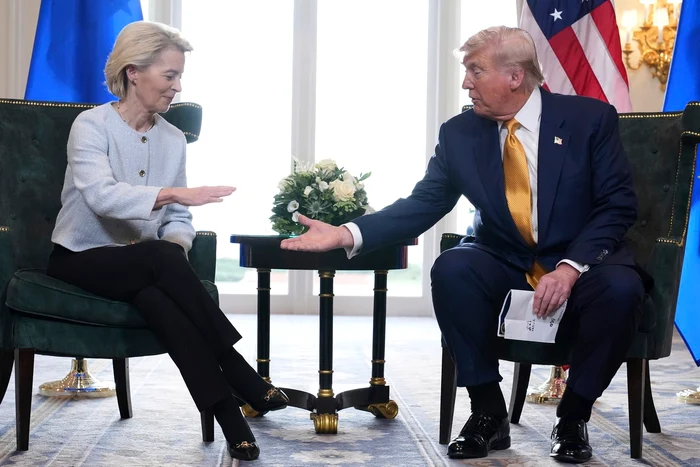
Ursula von der Leyen and Donald Trump/PHOTO: AFP
Donald Trump, beaming with excitement. The EU just meekly agreed to accept a basic 15% tariff on exports to the US without retaliating. Von der Leyen and his team literally had to grin and bear it.
This moment was particularly humiliating because trade was seen as the area where the EU could match the world's superpowers. The European single market is comparable in size to the economies of China or the United States.
The EU acts as a single member in trade matters. In the months leading up to the Turnberry defeat, there was much talk in Brussels about European action in response to Trump's tariffs.
In the end, the EU caved in – largely because Europeans feared that if they imposed tariffs on the US, the Trump administration would respond by reducing its commitment to European security. Given the war in Ukraine and growing concerns about Russia's wider threat to Europe, it was a risk they were unwilling to take, notes Financial Times columnist Gideon Rahman.
The weakness of Europe
Europe's security weakness offset its potential trade strength. One form of weakness led to another. If this were an isolated incident, it could be chalked up to an unfortunate coincidence. But in fact the examples of Europe's weakness or irrelevance are piling up.
“At the start of her term as European Commission president, von der Leyen expressed her desire to lead a 'geopolitical commission'. But the EU is diplomatically marginalized – even though wars are taking place right on Europe's borders and directly affect the continent's interests”. adds the columnist.
European countries are now the largest providers of military and financial aid to Ukraine. But when Trump tried to end the war earlier this year, he chose to negotiate directly with Russian President Vladimir Putin – while Europeans desperately lobbied the White House before and after the summit.
The same was true for Gaza. Decisive diplomacy aimed at achieving a truce centered around the US, Qatar, Egypt and Israel. Europe was once again a mere observer.
The brutal war in Sudan will undoubtedly lead to further refugee flows to Europe. But the main external actors fueling the conflict and determining its outcome are the United Arab Emirates, Egypt, Turkey and Russia. French influence in West Africa also declined sharply. In Mali, first Russia and now jihadist forces appear to be filling the gap.
Why does Europe seem so powerless?
“So why does Europe seem so powerless? Military and financial gaps are most often pointed out. But these are not the biggest problems. The EU has a strong defense industrial sector and remains a wealthy, albeit debt-ridden, continent.”writes Rahman.
The bigger problems are structural, political and even psychological. Brussels is a bureaucratic structure. He is good at lawsuits and legislation. But it is not able to act swiftly and ruthlessly like the great European powers of the past or like the US and China today.
European calls for morality and international law on issues like Ukraine often go unheard in Africa and Asia, where the history of these countries has been shaped by centuries of ruthless European imperialism.
Now, as European power recedes, we could begin to see what Oxford scholar Dimitar Bechev calls a “scramble for Europe,” as outside powers begin to increase their influence on the European continent.
The Western Balkans, where countries are theoretically on track to join the EU, are facing increasing influence from Russia, Turkey and China. A recent analysis by the European Council on Foreign Relations documented how Beijing uses infrastructure projects and loans to expand its influence.
“The fight for Europe also threatens the EU's internal unity, as external powers use a strategy of divide and conquer. One of the reasons why Europe did not react to Trump's tariffs was that different countries and sectors of the EU had different interests that the US could exploit“, claims the columnist.
Even Europe's unity on Ukraine, which has been impressive so far, could begin to unravel as parties more sympathetic to Moscow win elections in EU countries such as Slovakia and the Czech Republic.