Russian Roulette with Doomsday Clock. Expert: “Politicians are also willing to risk a nuclear war”


The “Doomsday Clock”, a symbolic indicator of global risks, was last week set by scientists the closest to midnight in history. Cristian Nițoiu, professor at Loughborough University, in Great Britain, explains, for “Adevărul”, why we are closer than ever to a global conflict that would automatically lead to a nuclear war and could even equate to the end of the world.
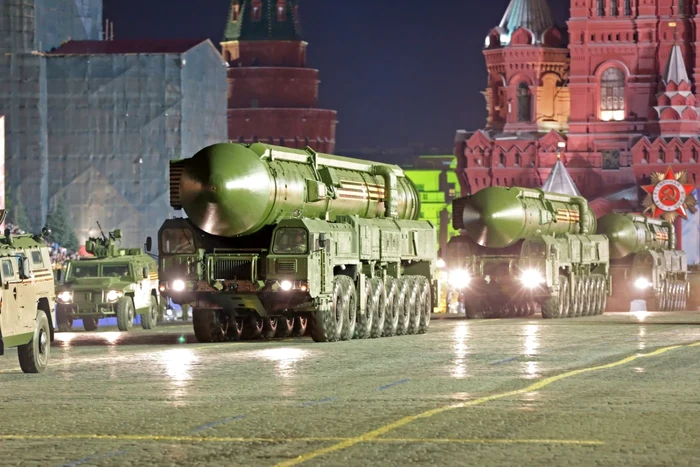
The Russians threatened nuclear weapons. PHOTO: Shutterstock
The Doomsday Clock, which serves as a symbolic indicator of global risks, was set just 85 seconds to midnight last week. That means humanity is at the closest point in history to an apocalypse, according to scientists who make up the organization Bulletin of the Atomic Scientists.
The Doomsday Clock has symbolized the imminence of a planetary cataclysm since 1947, and the organization Bulletin of the Atomic Scientists was founded in 1945 by none other than Albert Einstein, together with several scientists who worked in those years on the “Manhattan Project”, which led to the invention of the atomic bomb. Since then, every year, scientists estimate how much time humanity has left before an apocalypse.
Professor of political sciences at Loughborough University, in Great Britain, Cristian Nițoiu explains, for “Adevărul”, how great is the risk of a global conflict that would automatically lead to a nuclear war, but also the causes for which we are already here.
Where can nuclear war come from?
The aggressive policy of Russia and the ambitions of the Europeans to establish their own army would sooner or later lead to the point of collision, the Romanian professor believes.
“We certainly risk a war. For now, the EU does not have an army of its own, and when it intervenes, for example in certain conflicts, for example in Sudan or the Central African Republic, there are certain states that, alone or in cooperation with each other, send troops. Usually France does it, but so did Britain when it was part of the EU, maybe sometimes Spain. But France is the main military force at the moment in the European Union, and Britain is in second place, but it is no longer part of The EU. As things stand, it is very likely that we will have certain states that will send troops to Ukraine as part of a coalition of the will, as it is impossible for there to be a consensus within the EU, given the positions of Hungary, Slovakia and possibly Spain or Italy, which are quite skeptical about a military intervention.”says the teacher.
Even though the United States of America has made it clear that it will not send troops to Ukraine, a possible attack by the Russians on European troops would force Donald Trump to authorize a military intervention in the area.
“Trump has made it very clear that the Europeans, if they want to continue the war, are on their own. They can buy weapons from the Americans, but they won't have the support of the military in terms of troops. It's just that in the hypothetical case that such a confrontation starts, things change, because, you realize, there will be pictures in the United States of Frenchmen, Britons and Germans being killed by the Russians in Ukraine, and American public opinion could change and it could push any administration to help its European allies.I'm not saying anything new, history tells us that exactly the same thing happened in the two world wars when public opinion shifted along the way and put pressure on politicians to get US intervention“, says Nițoiu.
Even though nuclear deterrence has worked for decades, it now seems that things are not quite the same. There are now more and more influential figures pouring gas on the fire, including political and military analysts from both camps who are giving assurances that the other side would not risk using nuclear weapons. And precisely this appetite for risk could lead to a military confrontation, first conventional, but with a possible escalation that would lead to the use of nuclear weapons.
“Now, I don't want to repeat what a propagandist of the Putin regime said, but one of the most important Russian intellectuals, Sergei Karaganov, keeps repeating that the Europeans and the Americans have forgotten what nuclear weapons mean, and that maybe Russia should show them that. And they insist that Russia use tactical nuclear weapons in Ukraine or the Black Sea to show the Western world what they mean. Of course it's absurd, I can't stand for such of individuals, but the truth is that such discussions are taking place in Russia at the moment”warns the expert.
Greater risks than during the Cold War
Perhaps surprisingly, the stakes are now even higher than they were during the Cold War. At the time, the United States and the USSR were threatening each other from a distance with their finger on the trigger, but no one pulled the trigger. Today, there is no guarantee that, in a moment of wandering, one could not do it.
“Compared to the years of the Cold War, generations have changed. Then there was constant discussion about nuclear weapons, about non-proliferation, about the disaster that can be caused by their use. And everyone was afraid of them, did not want to use them. Today, some are too convinced and bet that the enemy will blink first and hesitate to shoot. The big problem is that the generations of the last 30 years are not afraid of nuclear weapons. I think that on a collective level the danger is not is still as present as it was for past generations. And I think that this is also true for politicians, who do not have the same level of self-restraint as the American and Soviet leaders had. During the crisis of the 1960s, as well as in the episodes of the 1980s, both the Soviets and the Americans tried to avoid a nuclear confrontation. I think that there are still such channels of communication, but Russia, from her point of view, she sees the war in Ukraine as an existential threat“, is the alarm raised by Nițoiu.
The Russians and Ukrainians would not hesitate to cause the Apocalypse
He recalls the statements of Valerii Zalujnîi, the former head of the Ukrainian army, now ambassador in London, who said that Ukraine wins only if the regime in Russia changes. Obviously, the Russians perceive exactly the same, and the statements of the officials in Moscow about the change of the regime in Kiev are notorious.
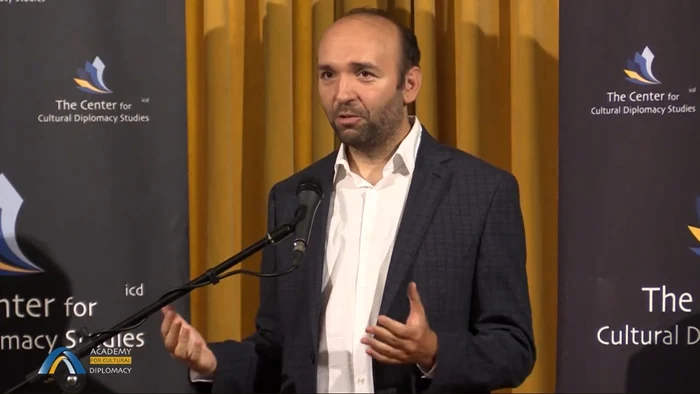
Cristian Nițoiu. PHOTO; Personal archive
“To understand how great the risk is, we have to see the war as the Ukrainians and the Russians see it: as a war for the survival of their current political system. As long as Russia has nuclear weapons, if they consider the survival of the political system to be in fundamental danger, it is to be expected that they will consider the use of nuclear weapons a viable course of action. That is why we are in a very dangerous moment, more dangerous than ever.” he states.
Cristian Nițoiu recalls the grim warning of scientists from the Bulletin of the Atomic Scientists.
“The clock of the Apocalypse is going to midnight, and when it reaches 12 o'clock, it will be too late. The world is disappearing. From 2021 until now, we have gone very far towards 12 o'clock. We are 85 seconds from 12 o'clock, which means the end of the world. And we are not told this by some crazy people or fanatical ideologues or politicians, but by some of the world's greatest scientists, based on analyzes rigorous. Never in history have I been so close from their point of view. I don't want to depress anyone, but that's the reality I see.”claims Nițoiu.
The British took into account the risk as early as 2022
He also recalls the talks in 2022, the year the war in Ukraine began. In the autumn of that year, the Ukrainian army launched the only successful counteroffensive, and a good part of the Russian troops had to withdraw for the time being. Then, says the expert, in Great Britain they talked in the most serious way about the huge risk that nuclear weapons would be used for the second time in history, after the time of Hiroshima and Nagasaki.
“I recommend the memoirs of former British Prime Minister Liz Truss. At the time when Ukrainian forces were able to regain some territory in the Kherson and Kharkiv area, the British government was already making preparations for the potential use of nuclear weapons by Russia. Liz Truss talks about the intelligence received at the highest level, about detailed analysis of how the wind could bring nuclear waste from Ukraine, when it looked as if the Russians would use weapons There were clear signals in the US as well, and the Biden administration knew that Russia could use nuclear weapons if Ukraine advanced much further that fall. But the Russians were able to stop them without needing nuclear weapons, and then forced the Ukrainians to withdraw, so Moscow no longer felt the need for nuclear weapons to defeat them.”explains the Romanian teacher.
Politicians are ready to drag their peoples into the cruelest war
The bad news that Cristian Nițoiu gives is that politicians from both camps are now willing to take risks to win the war. In addition, there are political analysts who underestimate the risks and believe that the enemy would be reluctant to pulverize an entire world, so they constantly urge escalation on both sides.
“The Russians, it is known, including through their new nuclear doctrine, are willing to use nuclear weapons if there is a risk that they will be defeated. And not only them. Most of the politicians who lead Europe today are determined to risk for the victory of Ukraine. And they are ready to risk anything, in the conditions that, for the survival of their own political careers, the war must continue and Russia must be defeated at all costs. The problem is that they do not think that they think about the danger nuclear as a final risk”he says.
The glass is half full is that, in his opinion, we're not there yet. Both camps can still avoid the final catastrophe. Even Russia would hesitate and not use nuclear weapons in any situation. Professor Cristian Nițoiu details.
“Russia would only use nuclear weapons if it was about to lose the conquered regions in Donbas and Crimea. I don't know if European troops would not at some point be willing, convinced to help recover those territories or just to maintain the front line. In the latter case, I don't see an imminent danger. But if there was a question of returning to the borders of Ukraine since 1991, then the danger would be very great”concludes professor Cristian Nițoiu.