“It's our strongest weapon.” This is how Greenland wants to defend itself against Trump


The Danish influence is visible everywhere in Greenland's capital, Nuuk: from the cinnamon rolls in cafe windows to the Scandinavian architecture of the Katuaq cultural center. Every tenth inhabitant of the Arctic island is Danish, many of them now have mixed roots. On the other hand, approximately 17 thousand Greenlanders live in Denmark.
More than 300 years of shared history have closely linked these two very different communities – but mainly at the expense of the people of Greenland. Relations between them are therefore tense to this day, and the majority of Greenlanders want independence in the long run.
US President Donald Trump is reportedly deliberately trying to exploit this weakness to persuade residents to join the United States – and thus press his claim to the island. However, the reactions of Greenland and Denmark in recent weeks show that this strategy has so far backfired.
During the long colonial period, and even later, when Greenland was incorporated into the Danish state, mutual relations were characterized by the exploitation of the Inuit and the repression of their culture and language. The “Dunization” of the indigenous population since the 1950s has caused social and economic problems that still affect Greenland today. Many Inuit feel like second-class citizens, and reports of their racist experiences in Denmark appear regularly.
A few years ago it came to light that in the 1950s, 20 Greenlandic children were taken to Denmark as part of a child-rearing experiment, and thousands of young indigenous women were forced to use contraceptives in order to lower the birth rate. This scandal further strengthened the growing desire for greater self-determination among the people of Greenland.
One of the most ardent voices in favor of independence is Pele Broberg, chairman of the opposition party Naleraq, which gained significantly in last year's elections thanks to a program strongly focused on the issue of autonomy. He receives us at the Greenlandic Parliament in Nuuk, an inconspicuous red building in the city center. On the wall of Naleraq's office there is a map of Denmark – but with the topography of Greenland.
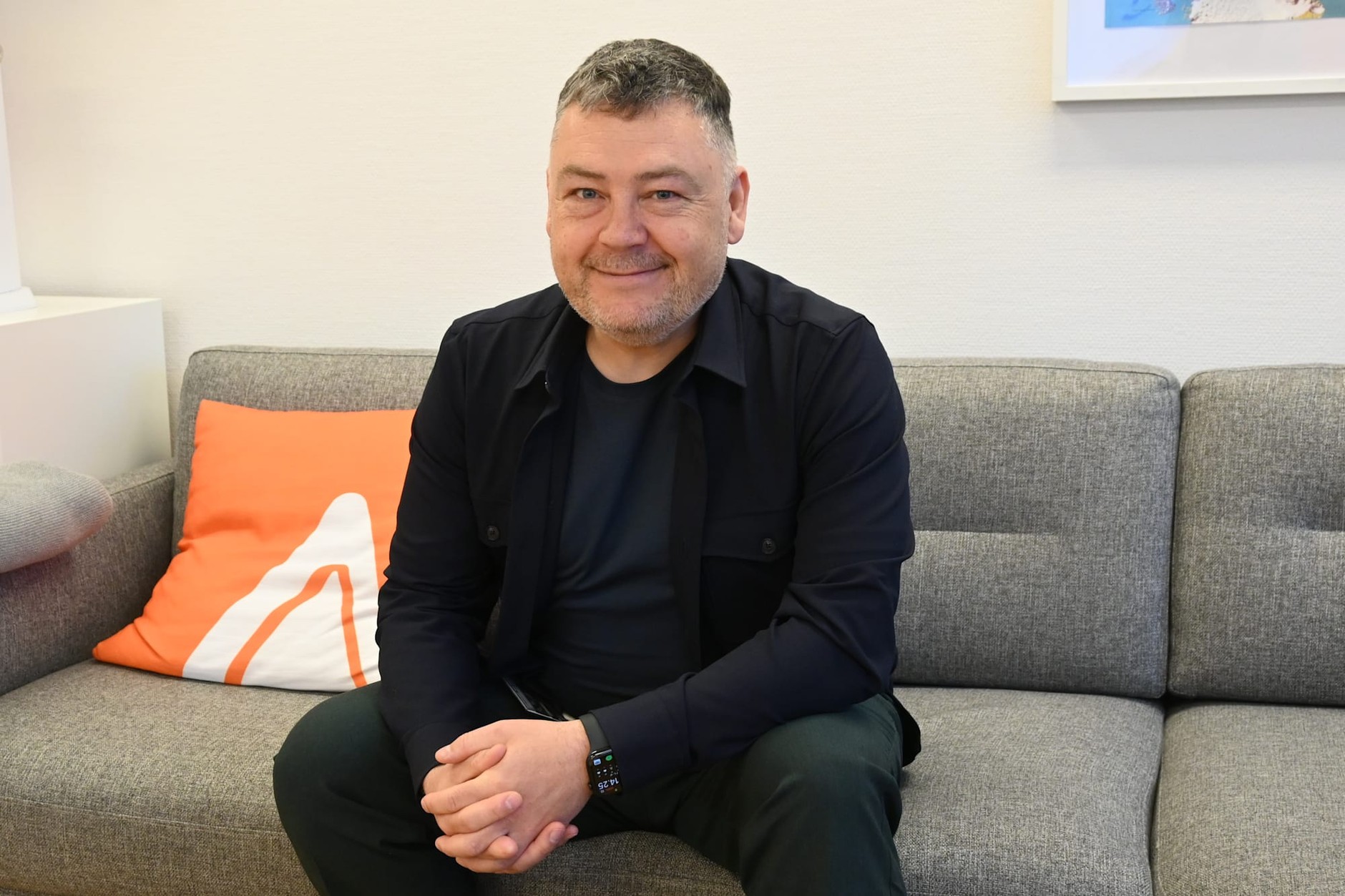
Pele BrobergLara Jakel / Welt
Broberg has been doing a lot of meetings lately and wants to use the current public attention to get his message out to the world. — We want to regain our country and our identity. We want to become citizens of Greenland, he told Welt. Since 2009, the autonomously governed island has the right to hold a referendum on secession from Denmark. If it were up to Broberg, it would be best if it took place tomorrow.
Due to his radical stance, he is currently an outsider in Greenland; the ruling parties opted for a well-thought-out process. However, almost everyone wants independence from Denmark, and the previous government has already planned concrete steps in this direction. In the middle of this situation, Trump stepped in with his annexation threats and shuffled the cards between Nuuk and Copenhagen.
The U.S. government has apparently seen an ideal ground for its annexation plans in the fractured relations – and, in parallel with threats against Denmark and Europe, it is focusing on exerting influence on Greenlandic society. The Danish intelligence service recently warned in a report against US campaigns in Greenland that exploit “existing or imagined differences of opinion” to “sow discord.”
Last year, Danish media revealed that at least three US citizens with ties to the Trump administration were looking for supporters on the island and trying to portray Denmark in a bad light. The second part of the strategy is apparently a charm offensive, such as visits from Vice President J.D. Vance or Trump's son, Donald Jr., last year. In addition, plans to pay Greenlanders large sums for incorporation into the US were publicly discussed.
— The Trump administration is trying to divide us from within, says Greenlandic-Danish writer Nauja Lynge. — We have a difficult past, but we are working to overcome it. However, these attempts have not had much effect among Greenlanders so far – also because they are deterred by Trump's harsh rhetoric – he adds in an interview with Welt.
The US president has repeatedly spoken about his desire to buy the island, for example calling it a “piece of ice” in his speech during the World Economic Forum in Davos. For Greenlanders, who are traditionally closely connected to the land and nature, this is a bull's-eye. -He talks about us as if we were worthless, as if we were just something he could just buy. It really hurts, comments Lynge.
However, many are still skeptical of the Danish government. Copenhagen subsidizes this underdeveloped island to provide it with a standard of living similar to that in Denmark. However, the trauma of the colonial period prevails to this day.
For Prime Minister Mette Frederiksen, dealing with the situation has therefore become a delicate balancing act: defending the sovereignty of a nation that actually wants to become independent — without patronizing the Greenlanders and thereby pushing them straight into the arms of the Americans. Frederiksen decided to escape forward.
Denmark publicly apologizes
The government made a hasty decision to invest billions in Arctic security and promised to improve the situation of Greenlanders living in Denmark. He publicly apologized for actions aimed at lowering the birth rate in Greenland, and also adjusted the kingdom's coat of arms so that Greenlandic polar bears are depicted in the same size as Danish lions. Any gesture, even a symbolic one, now seems appropriate to signal support to Greenlanders.
They accept this new interest with mixed feelings. On the one hand, many are happy about the unusual attention from Copenhagen: “Denmark has looked down on us for a long time,” says a 52-year-old woman from Nuuk who wants to remain anonymous. — Recently, we feel like we are treated more like equal partners, he adds. On the other hand, we often hear that it is too little, too late. — You can't just turn back 300 years, says 34-year-old Erneeraq.
Many people do not believe in the sudden concern of the Danish government. “They should have reacted 15 or 20 years ago,” says Lisbeth Valgreen, who has a degree in Greenland and Arctic studies and is involved in Greenland education in Denmark. “[Grenlandczycy] they demanded it as loudly as they could, but no one really listened. Only Trump suddenly made it a priority, he adds.
There are also a number of critical voices at the political level. The chairwoman of the Foreign Affairs Committee in the Greenlandic Parliament, Pipaluk Lynge, complains, for example, that MPs in Nuuk are not sufficiently involved in information processes, and even spoke of a “colonial approach”.
These are misunderstandings that Copenhagen is trying to eliminate as quickly as possible, so as not to give Trump any excuse to attack. — Of course, emotions run high in such moments, says Rasmus Jarlov, chairman of the defense committee in Copenhagen, in an interview for Welt.
— But we have the same goal: to prevent the Americans from taking over Greenland. We share this one hundred percent. – emphasizes the MP from the Conservative People's Party. — I think the Americans' attacks bring us even closer. When things get really serious, it becomes clear how important it is that we stick together.
So far, it's been successful, at least behind the scenes. Instead of distancing itself, the Greenland government is now focusing on demonstrating unity with Copenhagen. — If we have to choose between the United States and Denmark, we choose Denmark – said the head of government Jens-Frederik Nielsen during a press conference. Considering what has happened so far, this is a remarkable statement.
In addition, the two governments jointly participated in several foreign policy meetings. First, Danish Foreign Minister Lars Lokke Rasmussen and Greenlandic Foreign Minister Vivian Motzfeldt went together to Washington to meet with US Secretary of State Marco Rubio and Vice President JD Vance. Frederiksen and Nielsen then traveled around Europe, meeting, among others, German Chancellor Friedrich Merz during the Welt economic summit in Berlin.
This is also new in the relations between these countries, because Copenhagen is formally responsible for foreign and defense policy. — We have a common history that has not always been beautiful, says Sascha Faxe, an MP from the left-green Alternativet party. — But we're really, really close at the moment. I would even say closer than ever before.
Some voices in Denmark even hope that this rapprochement may be lasting – and that the people of Greenland will choose a solution that gives them greater sovereignty within the kingdom, rather than total independence. But for now, the topic has fallen by the wayside, Faxe says. — Where Greenland wants to go in the future is a different process than ensuring its security. This is the most important thing right now.
The best asset Denmark and Greenland have is a united front, says writer Lynge. — The only way to stand up to the Americans is to stick together. “It's our strongest weapon because it's a language that Americans don't understand,” he says. However, this weapon stands on very shaky legs.