Where did bitcoin capital flee? The new instrument is expanding on the market and replacing banks

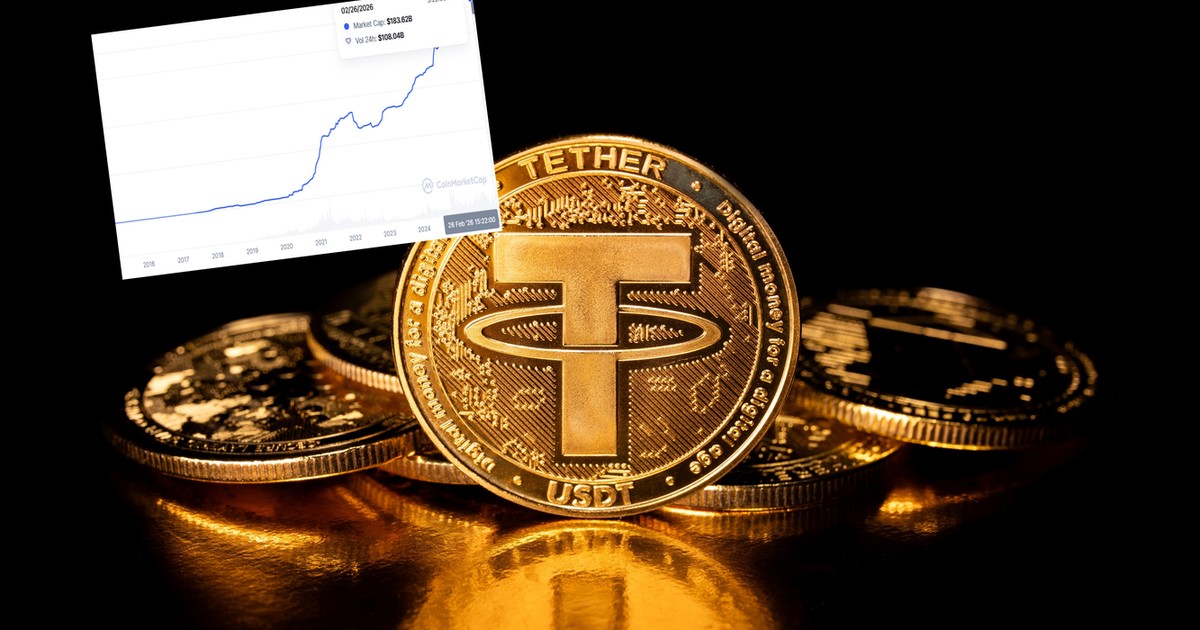
As of Wednesday, February 25, bitcoin, ethereum and other leading cryptocurrencies in the world began to recover from the crash. For investors in this speculative market, it is a breath of relief, i.e. if they are playing for growth, although they will still not remember February 2026 fondly. Out of 27 cryptocurrency trading days, as many as 18 were in the red this month.
Some of the capital completely disappeared from the market after the recent price crash. But some simply moved from bitcoin to other stable cryptocurrencies. Specifically, those that are by definition excluded from significant fluctuations in relation to the dollar.
How do they function, what do their issuers benefit from, and how many transactions with stablecoins, which are relatively new to the market, are made in real life? The numbers are surprising. The new financial era has already arrived.
Important: the calculations included in the text are for information purposes only and do not constitute a recommendation or any other form of suggestion for the purchase or sale of financial products. Investment decisions should be preceded by your own analysis of risk and financial situation.
Read also in BUSINESS INSIDER
What happened to Bitcoin in February?
Let's go back to bitcoin itself for a moment. Despite the rebound, in February it was negative by several percent, after four months of decline. The market has almost forgotten about levels above 100,000. hole.
Despite the rebound, the capitalization of the entire cryptocurrency market is $2.34 trillion, i.e decreased by USD 670 billion. this year, and since the peak on October 7 last year. — by as much as almost a trillion dollars. For comparison, the Polish economy has just exceeded one trillion dollars in GDP for the first time in history.
Capital flows into stablecoins
However, not all capital fled the market, and part of the outflow went to stable tokens. There is such a thing as the utility value of cryptocurrencies. Contrary to appearances, these do not have to be speculative instruments. This is what ultimately happened, but it is a very useful tool.
Thanks to cryptocurrencies, it is possible to settle international transactions instantly and without bank commissions. But do you really need bitcoin and ethereum, i.e. cryptocurrencies that are subject to speculation and rapid price changes, up and down? There is an alternative. The stablecoin rate fluctuates around one dollarand yet the market value during the collapse of other cryptocurrencies not only did not fall, but even increased. Here, the decisive role is played by the use value, not the speculative one.
Cryptocurrency market commentators have been focused on the declines in Bitcoin and Ethereum since the beginning of the year, and meanwhile, in the background of this discussion, the capitalization of the stablecoin market exceeding the level of USD 320 billion, set a historical record. This is not a one-off rebound, but a continuation of the upward trend already visible in 2025. At the end of 2024, their total market value was USD 200 billion, and a year earlier – USD 132 billion.
The world's leading stablecoin, that is Tether USDT is already the third largest cryptocurrency in the world with a capitalization of $249 billion.and another stablecoin USDC – sixth – with capitalization of USD 75 billion. The former is developing particularly rapidly.
Changes in the capitalization of USDT tethers in billion dollars.
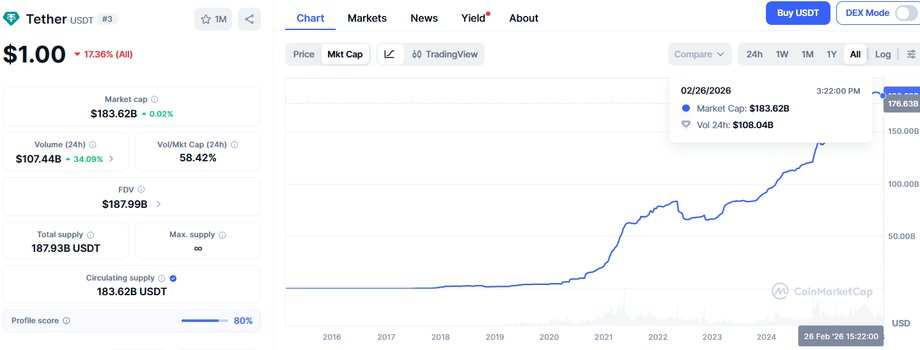
Changing the capitalization of USDT tethers
|
Coinmarkecap.com
The change in the market structure in favor of stablecoins is also shown by data on record transaction activity. This is about real transactions, e.g. buying a car or a house using a stablecoin, and not about buying other cryptocurrencies.
Banks are becoming unnecessary
This is the total value of real operations using stablecoins reached as much as USD 33 trillion last year, growing by 72%. rdr. In January this year real transactions were made in tether cryptocurrency (USDT) (up to USD 10,000) for USD 246 billion, and USDC for USD 42 billion. – reports the Getorbital website, which monitors flows on an ongoing basis. IN record June 2025 Transactions worth USD 319 billion were completed. using USDT and USD 50 billion. using USDC.
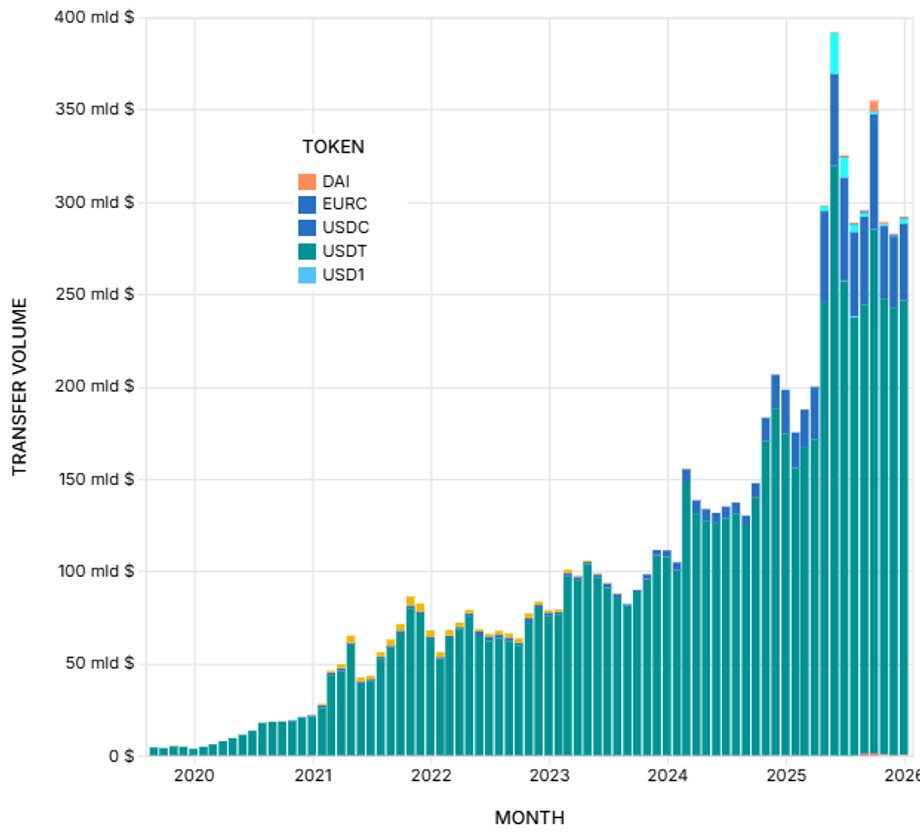
Real-life transactions made with stablecoins in billions of dollars.
|
getorbital.com
According to Bloomberg Intelligence forecasts, by 2030, annual payment flows in stablecoins may increase up to USD 56 trillion. annually.
“It places stablecoins at a level comparable to the largest traditional payment systems, such as Visa or Mastercard” – comments the Bitget exchange.
Banks are becoming unnecessary when it comes to asset transfers. International Monetary Fund recently warned that the rapid growth of the stablecoin market could threaten the traditional banking system in the long run and make conducting monetary policy more difficult.
— Such a scale clearly brings stablecoins closer to the volumes observed in traditional global payment systems and confirms that their role today goes far beyond that of an auxiliary cryptocurrency market tool. Instead, they become one of key channels of value transfer in the digital economy. This is a sign that the market is moving from the speculative phase to the infrastructure phase, Ignacio Aguirre, marketing director at Bitget, tells Business Insider.
Today, stablecoins are starting to provide an alternative settlement system based on the digital dollar. For investors, it is a way to stay in the digital asset ecosystem in the face of high market volatility, while avoiding portfolio volatility.
How do stablecoin issuers earn money?
Okay, but what interest do stablecoin issuers actually have in releasing them at all? Each coin is backed by one dollar and where is their profit, what interest do they have in it? The mechanism is quite simple.
Each USDT tether is backed not by the dollar itself, but by a US government bond. A bond that pays interest. And this interest is precisely the profit for the stablecoin issuer. And the buyer? This one has a convenient means of payment that can finance purchases in any longitude and latitude, i.e., of course, where cryptocurrencies are traded. Everyone is happy.
The financial statements of the independent auditing company BDO show that Tether has generated over $10 billion. net profit in fiscal year 2025. Although this amount is a decrease from the $13 billion reported in 2024, the company's reserve surplus increased to $6.3 billion and the total the value of USDT backing assets increased to $193 billion. with a capitalization of USD 187 billion. at the end of 2025
In 2025, Tether recorded the second largest annual emissions in history, adding over $50 billion. in new USDT to the circulating supply. He invests not only in bonds, but also in gold.
“Tether is on track to become a 'gold central bank,'” Tether CEO Paolo Ardoino told Bloomberg in late January. The company intends not only to issue tokens for dollars, but also for gold. Tether owns about 140 tons of gold worth about $23 billion, stored in a nuclear bunker in Switzerland. Bloomberg wrote that this is it the largest known gold reserve in the world apart from central bank reserves, ETF funds and commercial banks.
Paolo Ardoino said that US political rivals will probably introduce a gold-based alternative to the dollar. He expects his company's role in the gold market to increase. Tether reinvests its profits there.
Regulations stimulate the market
Tether and USDC-Circle are becoming large participants in the treasury bond and global finance markets. This gave the US authorities an incentive to regulate the market. The government wants to sell bonds, and a powerful entity has emerged that is willing to buy them. And the dollar itself, which has lost part of its role as a reserve asset in the world's central banks in recent years, is thus gaining the role of a reserve asset for ordinary people around the world.
Even though stablecoins are an invention from only a few years ago, their role on the market is growing very quickly. After the regulation enters into force MICA in the European Union (2024) and after the adoption of the Genius Act in the United States (2025), stablecoins as a form of electronic money have been covered by a specific legal framework. This increased investor confidence. Not necessarily those from our continent for now.
— The world's largest stablecoin, Tether, has not been regulated in the European Union and is not available here, Katarzyna Wabik, head of the Kraken platform for Central and Eastern European markets, recently told Business Insider in a conversation about asset tokenization.
The regulations result in an increase in interest in stablecoins not only among retail investors, but also among financial institutions. The latter are also increasingly willing to use them for capital transfers and risk management in portfolios. At the same time, the “digital dollar” project was launched in the USA, and central bank digital currencies (CBDC) are being tested in Europe and Asia. Stablecoins are a real revolution in the global financial infrastructure.
Note: the information contained in the text is for informational purposes only and does not constitute an investment recommendation, information recommending or suggesting an investment strategy within the meaning of applicable regulations, or any other form of advice regarding the purchase or sale of financial products.