
The new axis of Poland's dispute with Ukraine. Kyiv blocks the export of a key raw material

“Despite export duties, scrap exports are growing, often in transit to third countries, without creating added value for Ukraine. On the contrary, domestic processing provides jobs, tax revenues and products necessary for defense and reconstruction. The use of scrap in metallurgical production also reduces CO2 emissions, which is important in the light of EU requirements,” said Prime Minister Yulija Svyrydenko, quoted in the statement.
The rest of the article below the video:
Polish steelworks in trouble
Kiev's decision affects the steel industry in Poland. Mirosław Motyka, president of the Steel Chamber of Industry and Commerce (HIPH), admits that for domestic steelworks this means greater price volatility and disruption of earlier supplies. — Polish producers will have to replace lost volumes with purchases from other suppliers, which will affect raw material and logistics costs, he says.
The Polish steel industry was surprised by Ukraine's decision
|
Shutterstock
The Polish market has to cope with this challenge almost overnight. — The sudden introduction of a ban on the export of scrap from Ukraine (regulation issued on December 23, 2025) and the existing export ban (from January 1, 2026) caused a sudden interruption of the supply chain, forcing Polish recipients to terminate contracts for the purchase of scrap from Ukraine – says lawyer Anna Trocka, an expert in international law and waste management at the APT&right law firm.
There is scrap a key material used in electric furnaces. And these installations are to become crucial in reducing the sector's emission intensity. — Złom stalowy stanowi aż do 70 proc. costs of steel production from electric furnaces. Each increase in the purchase price of scrap per tonne translates into the same increase in steel production costs. In order to maintain their margins, steelworks most often increase steel sales prices by the amount equivalent to the increase in the purchase price of scrap, explains Trocka.
The export ban introduced in Ukraine has already led to a significant reduction in scrap prices in our eastern neighbor – the current price of scrap on the Ukrainian market is approximately $200. per tonne, while in Poland it is more expensive and amounts to approximately USD 330. per ton. However, it must be admitted that The reason for the price increase is not the Ukrainian blockade itself, but also the recent temperature drops, which hamper production.
Dish about scrap from Ukraine
In recent years, there have been reports in the media about an excessive inflow of material from Ukraine. The import of scrap from Ukraine was actually growing (according to Eurostat, it increased by 42% in the first 10 months of 2025), but according to representatives of the steel industry, it was far from “flooding” the Polish market.
– The pressure that the Polish market faced – and which we have signaled many times – resulted primarily from…
all from the inflow of steel products, and not from an increase in scrap imports. In 2025, we observed a dynamic increase in imports, including: prętów — tłumaczy Mirosław Motyka.
The annual scale of exports of steel scrap (ferrous metals) from Ukraine to Poland last year reached approximately 350,000. tons per year. That's about 5 percent. the entire steel scrap market in Poland, amounting to approximately 6.8 million tons.
— In Poland, on balance, we have a surplus of steel scrap generated in the amount of approximately 2 million tons per year, which should weaken the price pressure due to the suspension of supplies from Ukraine. The entire amount of surplus steel scrap in Poland is exported, mainly to Turkey and Germany, admits Anna Trocka.
However, not all industry representatives see the future in such bleak colors. Piotr Sikorski points out that the import of scrap to Poland is not very significant. — Generally, we have a surplus of scrap in Poland, we export almost twice as many tons from Poland than we check into the country. For this reason alone, you should not be afraid that this decision will have a very profound impact on our market or that there will be a shortage of scrap soon – he reassures.
The great fight for scrap
However, the president of PUDS admits that competition for scrap is becoming crucial in the industry. — Taking into account the ongoing decarbonization processes, the fight for scrap will certainly become more intense, because at some point there will simply be too little of it. Everyone will need more and more scrap, including Poland, when we replace the last blast furnaces with electric ones and the use of production capacity will increase, which is what we all wish. In a sense, scrap is becoming a strategic raw material and the protection of one's own market against scrap escape is already visible in many regions of the world. The EU will ban its export to non-OECD countries in 2027, says Sikorski.
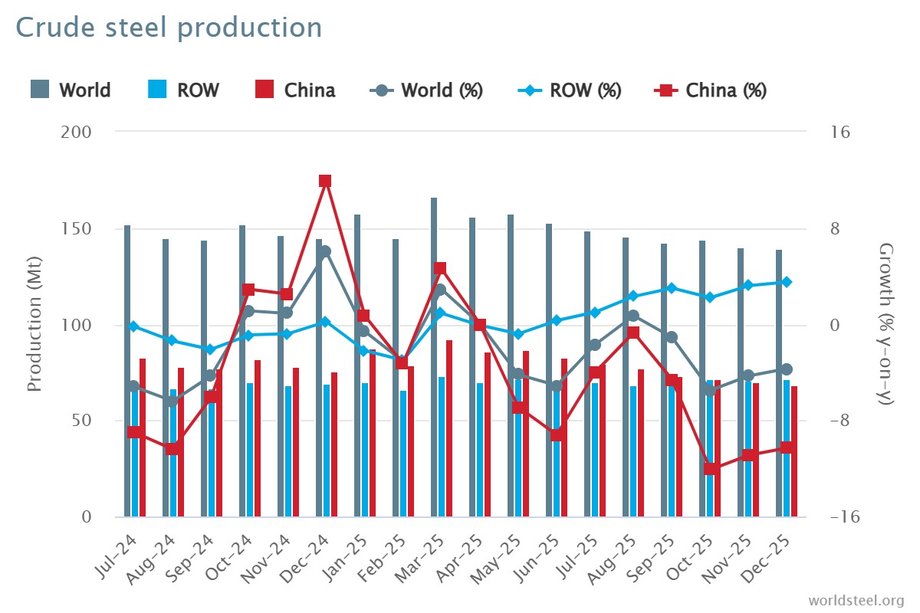
World production of crude steel
|
World Steel Association
Kyiv is fighting for its own
the decision “allows us to preserve strategic raw materials and direct them to domestic processing needs.”
Suspending the export of Ukrainian scrap abroad benefits the Ukrainian oligarchs. The local metallurgical industry largely belongs to them. The decision leading to lower prices on the domestic market is therefore a tribute to tycoons such as Metinvest, owned by the richest citizen of Ukraine, Rinat Akhmetov.
— Ukrainian steelworks announce increasing production capacity and investing in electric furnaces, so it seems understandable that they intend to keep scrap in the country. Additionally, the CBAM mechanism (so-called carbon duty – editor's note) introduced by the European Union from January 2026 has, in a sense, also contributed and accelerated such a move by the Ukrainian government. However, I see the one-sidedness of Ukraine's approach here – on the one hand, it increases steel exports and requests the European Union to suspend its steel and CBAM quotas, and on the other hand it closes its country to scrap exports – says Piotr Sikorski, president of the Polish Union of Steel Distributors (PUDS).
The Ukrainian Ministry of Economy did not respond to our questions on this matter.
Polish steelworks demand equal opportunities
From the perspective of business in Poland, not only rising costs may prove problematic, but also the growing pressure of products from Ukraine, which will now have access to cheaper scrap. This will make them even more competitive on the Polish market.
That is why steel workers are calling on the Polish authorities to intervene. — Diplomatic intervention is needed in EU-Ukraine relations to alleviate the effects of the restrictions and prevent disruptions in supplies to Poland. Secondly, it is another argument to use a fair allocation of quotas in the work on the new EU trade tool for steel products and cover all third countries without exception. There should be no preferential treatment for imports of steel products from Ukraine. The tool must be consistent and effective, says Mirosław Motyka.
We have sent questions on this matter to the Ministry of Development and Technology. We will publish responses as soon as we receive them.
Grzegorz Kowalczyk, journalist of Business Insider Polska


