January 23, 1926
On this day Ekimova Nina Nikolaevna was born.


Ekimova Nina Nikolaevna. Photo: Photo: Regional Library
She began her career in 1958 as an inspector of the culture department of the Obluchensky district executive committee. For more than twenty years, Nina Nikolaevna worked as secretary of the district executive council.
From September 1981 to 2000, she worked as the head of the organizational and control department of the administration of the municipal formation “Oluchensky District”.
N.N. Ekimova made a great contribution to the development of culture in the Obluchensky district, took an active part in public life, in organizing the women's movement, and headed the district women's council for 20 years. Nina Nikolaevna was repeatedly elected as a deputy of the Obluchensky District Council.
For many years of impeccable work, she was awarded certificates of honor and was encouraged by the gratitude of the leaders of the Obluchensky district.
Nina Nikolaevna was awarded the medal “For valiant labor. In commemoration of the 100th anniversary of the birth of V.I. Lenin”, “For valiant labor in the Great Patriotic War of 1941-45.”
In August 2017, Nina Nikolaevna passed away. There is a memorial plaque installed on the house where she lived.
January 23, 1935
The organizing bureau of the regional committee of the All-Union Communist Party of Bolsheviks for the Jewish Autonomous Region discussed the issue “On the work of an experimental agricultural station.” The adopted resolution notes that the experimental station has carried out extensive research work to develop a number of agrotechnical techniques, the best varieties of agricultural crops have been identified, the main diseases of cereal varieties and measures to combat them have been identified.
Having noted the existing shortcomings in the operation of the experimental station, the Organizing Bureau identified measures to eliminate them.
January 23, 1940
On this day, Evgeniy Nikolaevich Yanovsky, Honorary Citizen of the Jewish Autonomous Region, doctor of the highest qualification category, excellent health worker, was born.

Evgeny Nikolaevich Yanovsky. Photo: Photo: Regional Library
Evgeniy Nikolaevich graduated from the Khabarovsk Medical Institute with a degree in Pediatrics. After graduating from the institute, he worked as a pediatrician in the village. Ilyinsk, Sakhalin region.
In 1970 he moved to Birobidzhan, got a job at a regional children's hospital as a local pediatrician, and in 1972 he was appointed to the position of head of the somatic department. He worked in this position for 40 years until 2012.
For 25 years, Evgeniy Nikolaevich was the chief freelance pediatrician of the health department of the regional government, the organizer of the pediatric service in the Jewish Autonomous Region.
Yanovsky E.N. was awarded the Order of Friendship of Peoples, the badge “Excellence in Health Care”, the medal “For Valiant Labor. In commemoration of the 100th anniversary of the birth of V.I. Lenin.”
In 2000, by a resolution of the Legislative Assembly of the Jewish Autonomous Region, Evgeniy Nikolaevich was awarded the title of Honorary Citizen of the Jewish Autonomous Region.
In 2015, on the occasion of his 75th anniversary, Evgeniy Yanovsky was awarded the honorary badge of the JSC “Honor and Respect.”
On June 19, 2023, Evgeniy Yanovsky, a pediatrician at the regional children's hospital of the Jewish Autonomous Region, passed away.
January 23, 1969
The plenum of the Birobidzhan City Committee of the CPSU discussed the tasks of party and Komsomol organizations to further improve the organization of political education of communists and Komsomol members.
The resolution of the plenum noted that in the city’s party education system there were seven primary political schools, 81 schools of the fundamentals of Marxism-Leninism, 56 theoretical seminars, a city school of party and economic activists, 52 political circles, in which 4.2 thousand people studied. Such forms of study as theoretical and methodological conferences have been developed, and the experience of the best propagandists is studied. The Plenum recommended to continue to improve the organization of studies and to fully activate participants in classes at all levels of political education.
January 23, 1978
At the invitation of the US Congress, a delegation of the Supreme Soviet of the USSR headed by the Chairman of the Foreign Affairs Commission of the Council of Nationalities of the Supreme Soviet of the USSR, candidate member of the Politburo of the CPSU Central Committee, Secretary of the CPSU Central Committee B.N. arrived in Washington on an official visit. Ponomarev.
The delegation included deputy of the Supreme Soviet of the USSR, first secretary of the regional committee of the CPSU of the Jewish Autonomous Region L.B. Shapiro.
At the regional party committee he met with party activists and regional journalists. He told them about his trip to the USA.
January 23, 1982
The newspaper “Birobidzhanskaya Zvezda” (12+) in the section “People of the Soviet Village” published an essay by N. Aizman entitled “Field of the Yarov brothers” about the combine operators of the Dezhnevsky state farm.
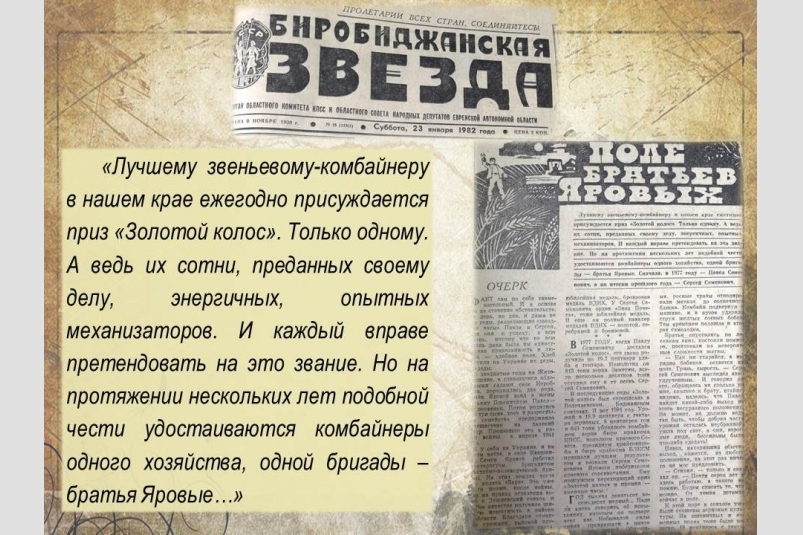
Clippings from the newspaper “Birobidzhan Star”. Photo: Photo: Regional Library
“The best unit combine operator in our region is annually awarded the “Golden Ear” prize. Only one. But there are hundreds of them – dedicated, energetic, experienced machine operators. And everyone has the right to claim this title. But for several years, combine operators of one farm, one brigade – the Yarovye brothers – have been awarded this honor…”
In April 1941, the Yarov family: Semyon and Tatyana, their four sons and daughter, moved from Ukraine to the Amur, to the village of Kvashnino. The father of the family, Semyon Yarovoy, worked as a tractor driver and foreman of a tractor-field brigade, then at the Zarya collective farm. Later after the war, the Dezhnevsky state farm was formed. The father of the family made a significant contribution to the achievements of the state farm; he also brought his sons to the Dezhnevsky state farm, looking at their father, the brothers also worked hard.
Pavel's childhood was cut short by the war, and at the age of 14 he got on a tractor. Sergei grew up, and his father, the foreman, assigned him to work as a trailer for Pavel.
Semyon Yarovoy raised a worthy replacement; since 1942, the brothers have conscientiously and with special diligence cultivated the Kvashninsky arable lands.
“In 1977, when Pavel Semenovich got the “Golden Ear,” his unit received 19.3 centners of grain per hectare. He threshed 813 tons of grain. Note that Sergei Semenovich lost only a few dozen tons to him that fall.
In subsequent years, the “Golden Ear” was “registered” in the Volochaevsky and Bidzhansky state farms. And here it is 1981. The harvest of 18.9 centners per hectare of grain, 8 centners of soybeans and 649 tons of grain harvested by a combine was recognized by the bureau of the regional committee of the CPSU, the executive committee of the regional Council, the presidium of the regional trade union and the bureau of the regional committee of the Komsomol as the best result and named Sergei Semenovich Yarovoy the winner of the regional competition. He was awarded the challenge prize “Golden Ear” and a prize – a personalized watch…”
The essay notes that the brothers are no longer young. Pavel is 54, Sergei is 51. Both already have grandchildren. Their age difference is only three years. Three years separate the time they enter school, start working, serve in the army, and get married. They were awarded with orders and the “Golden Ear”, also at three-year intervals.
The Soviet state duly noted the labor valor of the brothers. “…Pavel Semenovich has the Order of the Red Banner of Labor, the Lenin Jubilee Medal, the VDNKh bronze medal. Sergei Semenovich has the Order of the Badge of Honor, also a jubilee medal. And he is also a full holder of VDNKh medals – gold, silver and bronze…”.