How the EU forced Trump to swallow his threats about Greenland: “No one really cares about the European Union”


Almost overnight, Trump dropped both threats of military intervention in Greenland and threats of tariffs on some European countries. Security expert Iulia Joja says that the decisive argument was the drop in the American stock market.
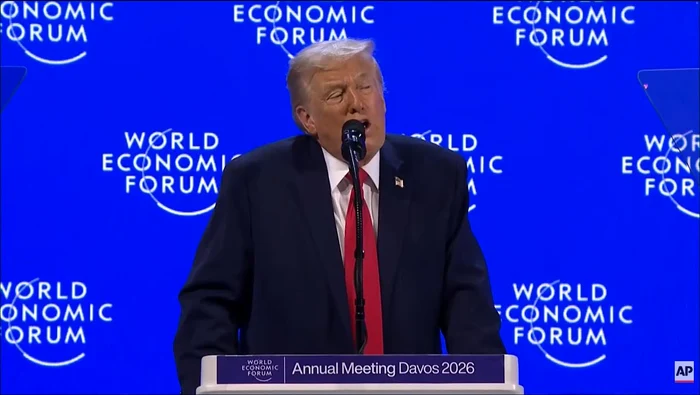
Trump swallowed his military and tariff threats at Davos. PHOTO: Video capture
In a speech at the World Economic Forum in Davos on Wednesday, Trump said he would not use military force to take control of Greenland, although he insisted the US should have a strong role there for security reasons.
Hours after meeting with NATO Secretary General Mark Rutte, Trump announced that he would not impose the 10% tariffs on imports from eight European countries (Denmark, Norway, Sweden, France, Germany, the United Kingdom, the Netherlands and Finland) that had been planned to take effect on February 1 as pressure to get their support on Greenland. This threat had been heavily criticized by the Allies and caused transatlantic tensions.
Trump said that after a meeting with NATO Secretary General Mark Rutte, the US and allies laid the foundations for a framework for a future agreement on Greenland and the Arctic region. He said the deal, if completed, would be beneficial to the US and all NATO nations, and used that as a reason to drop the planned tariffs.
Trump said negotiations on the finer details of the deal are continuing, including talks about a missile defense system called “The Golden Dome” that would involve Greenland. He suggested that the US side could gain extensive and strategically important access without specifying exactly how this would be achieved.
Even after dropping tariffs and military force, Trump reiterated that he considers Greenland essential to national and global security and that the US wants “full control/expanded access” to the island in a negotiated manner.
“It wasn't that big of a surprise that the United States took maybe a step or two back, because that's what the economy required”
Iulia Joja, foreign policy analyst in Washington, professor at Georgetown University and researcher at the Middle East Institute, explains to “Adevărul” what caused the change in the US president's speech regarding Greenland.
“On the subject of Greenland, it wasn't that big of a surprise that the United States took a step or two back because the economy demanded it. The United States stock market has been at its lowest point in months in recent days amid threats to break up NATO, the Greenland controversy and so on.”claimed Joja.
The president of the United States, says the expert, does not have the European public, the Greenland public or the international public as a priority. “His priority is the American public, and the American public, the American consumer is closely tied to the stock market, and the stock market has looked bad these days.”
Indeed, the Washington Post headline the other day: “Around January 20, 2026, US markets fell sharply after President Donald Trump threatened to impose trade tariffs on some European allies in response to opposition to his Greenland plans. During that time the S&P 500 fell more than 2%, the Dow Jones nearly 1.8%, the Nasdaq about 2.4%.”
After Trump announced that he would not introduce tariffs and reached a “framework of cooperation” related to Greenland, the markets recovered strongly: S&P 500 rose about 1.16%, Dow Jones more than 1.20%, Nasdaq rose about 1.18%.
“The president of the United States does not speak to the world. The effect on the public in Europe is an unintended secondary one. It has no importance for the behavior of the voters, the political preferences in the United States what the Romanians, the Japanese or the Germans think. The president of the United States in general and this president in particular makes policy in relation to his own population, with his own voters for whom the economy is the most important. In this context, the stock market did not react well at all to these tensions and to this lack of security, so it was expected that Trump would take a step or two back”the security analyst explained.
Why aren't we breathing a sigh of relief about Greenland?
Asked to what extent Trump would balk at a more or less hostile takeover of Greenland, Joja claimed: “Ni believe He said he was abandoning the idea of a military takeover. We breathed a sigh of relief only momentarily. Why? To quote the White House spokeswoman: “Only the President of the United States knows what he's going to do.” And then … the fact that he has assured us now that there will be no military intervention is no guarantee of what will happen in a few months.”
In the context of Ukraine, he has repeatedly changed his point of view. A week ago, the teacher recalls, when the topic of the day was Iran: “The President of the United States has sent messages to Iranian protesters encouraging them to take to the streets and risk their lives. Thousands, if not tens of thousands of people have died because President Trump assured them that help was on the way and help has not come. It's about people's lives. And this happened a week ago and that's why I say, it wouldn't be rational, it wouldn't be prudent to rule out that scenario just because Trump said now something. Let's not forget that the planes were in the air in Iran and the president changed his mind.”
Asked if the reaction of the American stock market also came as a result of the firm reaction of the Europeans, Joja said: “That's a very good question. The stock market is also made up of people and the stock market reacts to uncertainty or a greater level of uncertainty“. She exemplifies the 12-day war in the Middle East or the situation in Venezuela, a few weeks ago: “IIn these situations, we asked ourselves how the price of oil remained so stable. Because the degree of uncertainty was not enough to destabilize the stock market so much. Now, the degree of uncertainty was much greater.”
The differences lie in the fact that the trade relationship between the European Union and the United States is that “the most important, the broadest, the strongest economic relationship in the world. As we speak, in the space of a minute, tens of millions worth of trade is taking place across the Atlantic.”
In this situation, the expert says, the stock market would not know how the Europeans would react, because the decisions were to be made after the discussions in Davos and after the European Council that takes place on Thursday in Brussels.
“The stock market reacted strongly in the United States”
“This meeting on Thursday could have far-reaching consequences with a tool, the so-called fiscal bazooka, that would cost the United States up to 100 billion, and this is not the only tool. At the beginning of February, the European Union's moratorium on suspending the tariffs imposed by the EU in response to the tariffs imposed by Trump a year ago expires.”she explains. The European Union had prepared reciprocal tariffs, but abandoned them in order not to escalate. “But now, in the next two weeks, the European Union must decide whether to continue the moratorium or impose reciprocal tariffs on the US's initial 15%. These two elements plus all the other possibilities show us that the EU has the economic capacity to wreak havoc on the entire EU, to wage a successful trade war against the United States.”Joja explains.
In this context and taking into account these elements, the American stock market reacted, Joja concluded. “The stock market reacted strongly in the United States and the effects were seen as far as the stock market in Japan.”
“No one is really on board with the EU from an economic point of view. Neither China, nor the United States, nor other actors”
Asked if the EU finally got to speak with the same voice and this was noticed on the stock exchanges, the expert showed “The European Union has the structural capacity to speak with a very strong economic voice. Nobody really aligns with the European Union from an economic point of view. Not China, not the United States, not any other actors.”
Then the EU scores important gains with the Mercosur agreement. In addition, Britain and Canada are moving closer to the European Union, and the European Union is in full negotiations for an agreement with India, which means a huge market.
“All of these issues strengthen the enormous economic power of the European Union through the single market. So, from this point of view, the answer to the question is yes, and the United States does not really know what awaits them, because they do not understand how the single market works as a single actor. That you cannot divide, except through certain very difficult subterfuges, the Europeans from an economic point of view.”Joja points out.
Russia has succeeded in dividing the EU, she says: “Instead of the EU finding its voice to negotiate a single price for gas before the full-scale war in Ukraine, and they let Russia divide the EU, creating a situation where at one point Poland, which has a much smaller GDP than Germany, was paying three times more for gas than Germany for gas.”
The problem is that although from an economic point of view the European Union is very well developed, from a political and geopolitical point of view it is not. “Therein lies the difficulty of having a strong voice, and somehow the president of the United States has pinpointed this, this weakness. The reality is that the United States has abandoned Ukraine, it considers itself a neutral power that is trying to negotiate a settlement, a peace treaty, and so on. So I no longer support Ukraine economically and financially. That was part of President Trump's campaign. Stop supporting Ukraine. So everything remained in the hands of the European Union“, details Joja.
Due to the lack of political will of the European Union, we are in a situation, says the expert, in which the European Union boasts that it manages to give for a year or so days, the amount of 90 billion euros, an amount that represents approximately half of Ukraine's needs. “And now we are in a situation that President Trump has characterized as a failure of the European Union in terms of its ability to be a political actor and to defend itself.”
The expert points out that in a Times interview with the mayor of Kyiv, he confirms that 600,000 people left Kyiv in January.
“The risk for the European Union that has always been and is now increasingly emphasized against the background of propaganda is that the war will lead to large new waves of refugees from an enormously large country like Ukraine for the criteria of the European Union“, says the expert.
This looming wave of refugees is the EU's responsibility.
“There is a risk that some diseases will spread because of the problems of electricity, heat, light and so on. Well, against the background of the United States taking this matter out of hand, against the background of the European Union being one of the most prosperous regions in the world, and with such a large economic capacity, this situation in Ukraine is a total failure of the European Union from a political point of view.” concluded Iulia Joja.