The communist “diet”: how the regime shaped the figure of the Romanians. The menu of the 80s, between “pork sneakers” and Ceaușescu's tastes


In the last decade of the communist period, food had become the obsession of the common Romanian. And this under the conditions in which the communist party had put him under strict regime, on “scientific grounds”. All this time the party people were doing whatever they wanted. On top of that, Ceaușescu preferred a simple diet.
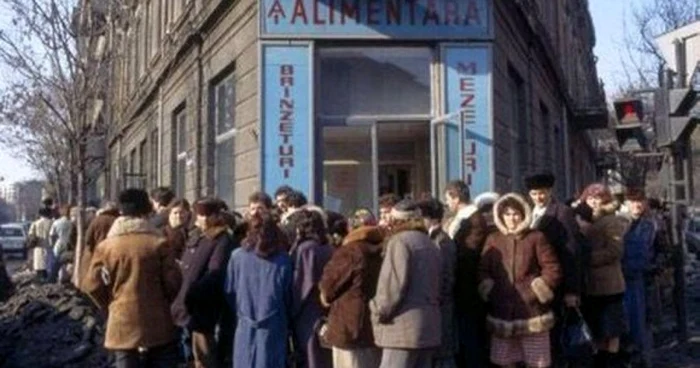
Queue in the communist period PHOTO archive
The life of many Romanians changed radically during the communist period, including food. And that's because many woke up, overnight, from peasant-townspeople. The cities were filled with people coming from the countryside, staying in the famous working-class neighborhoods that appeared on the outskirts or in place of the neighborhoods of houses torn down from the face of the earth. This whole category of new townspeople of Romanian communism would “supply” Ceaușescu's factories and plants with labor. People came with culinary habits from the countryside and polished or improved them with urban additions. That's how the “traditional” boeuf salad or stuffed eggs appeared next to the pot with sarmales or cozonacs.
The culinary habits of the Romanians also varied depending on the policies and personal ambitions of Ceaușescu, varying from the abundance of the 60-70s and ending with the decade of famine, from the 80s. Obviously, the elite of the Communist Party, but also all the rubedenia and friends did not have the same problems, dilemmas, nor did they submit to the forced food regimes imposed by the dictator. That is, they ate what their hearts desired, receiving products, including imports, either handily or directly from the party's warehouses, dedicated mainly to the nomenclaturists and Securists. In this totally discrepant culinary world of communist Romania, there were also the Ceauști. It was an absolute paradox for them. Although they could afford to eat whatever they wanted, their favorite foods were quite simple, even banal.
From smoked bacon to the “Petreus brothers”
Since 1965, with the coming to power of Nicolae Ceaușescu, Romania seemed to experience a period of relaxation, relative liberalization and prosperity. In the sense that music festivals appeared, including with foreign guests, Western films were shown in cinemas, art had some freedom of expression and food was found in gallantry. There were those Gostaturs, that is, state farms, where animals, birds and vegetables-fruits were raised. These Snacks had outlets where, at least in the 60s and until the mid-70s, there were quite a few goodies.
From 1965 until 1974-1975 the shops were not empty. Romanian own brands were very popular. Moving towards the end of the 70s and the beginning of the next decade, things changed, and Romanians from the city got to know the “Petreus brothers”, that is, two rib-eye chickens, sold two to a pack in the shops of the communist period. They barely reached the weight of one kilogram. They became a symbol of the food crisis in Romania in the 80s.
The desperate chase for food of the Romanian socialist
Later, the 80s came with the great starvation of the Romanians. That is, a tightening of the food shortage. The situation was desperate for many ordinary Romanians forced to stand in endless queues. Some were queuing the night before. Others tried to get food through knowledge or fraudulently, from the countryside. It is certain that Ceaușescu imposed a forced menu on the Romanians, based on “scientific principles”. And all to pay a foreign debt on the backs of the Romanians. That's how it came to “The program of scientific feeding of the population” adopted by MAN in the summer of 1984. It was a scientific nutrition thesis supported by the academician Iulian Mincu, who also made a report and the necessary recommendations. This program of scientific feeding of the population was actually presented as early as 1982, when the external debts reached the climax, in a meeting of the Executive Political Committee.
“Program that focuses on man and his needs, the balanced satisfaction of the food consumption requirements of all members of our society“, justified Ceaușescu's specialists.“The reservations of Western governments to grant credits for an unprofitable industry forced the party leadership to find solutions for the rationalization of consumption and the recovery of the economy. The pressures of the International Monetary Fund for the government in Bucharest to reevaluate its industrial development plans, as well as the prospect of insolvency led Ceausescu to announce that Romania intended to pay off its foreign debt, a burden that was thrown directly on the population.”explains the historian Mioara Anton in “Culture of scarcity in the 80s: Program for scientific nutrition of the population”.
According to Iulian Mincu's recommendations, the population of Romania had to consume fewer calories. And this after it was concluded that the Romanian ate too much and risked damaging his health and gaining weight.
“It turned out that in the bioclimatic conditions of Romania, an adult needs a daily consumption of 2800 calories. The statistics compiled after fictitious reports of the achievements of the plan showed that the Romanian was eating too much, exceeding 3300 calories daily. (…) “Candy on the cage was put, in the summer of 1984, by the entry into force of the “Program for scientific feeding of the population“, adopted by MAN. Depending on the number of calories calculated for the age and work groups, the menus in the workers', school's and students' canteens were made up. Treated like animals fed according to the plan, the Romanians felt more humiliated than ever “, stated Lavinia Betea, in “Ceaușescu and his era”.
In this context, the most important concern of the Romanian was to get food. Many times, standing in line ended with an empty bag, because by the time you got to the front, everything was gone. “A former high official of the party lamented the disappearance of eggs from Bucharest stores. George Macovescu, former Minister of Foreign Affairs, marginalized in the 80s as a result of the general secretary's fall from grace, was disappointed by the sad spectacle that the Bucharest landscape offered: “For a while, for more than a year, the queues formed by citizens of different ages have been permanent. Sometimes they start forming at two o'clock in the morning. Tails for meat, flour, eggs, milk, sausages, butter, potatoes, fruit, soap, detergents»“, pointed out Mioara Anton in the mentioned work.
Fed up with such humiliation, people began to “traffick” food from relatives in the countryside. There, people still raised pigs, poultry, in the household. And around the holidays, the supply frenzy began. Obviously, this “trafficking” in country food was illegal, but people eager for a hearty meal were taking risks.
“The existence of the common man under socialism had been reduced to a permanent rush to procure food, while in the pages of “Scânteii” information about socialist welfare continued to flow unhindered. It was impossible to see or find in the shops what was presented in the official speeches. In a private letter, Karolina Kovács from Mărculeni, Mureș county, informed a relative from Bucharest that, in Sovata, people had attacked the truck carrying bread, and as a result of the stampede, a woman had lost her life: “There is a big sale for bread. I have never experienced times when bread was in such small quantities. We still have problems with detergents, soap and many others»“, added Mioara Anton.
The menu of the common Romanian under communism from “pork sneakers” to claws
Here is the ration of a Romanian in the 80s and what products he was entitled to: 300 grams of bread per day, 500 grams of cheese per month, about 10 eggs per month and 500 grams of pork or beef per month, 1 kilogram of poultry meat per month, 100 grams of butter each month, 1 kilogram of sugar, 1 liter of oil, and one kilogram of flour. Annually, the decree of 1984 stipulated the following amounts per person: 39 kilograms of meat, 78 liters of milk and 166 kilograms of vegetables.
Oil and sugar were given once a month, the ration being one kilogram. Obviously, these quantities were often theoretical, because due to the lack of food goods, sent for export to the Russians, they were not really found in stores. From the menu of the Romanian during the communist period, “pork sneakers”, i.e. pig's feet, at discretion because they were not required for export, were not missing, but neither were “computers”, i.e. pig's heads. Besides these in the mains there was a “richness” of tomato paste, chicken claws and some prawns from Vietnam. Do not imagine that there were shrimps that today we give considerable sums.
They were shrimp-flavored expanded products that we still find in supermarkets today. It should be noted that there was also ocean fish and soy salami. And then, especially around the holidays, the “traffic” in food products from the country began. The party “cared” for the figure of the people. He had even developed some ideal weight standards. For example in men: 1.65 m height and 67.5 kilograms for those aged between 30 and 40 years, at 1.80 height the weight had to be 80.5 kilograms for those up to 50 years old. In women: at 1.57 height, the optimal weight was 56 kilograms, at the age of 30-40 years, at 1.68, the ideal weight had to stop at 66.9 kilograms. Calories were also calculated according to each person's job. White-collar workers, for example, were allocated fewer calories, while employees in sectors requiring increased physical labor enjoyed a diet with more calories.
Dictator's menu: cheese with tomatoes and moussaka
Obviously, the communist protipendada and their entire area of influence did not submit to the “food regime” that the common Romanian had. Activists, especially people in positions, ate their fill, including imported products. For his part, Ceaușescu enjoyed the choicest dishes. However, the dictator's culinary passions were extremely simple. Ceausescu especially preferred vegetables and dairy products, loving vegetable moussaka, with eggs and cream. At the same time, he most often ate simple salads with tomatoes, onions and cheese. Another favorite culinary dish was Romanian carp in aspic, or carp steak, but also the usual chicken steak. Ceaușescu's favorite moussaka is very simple and easy to prepare. For her part, Elena Ceaușescu was in love with trout with polecat.