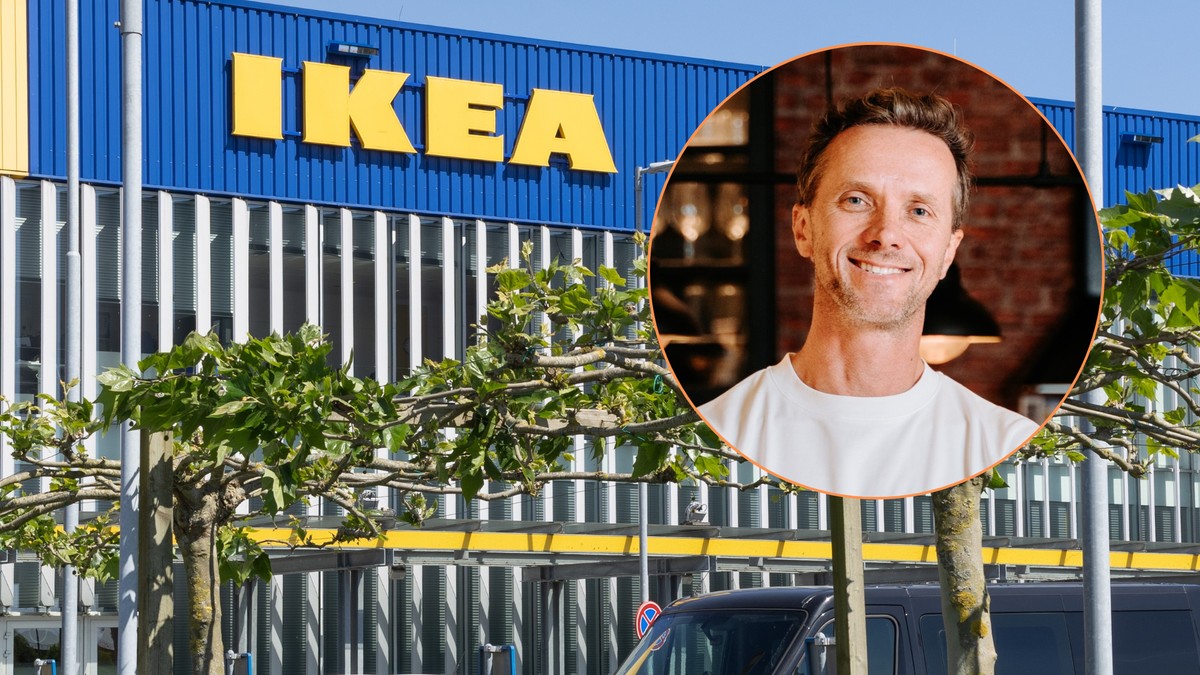
— Jakub Jankowski is an experienced and value-oriented leader who perfectly understands the value chain. I am very pleased that he has agreed to take over as the new CEO of Inter IKEA Group, said Anders Dahlvig, president of Inter IKEA Holding.
Jankowski announced continued work to make IKEA “even more affordable, accessible and sustainable.”
Read also: He accidentally started selling pencils and is making millions. He played va banque with Ikea
25 years in one company
Jakub Jankowski can only list one company in his CV – IKEA. He joined it in 2001. First, in the IT department. Then he worked as deputy manager for operations, business developer and deputy manager of the materials area.
In 2008, he became business development manager. He held this position for two years. Among his achievements from that period, he mentions, for example, the increase in mattress sales from 400,000 to 400,000. up to 5.5 million pieces.
In 2010, Jankowski went to Romania to take up the position of deputy sales manager at IKEA. He managed six teams there and achieved very good results, but in 2014 he returned to Poland for two years to take up the position of store manager. Effect? Jankowski points out that the store achieved very good financial results. In the financial years 2014-2015, sales increased by 24%. above the assumed budget, the number of store visits increased by 27% and the number of buyers by 17%.
He left the position in December 2015 to appear at IKEA in the Netherlands in January 2016 and take up the position of assistant to the president of the management board. Two years later, in January 2018, he was already in Switzerland, where, as the manager of Category Logistics Services, he created a new department employing 50 people. In February 2020, he became Category Area Manager, leading a team of 100 people. He was responsible for developing and implementing a materials strategy and improving existing materials and production techniques.
In 2022, he became managing director of IKEA Industry and held this position until the end of December 2025.
Jankowski completed studies in computer science and linguistics at the Adam Mickiewicz University in Poznań in 1998, as well as postgraduate studies in logistics management at the Warsaw School of Economics and in capital investments at the WSB Merito University in Poznań.
Read also: Ukrainian soldier: the end of October turned out to be a disaster for us
Serious turbulence
At IKEA, Jankowski will not have an easy task. Bloomberg noted in a recent article that The Swedish brand is in one of the most difficult periods in its over 80-year history. Why? Mainly due to growing competition from online platforms such as Amazon, Temu, AliExpress and Shein.
The report for the financial year ended in August 2025 (fiscal) published in November shows that IKEA's net profit decreased by 32%, to EUR 1.5 billion, which corresponds to approximately USD 1.73 billion. Inter IKEA's revenues remained at a similar level and were only 0.9 percent higher. lower year on year, reaching EUR 26.31 billion.
The company said that the worse results were caused by market uncertainty, especially related to US tariffs. Trade tensions have driven up raw material prices and logistics costs. Tolga Oncu, head of global retail, admitted that the brand must adapt to the new realities and “pass on part of the increase in costs to customers.”
After taking over, Jakub Jankowski said: “We are surprisingly good when everything goes well; now we need to work on being very resilient and reacting when things don't go according to plan,” he said.
In January, IKEA announced that it was closing seven large-format stores in China and instead opening several smaller outlets. The chain will also develop online sales. The goal is to get closer to the customer and speed up delivery times.
The breath of competition
IKEA is facing the outflow of customers who prefer to shop on Chinese platforms. The Cross-Border E-Commerce Shopper Survey 2025 conducted by the International Post Corporation (IPC) shows that Chinese platforms are recording huge increases in interest around the world. The report is based on data from nearly 31,000 people. buyers from 37 countries, including many European countries, as well as from Australia, Canada, China, Mexico, New Zealand, South Korea and the United States.
What is surprising is the interest in Temu. In 2025, as much as 24 percent respondents admitted that they had recently made an online purchase on this platform. For comparison, in 2022 this share was only 1%, and a year earlier the platform did not exist at all. Temu's share increased from 1 to 24 percent. within three years and caught up with Amazon, whose share was also estimated at 24%.
Amazon also saw a 24% increase. participation in an international study. According to the study's authors, from this perspective, Amazon and Temu together account for almost half of all cross-border sales. Shein recorded a share of 9% and Ali Express – 8%. eBay accounts for 5%, while Zalando is the first European player with a share of 3%.
Data from ecommercenews.eu show that Shein is particularly popular in France, Spain and Italy. The platform attracts 27.3 million, 25.8 million and 22.8 million unique users in these countries, respectively. It is most popular in Germany (19.3 million), France (16 million) and Poland (13.2 million).
Changing the balance of power
The problem of growing competition is also visible in Poland. Analyzes by the research company PMR Market Experts indicate that in 2024, cross-border sales accounted for less than 7%. value of the Polish e-commerce market. In 2025, the growth rate of this segment accelerated significantly, mainly due to the expansion of platforms such as Temu, Shein and AliExpress. Last year, Chinese sales platforms recorded dynamics clearly exceeding the pace of development of e-shops and marketplaces in the country.
— Chinese platforms quickly adapted their strategies to the expectations of Polish consumers. Aggressive pricing policy, wide offer and refined logistics mean that today they set the pace of cross-border development in Poland. For domestic e-stores, this is a signal that the competition is no longer local, but global – notes Agnieszka Skonieczna, Head Retail Market Analyst at PMR.
In the ranking of the top 20 largest Polish e-commerce players according to sales value for 2025, there are already 3 cross-border platforms, and Temu and AliExpress are in the top five. Although the difference from Allegro remains significant, the presence of global giants is increasingly influencing the balance of power in Polish e-commerce.
A huge crisis
The growing interest in Chinese platforms is just one of the problems of the furniture industry. In a report from September 2025, Bank Pekao analysts write directly that the wood and furniture industry is undoubtedly immersed in a prolonged crisis. The production volume of both wood products and furniture, after further declines, in 2024 reached a level several percent lower than in 2021. This result places the analyzed sector among the sectors of EU processing that are performing the worst in the current decade.
Overall industry sentiment remains weak
– analysts noted.
The Polish wood and furniture industry believes that it is one of the biggest losers of the current economic recovery. The average net profitability was the lowest in years – in the wood sector since 2013, and in the furniture sector since 2018. The average levels of indicators do not fully reflect the difficult situation of the sector – the median net profitability of the wood industry dropped below 2%, and in the furniture industry to 2.3%. (the lowest after 2007). 35 and 30 percent respectively. wood and furniture companies showed a loss in 2024.
High costs
Producers in Poland point to the high prices of raw materials as the biggest challenge. According to the Polish Chamber of Commerce of Furniture Manufacturers, the average price of wood in 2025 was PLN 279 per cubic meter. compared to PLN 194 in 2019
“This is an increase of PLN 85 per cubic meter, or 44 percent! No entity in the wood industry can take inflation into account in its sales prices, because it operates on a global and highly competitive market. The State Forests take advantage of their monopoly position and set prices administratively, imposing them without any connection with the market situation,” producers warn.
According to them, in 2025 there was a decline in wood sales to 38 million cubic meters, and in 2026 even less wood is expected to hit the market.
“This once again shows that domestic companies are forced to give up purchasing wood because the pricing policy of the State Forests ignores the needs and opportunities of the Polish economy, deepening the crisis in the wood and furniture sector,” the producers say.
They also criticize the action of the Ministry of Climate and Environment, which consists in limiting the supply of wood and excluding further areas from use (moratoriums, old forests, community forests, reserves). They claim that this has a price-setting and destabilizing nature.
“This is not an ecological transformation, but a planned extinguishment of the potential of one of the most important branches of Polish industry. Without a stable, responsible raw material policy, the wood and furniture sector may not survive in the next few years on the current scale,” producers warn.
They also indicate that China will not have a problem with the raw material, because since 2012 it has afforested over 77 million hectares and is currently entering a period of intensive timber harvesting from its own resources.
This means that they will be able to compete even more on price, especially as the EU's regulatory pressure on the supply of raw materials increases. In addition, labor costs in Europe are also continuing to rise.
The problem of domination of Chinese platforms may be growing. Credit Agricole analysts point out that “China is reorienting its exports geographically amid difficulties in selling its goods to the USA.” So they can focus particularly on Europe.