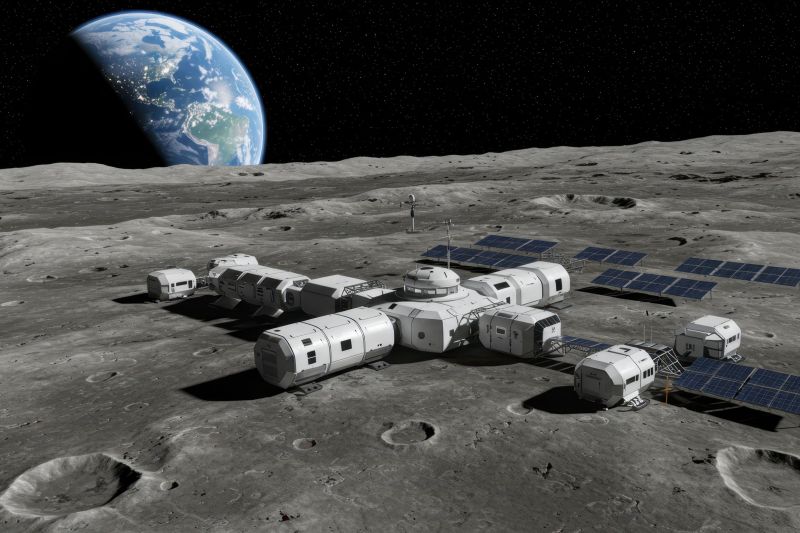
A fictitious base on the surface of the Moon, image generated with AI (photo source Niel Ibragimov, Dreamstime.com)
NASA will build a nuclear reactor on the Moon by 2030, and the United States is determined to achieve this goal, according to statements made on Tuesday by NASA Administrator Jared Isaacman, Space.com and Agerpres write.
NASA has been working for several years on a prototype nuclear reactor that could power one or more bases on the lunar surface, and Sean Duffy, the former acting administrator of NASA, said last August that the US had moved from the study phase of the project to the implementation phase.
The reactor would be built as part of the Artemis program by which the US aims to bring astronauts back to the surface of the Moon and establish bases on the Earth's natural satellite.
In December, President Donald Trump signed an executive order to begin construction of such a base by 2030 and to have a nuclear reactor ready for operation on the moon by the same time frame.
American officials recall the Apollo missions and the Manhattan Project
NASA and the US Department of Energy (DOE) announced on Tuesday that they had signed a memorandum reaffirming their commitment to meeting this deadline.
“Under President Trump's national space policy, America is determined to get back to the moon, build the infrastructure to stay there, and make the investments necessary for the next giant leap to Mars and beyond,” said NASA head billionaire Jared Isaacman.
“History shows that when American science and innovation come together, from the Manhattan Project to the Apollo mission, our nation leads the world to reach new frontiers once thought impossible,” said US Energy Secretary Chris Wright in the joint statement with the NASA administrator. “This agreement continues that legacy,” he emphasized.
Nuclear power plants are indispensable for human outposts in deep space, such as those on the Moon and Mars. Nuclear fission systems can generate electricity continuously for years without needing to be refueled and are not affected by weather conditions or sunlight.
However, it should be noted that, despite the optimistic statements of American officials, the Artemis program has been plagued by numerous delays and postponements.
Last October, the former NASA administrator threatened SpaceX, Elon Musk's aerospace company, to withdraw its contract to build the lunar lander because of delays. But SpaceX is not the only party involved in the project that failed to meet the ambitious deadlines set by NASA.
The US fears it will be overtaken by China in the new race for the moon
The plans are in line with the Trump administration's emphasis on manned spaceflight. The White House has proposed a budget that would increase funding for these types of missions in 2026, while advocating major cuts to other programs — including a nearly 50 percent cut to science missions.
The nuclear reactor directive calls for the agency to solicit proposals from industry for a 100-kilowatt nuclear reactor to be launched by 2030. The reactor would be a key element in returning astronauts to the surface of the moon. NASA had previously funded research into a 40-kilowatt reactor for use on the Moon, with plans to launch in the early 2030s.
The country that gets the first reactor could “declare an exclusion zone, which would significantly inhibit the United States,” the directive said — a sign of the agency's concern about a joint project to do so launched by China and Russia in 2024
PHOTO article: Dreamstime.com.
 China takes on the US and presents the first system to set the time on the moon, with an accuracy of up to 1,000 years