How the Russians seized Crimea and settled in the Black Sea. The treaty, signed on today's territory of Romania


In Iasi, on January 9, 1792, Russian rule on the northern shores of the Black Sea was officially confirmed, and implicitly the annexation of Crimea. In addition, after this date, the Romanians became neighbors with the Russians, facilitating the intervention of the latter much easier in the Principality.
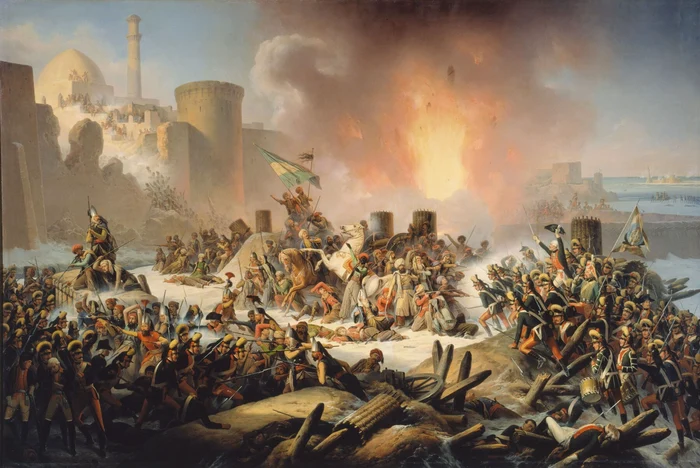
Siege of Ocheakov PHOTO wikipedia
By the 18th century, Russia had become, under Peter I and Catherine, a powerful empire and a particularly important player in European geopolitics. With the victories in the Northern War and the expansion of the borders, plus the modernization of the army and the fleet, the Russian Empire began to have greater ambitions. Having gained access to the Sea of Azov and then the Baltic, the Russians wanted to gain control of the Black Sea and turn it into a Russian lake. Moreover, the Russian tsars dreamed of conquering Constantinople and implicitly occupying the Bosphorus and Dardanelles straits, which would have allowed them access to the Black Sea. Under the pretext of protecting the Orthodox “brothers” of the Ottoman Empire, the Tsarist Empire concentrated its attacks on the Ottoman Empire, with the hope of capturing the Romanian Principalities and the Balkans. It was the dream of a huge Slavic Empire. The first and most important stage was securing access to the Black Sea and consolidating control over its northern shores. This happened after a strong Russian-Turkish war, in the period 1787-1792, completed by a peace concluded in Iași, in the capital of the Principality of Moldavia.
Russian Crimea and a tsarist dream come true
After the Russian-Turkish war of 1768-1774, ended with the peace of Kuciuk-Kainargi on July 24, 1774, the Crimean Khanate became independent from the Ottoman Empire and Russia received the Yedisan region between the Dnieper and Bug rivers. This territory also included the port of Kherson, which meant a dream come true for the tsarists, i.e. they had access to the Black Sea for the first time. In addition, the Russians also received the ports of Kerchi and Enikale in Crimea. Empress Catherine II was far from satisfied with just that and was preparing the Black Sea Fleet to acquire new territories and full control over the northern coast of the Black Sea. At the same time, the Russians were aware that the Turks would not accept the heavy losses of the Kuciuk-Kainargi treaty. The Turks had set about creating unrest in the Crimean Khanate and inciting the population against the pro-Russian Khans. Following a period of maximum agitation in which the khans changed repeatedly, with revolts and Turkish instigations, Grigori Potemkin, the empress's principal adviser, convinced Catherine II to definitively liquidate the Crimean Khanate.
The Turks had already attacked the areas surrounding the Crimea and were preparing to invade the Khanate. Potemkin was sent to the Crimea to resolve the situation. The Russian armies quickly occupied the Crimean cities and in 1783 the Crimean Khanate was dissolved, the entire territory being occupied by the Russians. The Ottoman Empire only formally agreed to this situation. The Russians achieved their goals of capturing significant territory in the northern Black Sea and opening a new naval base at Sevastopol through which they better controlled the maritime area, but these were fragile gains, still unconsolidated. “The treaty opened the Black Sea to Russian merchant and naval vessels. Until 1774, the Black Sea and the straits were for the exclusive use of Ottoman ships. Article 11 of the Treaty of Kuçuk Kainardji now allowed merchant ships of both sides the right to navigate freely in the seas that bathed the shores of both empires and granted Russian subjects privileges and advantages enjoyed by the most favored nations of Ottoman Empire. Although the provision refers explicitly to “commercial” vessels, “most favored nation” treatment granted the Russian navy the right to navigate freely in the Black Sea as far as the Bosphorus and in the Mediterranean as far as the Dardanelles.stated Viktorija Jakjimovska, in “A shift in the Russo-Ottoman balance of power in the Black Sea region: The Treaty of Kuçuk Kainardji of 1774”.
The Turks go to war again
Not reconciled to the massive territorial losses and especially to the fact that they had a serious and dangerous competitor in the Black Sea, the Ottomans were preparing for war. But above all, they created a favorable diplomatic climate and secured the support of Great Britain, France and Prussia. Only then did they issue an ultimatum to Empress Catherine II demanding that the Russians evacuate Crimea and relinquish their Black Sea territories. Obviously, the Ottomans were refused.
War followed. The Ottomans seized the Russian ambassador Iakov Bulgakov and also demanded the right to customs Russian ships passing through the Bosphorus and the Dardanelles, despite the provisions of the Kuciuk Kainargi Peace Treaty. However, the Ottoman preparations were in haste and the timing was ill-chosen, as Russia and Austria had already concluded a treaty of alliance and were preparing to face the Gate together, hoping to wrestle from the sultan's territories. Initially, the Ottomans carried back victories against the Austrians in the Banat, but stalled against the Russians. Tsarist armies achieve their first major victory at Kinburn in October 1787, thanks to Russian General Alexander Suvorov, who had repulsed another Ottoman naval attack a month earlier, preventing a Turkish invasion of the Crimea. In the Principality of Moldova, Russian troops captured the capital, Iasi. Later, on December 6, 1788, with great losses and great efforts, the Russians manage to occupy Ocheakov, at the mouth of the Dnieper. The Russians crowded the Ottomans badly in Moldova. The tsarist armies achieved some remarkable victories with few men against the numerous armies of the Turks at Focșani and Râmnicu Sărat in 1879. Suvorov was the master of these victories receiving as a reward the title of Count Rymniksky.
The Ottomans took revenge on the Austrians for these defeats by managing to inflict serious damage on them in Serbia and Transylvania. The Habsburg army only recovered under the leadership of General Ernst Gideon von Laudon, succeeding in guarding Croatia from an Ottoman invasion. However, a revolt of the Greeks put an end to the war between the Ottomans and the Austrians. Both armies were exhausted from the intense fighting in the Balkans and Transylvania. In addition, the Turks also had to quell the revolts of the Hellenes. The Russians, on the other hand, were determined to reach Istanbul, trying to fulfill Catherine the Great's dream of establishing a Christian Empire in the East. To this end, they achieved an important victory at Măcin in 1791. In addition, a year earlier, the Russians had captured, also with the help of Suvorov, the powerful Ottoman fortress of Izmail. Finally, the Turks, devastated by the war, and the Russians, fearing that Prussia will also enter the fight on the side of the Ottomans, decide to make peace.
How the Russians got to be the neighbors of the Romanians
Therefore, the Russians and the Turks met in Iași, in the capital of Moldova, completely occupied by the Russians, and signed the peace treaty on January 9, 1792. That is how it remained in history, as the Iași treaty. By means of this treaty, the Ottomans were forced to definitively recognize the annexation of the Crimean Khanate by the Russians. Edisan, with the fortresses of Odesa and Ocheakov, was ceded to Russia. Borders were also established. The Russians gave back to the Ottomans the territories occupied during the war, i.e. Bessarabia, Moldavia and Wallachia. Instead, occupying an important area of today's Ukraine, the Russian frontier advanced on the Dniester. It is the moment when the Romanians became neighbors with the Russians. This meant that Russian incursions were much easier and faster in the Russo-Turkish wars that followed in the early 20th century.
The Russian Asian border was on the Kuban River. The Russo-Austro-Turkish war ended by the peace of Iași represented a disappointment, with different intensities, for almost all sides. The Ottomans failed to recover Crimea. Moreover, they took a heavy beating and lost territories. For her part, Empress Catherine II failed to carry out her plan to divide the European possessions of the Ottoman Empire with the Austrians. This was in view of a revival of the Byzantine Empire, with the center in Russia this time. Her plan failed due to Austria's withdrawal from the war, but also the lack of substantial involvement of the Balkan Christians. That is, they did not organize the riots that the empress would have expected. Instead, the major gain for the Russians was the confirmation of tsarist dominance in the Black Sea.