The winters of recent years have been mild, with temperatures just above the limit of the period. However, things were not always like this in Romania. The last frosty winter was that of 2011-2012, when temperatures reached minus 30 degrees. The lowest temperatures, however, were recorded in 1929 and 1942. A list of the coldest winters since meteorological records are found in the article below.
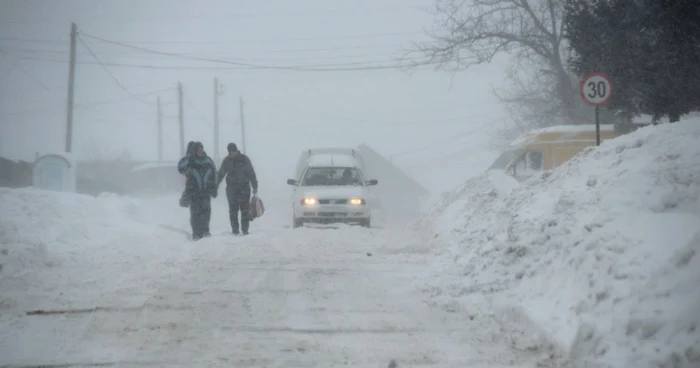
PHOTO The Truth Archive
Winter 1941–1942: absolute frost in Romania
This winter brought the lowest temperature ever recorded in Romania: – 38.5 degrees, at Bod, in Brașov county, on January 25, 1942.
In January 1942, temperatures below –30°C were recorded simultaneously in many regions:
- Bucharest: approximately –32°C
- Iasi, Brașov, Cluj: values close to -30°C or even lower
The winter of 1941-1942 is considered the coldest in Romania's history and among the coldest in all of Eastern and Central Europe. It affected the economy, transportation, and daily life: trains ground to a halt, heating sources were overtaxed, and power grids frequently failed.
The context of the Second World War amplified the dramatic effects of the frost.
Winter 1928-1929. Bitter frost and heavy snow
The winter of 1928-1929, the coldest of the inter-Berlin period, was not far off in terms of the intensity of the cold. Then, a wave of polar air swept over Romania and led to temperatures down to -38°C on the Omu peak on February 10, 1929. It was the winter when the Danube almost completely froze over, and the frost was combined with massive snowfalls and prolonged isolation of the towns.
- Bucharest: down to -30.2°C (January 24, 1929) and -29°C (February 10, 1929)
- Cluj-Napoca: around -32°C during the same period
The hard winter led to indescribable tragedies. The press of the time recorded that in Buzău, in February 1929, an entire family was found dead in the house from the cold: “Mother, father and 12 children fell prey to death due to the severe frost”.
Due to the extreme temperatures, the post office and telecommunications did not work for more than a week, and the partial elections for the Chamber and the Senate, set for February 20, were postponed to April 17.
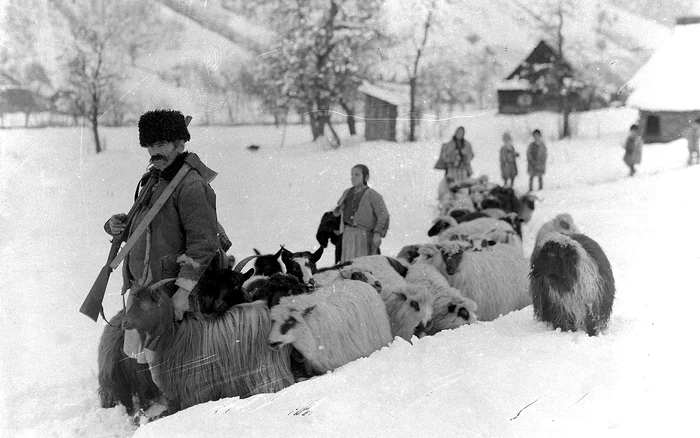
Image from the winter of 1928-1929 PHOTO Ethnographic Museum of Transylvania
Winter 1953-1954. The winter of the great blizzard
The winter of 1954 remains a legend for the amount of snow, not just for the cold. In February 1954, repeated blizzards and heavy snowfall resulted in snow layers of over 5 meters in south-eastern Romania, with winds of 126 km/h measured in Bucharest;
The frost was exacerbated by the blizzard, and trains and roads were blocked for days, testing both authorities and local communities.
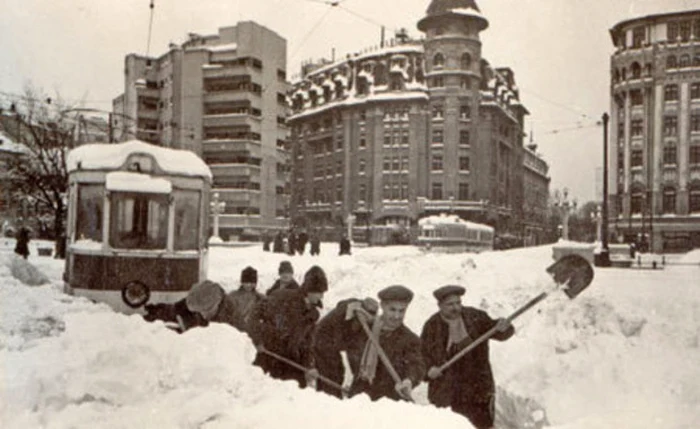
Winter of 1953-1954 PHOTO Agerpres
“In my yard, the snow had reached almost 2 meters, just like on the street, where it was practically impossible to move around. The world ran out of bread until the army intervened with tanks and cleared the boulevards of people. It was only then that people could leave their houses and go to Domenii Square, where they bought the bread that was brought by the military cars”the story for Historia Valentin Ștefănuț, who was 12 years old that winter and lived in Bucharest. The snow removal was then done including with the tanks.
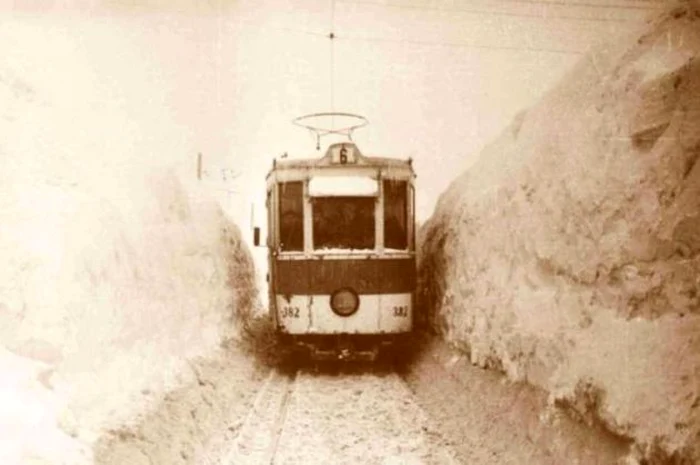
Tram in the slush, during the Great Blizzard
Winter 1962–1963. Extremely cold in the south, east and center
The winter of 1962–1963 is one of the coldest in Romania's modern history, with numerous regional records:
- Cluj-Napoca: up to -34.2°C, on January 23, 1963.
- Iasi: approximately -30.6°C, on January 20, 1963.
- Craiova: -35.5°C
It is often described by climatologists as the longest freezing winter of the 20th century, because the frost began as early as December 1962 and lasted until late March 1963.
Agriculture was severely affected, because the ground froze at great depths. In the countryside, people used to say that “the earth sounded hollow when struck with the pick.”
In other countries it was even worse. In western Europe, the winter of 1962-63 was considered the coldest in 200 years, and Britain had frozen rivers and blocked ports.
Winter 1984–1985. Severe frost and local records
In January 1985, the wave of polar air took Miercurea Ciuc: -38.4°C — one of the lowest values measured since 1942. In Bucharest and other big cities, temperatures frequently dropped below -25°C, and the heating systems were overloaded. People remember cold buildings, frozen pipes and streets buried in snow. Schools and some public institutions were temporarily closed.
Winter 2011–2012. The coldest winter of the 21st century
The winter of 2012 remains one of the coldest recent periods in Romania. Temperatures below -30°C were recorded in some areas.
- Miercurea Ciuc: down to -33°C, in January 2012
- Bucharest: nights with temperatures below -20°C, and daytime highs did not frequently exceed -10°C
- Cluj-Napoca, Iași, Brașov: values frequently between –20 and –30°C
Heavy snowfall, often combined with strong winds, created snowdrifts of up to two meters in the north and east of the country, and local roads and highways were temporarily blocked. The worst was in Buzau county, where over a hundred localities remained isolated due to the snow, without electricity, water or food.