
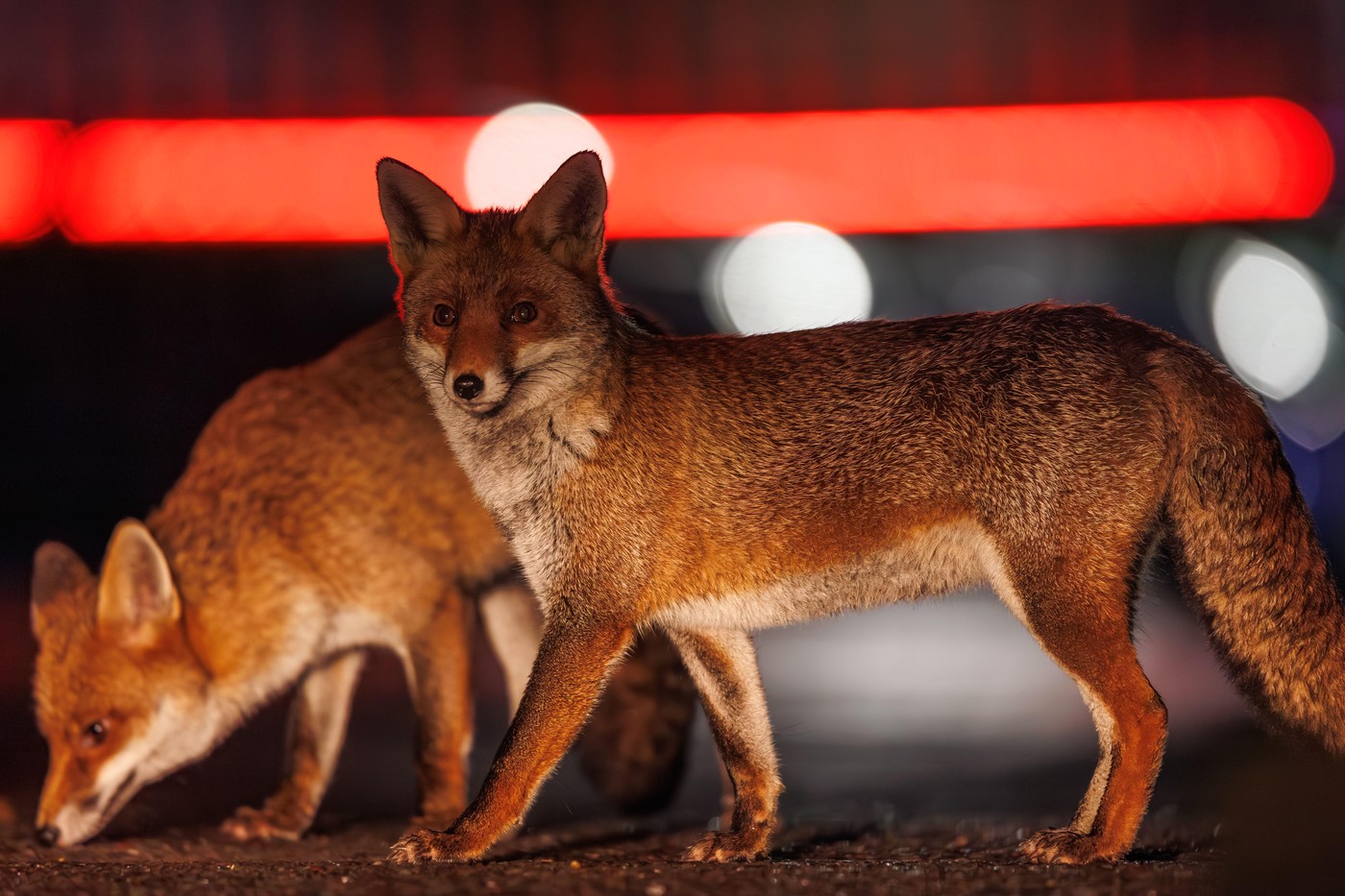
Foxes in the city – illustrative image. Photo: Alex Witt / Alamy / Profimedia
Three foxes were surprised by the surveillance cameras of the “Grigore Antipa” National Museum of Natural History, the images being published by the representatives of the museum unit, who appreciated the event as an opportunity for scientific education regarding urban biodiversity, writes News.ro.
“This morning, the surveillance cameras of the National Museum of Natural History “Grigore Antipa” caught the presence of three foxes in the outer area of the museum, located in the center of Bucharest”, the representatives of the museum announced on Saturday.
According to them, the appearance of foxes in the urban environment is not an isolated phenomenon.
In the big European cities, the fox is one of the wild species with the greatest adaptability, being attracted by the available food resources, green spaces and urban ecological corridors.
“The presence of these animals is a clear signal that wildlife is adapting to human-made environmental transformations. It is a subject of urban ecology that can be explained and understood, without looking at it with fear,” said Dr. Luis Popa, director of the Antipa Museum.
The representatives of the museum specify that during the event there was no interaction between the animals and the public, and the situation did not involve risks for visitors or staff.
The unit's specialists monitor the phenomenon and treat it as an opportunity for scientific education regarding urban biodiversity.
The Antipa Museum is one of the most important in Romania and Eastern Europe, founded on November 3, 1834, at the initiative of Great Ban Mihalache Ghica, who donated valuable collections of coins, fossils, animals and works of art.
Currently, the “Grigore Antipa” National Museum of Natural History has a scientific heritage of about 2 million specimens, grouped in zoological, geological, paleontological, but also comparative anatomy, anthropology and ethnography collections.
With an average of over 500,000 visitors annually, the museum is among the most visited cultural institutions in Romania.
The current headquarters in Şos. Kiseleff no. 1 was designed by Dr. Grigore Antipa, director between 1893 and 1944, who modernized the exhibits and introduced the first biogeographical dioramas in the world. The museum continues to inspire through research, education and the promotion of biodiversity.


