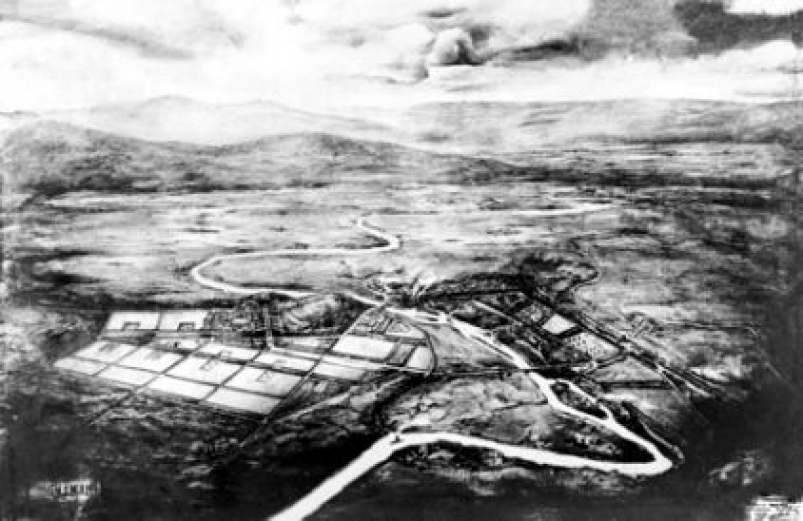
Draft Master Plan for Birobidzhan
Photo: State Archive of the Jewish Autonomous Region
January 2, 1936
The names of the city streets of Birobidzhan extensively represent the geography of our country: more than two dozen streets and alleys bear the names of rivers, lakes, regions, and many streets are named after other cities of the country and various prominent figures.

The reference and information publication “Streets of the City of Birobidzhan” (0+) contains information that by Resolution of the Presidium of the Regional Executive Committee dated January 2, 1936 No. 2, a new street parallel to Oktyabrskaya Street, from Station Square to Birsky Bridge, was named after Frenkel. Exactly a year later, this street was named after M. Gorky.

Day in the history of the Jewish Autonomous Region. Photo: Photo: Regional Library
Biographical information: Frenkel Naftaliy Aronovich is known for certain that he was born in 1883. Different sources describe different places of his birth, some researchers talk about Odessa, others about Moscow, but often Constantinople is named as the place of his birth.
In the 1930s, he proved himself to be a good organizer and a highly qualified specialist. Naftaliy Aronovich supervised the construction of the White Sea Canal and BAMLAG. And in 1940 he invented and headed a special unit of the Gulag – the Main Directorate of Railway Construction Camps (GULZhDS). He held this post for 7 years and was awarded many government awards, including three Orders of Lenin. In 1947, he retired “due to illness” with the rank of lieutenant general and lived quietly in Moscow, receiving a personal pension. He died quietly in 1960 at the age of 77. He was buried at the Vvedensky cemetery.
Representatives of large factories in the city of Leningrad (now St. Petersburg) “Krasny Putilovets”, “Bolshevik”, “Marti plant” and “Skorokhod” sent their representatives to Birobidzhan to help in the construction of “socialism in Birobidzhan”. In the magazine “Tribuna” (12+) for 1932, in issue No. 3, the article wrote that on January 2, 1932, an evening meeting took place between six delegates of the Moscow-Vladivostok courier train with representatives of public organizations in Birobidzhan.
A representative of the Birobidzhan Regional Committee, Grigoriev, welcomed the delegation and spoke about the work and achievements of collective farmers and workers of the region, and also shared information about their needs and problems.
“And they will say to Leningrad:
— Lenin’s city, Birobidzhan, needs your experience, your help, to build a socialist outpost in the Far East, near the Chinese border, to implement the resolution of the USSR Central Executive Committee on the creation in Birobidzhan of an administrative-territorial unit for Jewish workers, to build workshops as bright as ours in Leningrad. To build Leningrad in Birobidzhan.”

Day in the history of the Jewish Autonomous Region. Photo: Photo: Regional Library
January 2, 1953
The newspaper “Birobidzhan Star” (12+) January 2, 1953 is entirely devoted to the upcoming elections to the Council of Workers' Deputies of the Jewish Autonomous Region. The newspaper informs its readers about the approval of district election commissions for elections in the city and districts of the region.

Day in the history of the Jewish Autonomous Region. Photo: Photo: Regional Library
The issue contains information that “the executive committee of the regional Council of Workers decided: in accordance with Articles 30 and 31 of the “Regulations on elections to the regional, regional, district, district, city, rural and town Councils of Workers’ Deputies of the RSFSR”, to approve the composition of district election commissions from representatives of public organizations and working people’s societies, as well as meetings of workers, employees and collective farmers.”
January 2, 1906
Soviet Jewish writer Lurie Note (Natan Mikhailovich) was born on January 2 (old style) 1906 in the village of Roskoshnoye in the family of Rabbi Mendl (Mendel Vulfovich) Lurie and Lyubov Mikhailovna Lurie.

Day in the history of the Jewish Autonomous Region. Photo: Photo: Regional Library
At the age of 16, he left his family and moved to Belarus, where he worked on the Kurasovshchina agricultural farm and at the same time studied at evening general education courses. In 1925, he published his first story in the Moscow magazine “Yungvald” (16+). From 1926 to 1931 he studied at the literary department of the Second Moscow State University, and at the same time worked in the journals of the Central Committee of the Komsomol in Yiddish, in the newspaper “Der Emes” (16+) (“Truth”). Nathan Mikhailovich wrote in Yiddish.
At the age of twenty-nine, he wrote the novel “The Steppe Calling” (6+), which shows the life of a Jewish village, the problems of collectivization, the desire of peasants for something new; the play “Elsa Rudner” (6+) was based on it. After this novel, Note Lurie began to be called the “Jewish Sholokhov.”
In the 1930s lived in Birobidzhan. As a journalist for the newspaper “Birobidzhaner Stern” (16+), he traveled throughout the region and created many essays and stories about autonomy. Participant of the Great Patriotic War.
In 1950, he was arrested and sentenced to 15 years in forced labor camps on charges of “anti-Soviet activities.” In 1956 he was released and rehabilitated. After his release he returned to Odessa.
He was a member of the editorial board and author of the magazine “Soviet Gameland” (16+). Author of the books “Heaven and Earth” (6+), “The Story of a Love” (12+), etc.
Died in Odessa on November 28, 1987.
18+. Information agency EAOMedia, registration number IA No. FS 77 – 83168 dated 05/12/2022, registration authority – Federal Service for Supervision of Communications, Information Technologies and Mass Communications.