Saint Basil the Great – what does the feast of January 1 mean and what are the most famous miracles

Saint Basil the Great, celebrated on January 1, is one of the most important Fathers of the Church, a great theologian, hierarch and philanthropist from the 4th century, known for his theological writings, the organization of monastic life, the construction of the first hospitals and asylums (Vasileada), and for the defense of the true Christian faith.
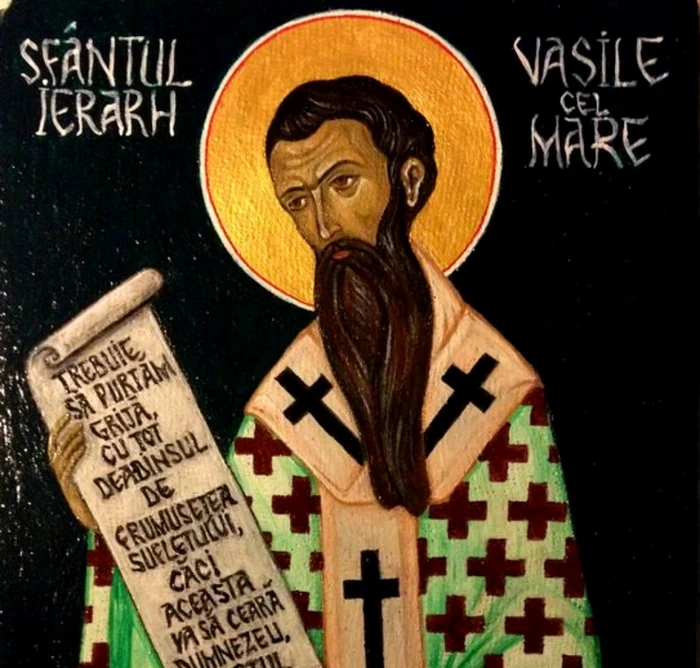
Saint Basil the Great is celebrated on January 1
His story is marked by a chosen education, an ascetic life, a high church hierarchy, but above all by an immense love for the poor, his miracles often being linked to the response to the needs of those in suffering, but also to the spiritual protection he offers, being considered a guardian of evil spirits.
Who was St. Basil the Great and what miracles did he perform?
Saint Basil the Great lived between 330 and 379, during the time of Emperor Constantine. Saint Basil was born in Caesarea Cappadocia, of faithful and wealthy parents, Emilia and Basil, his father being a teacher in the city. A lover of learning and gifted for books, Saint Basil enriched his knowledge by studying in the schools of Caesarea, Byzantium and Athens, at the latter meeting Saint Gregory of Nazianzus, with whom he formed a close friendship. He was elevated to the rank of archbishop of Caesarea in 370, during difficult times for the church. Among his writings of great theological importance, the “Liturgy of Saint Basil the Great” has a place of honor.
Saint Basil is one of the saints who performed the greatest miracles. He is the first hierarch who founded, in addition to churches, asylums and hospitals for the poor, a leprosy and an establishment for the recovery of prostitutes. He died on January 1, 379, when he had not yet turned 50 years old, entering Christian history with the name of Saint Basil the Great.
“Vasile could make bread rain from heaven here by prayer”
The settlement of Saint Basil the Great was a social institutional complex intended to supplement the state in this field. The complex was so vast that, after all, it was called “a new city”. It included at least one church and the annexes that we will mention. Also, adjacent to the hospital, it was affiliated under the careful supervision of Saint Basil, a monastery, according to Ziarul Lumina.
Saint Basil radically changed the existing charity system at that time, replacing the occasional distribution of gifts with something permanent, which would effectively and continuously help those in need. He considered this an essential duty for the bishop, and, well aware of this, he accepted it with joy and gave himself completely to him. “But if you want to serve, serve in the name of Christ. Because He said: “As you did it to one of the least of these My brothers, you did it to Me” (Mt. 25, 40). Because if you welcomed strangers, and helped the poor, and comforted those in suffering, and gave help to those in need and calamity, and served the sick, Christ receives all these as done to Himself” (Ascetic Constitutions I, 1).
This great work of help can only be understood in the conception of Saint Basil as a reformer of Eastern monasticism. For after having put the last orders in the cenobitic monastic life, Saint Basil, in order to allow the monks to do good to their fellows in a more concrete way and to make the work of charity available to them, he annexed, to his monasteries, hospitals or asylums for the sick and the poor, in which the monks fulfilled the required tasks.
The complex included, on the one hand, houses for housing lepers, on the other hand, asylums for the elderly and sick; a large building for foreign travelers; schools for children, where different trades were also taught. All these various buildings were separated by gardens, which gave the whole edifice a very harmonious appearance. Here is also a description made by St. Gregory the Theologian: “Vasily could make bread rain from heaven here by prayer…, with his word he opens the barns of the rich… saturates the poor with bread. He gathers in the same place those wounded by hunger, among them there are some who can barely breathe, men, women, children, old people… Then he imitates the Savior Jesus Christ the servant, Who, girded with a cloth over the middle, does not he disdained to wash the feet of the disciples, and, with his own servants, or, if we want, with those like him in captivity, who became in this circumstance, similar in the work, he cared for the bodies of the sick, he cared for the souls, thus bringing them comfort” (Saint Gregory of Nazianzus, Apology or speech in which he shows the reasons that prompted him to flee the priesthood and Eulogy of the Saint Basil).
In this description, St. Gregory of Nazianzus points out one of the major characteristics, which underpins the charitable program of St. Basil: the destigmatization of the sick, especially those suffering from incurable diseases. Saint Basil not only established a home for lepers, but he even tried to restore them, in the eyes of contemporary society, as human beings in need of love.
A new conception of the disease and the patient
Saint Basil was aware of the fact that he was imposing on the world a new conception of disease and the sick, a revolutionary conception compared to previous states. Indeed, in the society of that time, the sick man, who became powerless to take part in active life, was outside the interest of the community members. He was left to end up in isolation, producing only the feeling of fear of contagion.
Theodoret of Cyrus writes that the emperor Valens donated lands for the hospital, specifying that they be used for the recovery of the poor (Theodoret of Cyrus, Church History). The sick were treated in hospitals, called by Saint Basil the xenodocheia, which differed from the charitable institutions of that time in that they had employed medical personnel. The hospital, although it was not a secular institution, was served by doctors and specialized nurses. Saint Basil administratively linked the hospital to the monastery, and the monks regarded service in the hospital as one of the main monastic duties.
The prayer of Saint Basil the Great
“Holy Hierarch Vasile, please enlighten us, strengthen us and deliver us, from all enemies seen and unseen. Quick helper of the faithful, direct your mercy towards us and drive away the evil spirits from our hearts, souls, minds and lives, and from the houses in which we live!
Saint Basil, we beg you, untie with your all-powerful prayers, the ties, curses, oaths, enchantments and charms that have fallen from our ancestors on us, our families, our houses, knowingly or unknowingly, out of carelessness, malice or living in sin!
Be merciful to our children, who have strayed from God's law, help them to return, dripping the holy Light into their minds, and make them submissive and obedient to the Most Holy Church and strengthening them in faith and in the Love of God!
Give us all self-restraint, clean thought, kindness, holy peace of heart, purity of life and living according to the Redemptive Law of God's Word!
That you are great and too well-pleasing before the Holy Master and you show a lot of mercy to those who with faith fall in prayer, interceding for your help! Amen!”