The day when 400,000 Romanians demanded their rights. How the Romanian Government reacted to the first general strike in the country's history


105 years ago, between October 20 and 28, 1920, the first great general strike in Romania's history was triggered. Poverty and exploitation by employers, as well as the inefficiency of legislative acts, brought more than 400,000 Romanian workers to the streets, shaking society from its foundations.
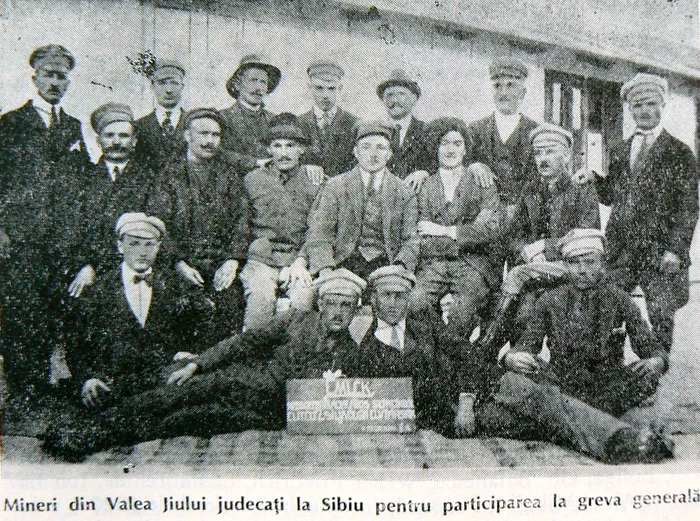
Miners from Valea Jiului present at the strike PHOTO Independentul.com
At the beginning of the 20th century, industrial production in Romania had begun to gain momentum. Obviously, not like in the highly developed states of Western Europe, but it was a promising start. There were activities in mining, metallurgy, electric car manufacturing, battery production, textile industry and many others. The workers were becoming a social category increasingly better represented especially in the big cities of the kingdom, where there was an increased industrial and production force.
Many came from the slums of the cities but also from the countryside. Most had a hard life, without a well-regulated work schedule, miserable wages and difficult working conditions. Often, when they fell ill, workers were unscrupulously replaced and fired, or were not paid for the recovery period. Things got even more complicated after Romania went through the Great War. Workers' grievances, increasingly difficult life, but also socialist propaganda led to the outbreak of the first great general strike in Romania's history. It was a movement with a great impact in society, but was brutally suppressed by the authorities.
A Romania impoverished by the war
After a period of Belle Epoque from the end of the 19th century until the First World War, in which Romania experienced substantial development, after 1919, Greater Romania was a country close to economic collapse. World War I was a calamity for our country. First of all, the national territory was half occupied and cruelly looted by the conquerors. Diseases, poverty, but also huge losses and expenses undermined the Romanian economy. At the end of the Great War, it is estimated that 60% of the Romanian industry was destroyed. In terms of infrastructure, the roads were dusty and 30% of the railway network impassable. Because of the destruction of farmland, especially in the south, harvests were compromised and agricultural production almost collapsed. Romania had ended up importing cereals, in a proportion of 48%.
War damages amounted to 72 billion gold lei. Through the Paris Peace Conference, Romania received compensation of only 3.1 billion lei. In addition, the Great Union brought new administrative and economic challenges. In 1919, the Kingdom of Romania reached an area of 295,641 square kilometers, which is almost double the pre-war period. The costs of the union were quite high, as monetary unification, a new administrative network, plus the social, educational and administrative integration of the new inhabitants of the Kingdom had to be achieved. Not to mention the fact that the number of state officials, law enforcement, but also all the education and health budgeters has increased a lot. This meant very high costs. According to a study, “Romania's Economic Evolution (1859 – 1947)”, published by the Institute of National Economy of the Academy, the leu was greatly affected by inflation after the First World War.
Abuses by employers, workers on the brink of despair
Although the country and the population were quite affected by the effects and the post-war crisis, the state's response was ineffective to the emerging social problems. The government of General Alexandru Averescu, with Constantin Argetoianu as its internal minister, tried to rule the country with an iron hand, for fear of revolts, revolutions or serious social movements, caused by post-war poverty. The biggest fear was the organization of a Bolshevik revolution like in Russia. Instead, the life of the workers was increasingly difficult. The owners of factories, factories, mines, CFR workshops and other production units, wanted to extinguish as quickly as possible the losses suffered in the war and possibly obtain a profit.
Those who suffered the most, in this process, were the workers. Many production units extended the work schedule to 12 hours, wages, already miserable, were reduced, workers were not entitled to days off or holidays. In addition, from December 20, 1909, by the Orleanu law, union movements as well as strikes were prohibited. Not to mention the fact that the prices of food and basic goods have exploded. That is, until 1921, bread became more expensive eight times, milk 10 times, pork 11 times and wine 15 times. It was a disaster and the workers were at the end of their patience.
People take to the streets
Workers' discontent and despair encouraged the emergence of left-wing political currents. Already in the 19th century, socialism began to take hold among the working class. This is how the Social Democratic Party of Workers of Romania (PSDMR) appeared on March 31, 1893, founded in Bucharest by leftist intellectuals including Vasile Morțun, Constantin Dobrogeanu Gherea, Ioan C. Frimu and Ioan Nădejde. The PSDMR intellectuals campaigned for the eight-hour work schedule, progressive tax, accessible credits for workers and peasants, universal suffrage and equality between the sexes. Socialist ideas are transmitted mainly through newspapers and magazines such as “Contemporanul” and “Lucrătorul român”.
During the First World War against the background of the Bolshevik revolution in Russia, communist ideas began to appear more and more among the workers in Romania. In fact, some of the workers imbued with this ideology began to organize themselves in the first communist cells in Romania. They campaigned for revolution and change in the social order.
On the other hand, the social democrats campaigned for workers' rights and the change of relationships in society, but in a democratic, parliamentary, not revolutionary way. On November 14, 1918, labor unions were able to resume their activity legally. The first trade union movements and strikes also followed. On October 29, 1918, the miners from Petroșani declared a general strike. This after previously, on September 1, 1918, the workers from the Printing Offices in Iași demanded an eight-hour work schedule. The most dramatic strike of 1918 took place on December 26, 1918.
Approximately 600 workers from the print shops in Bucharest, “Sfetea” and “Minerva” went on strike, demanding improved working conditions, increased wages and an 8-hour working day. Seeing that their demands are not met, they go out to a peaceful protest in the Capital heading to the Ministry of Industry and Commerce. The moment they arrived at the National Theater Square, the printers found themselves face to face with military units from the mountain hunter regiments. The soldiers, on the orders of the officers, opened fire on the demonstrators, killing dozens of people. The great intellectuals of the time, especially those with socialist convictions, condemned the Government's repressive gesture. In 1919, the workers' movements continued with strikes at the mines in Lupeni, the CFR workshops in several localities, but also with the movements of the oil workers in Valea Prahova.
The first general strike in Romania's history
The Averescu-Argetoianu government failed to defuse the tense situation. In fact, they made things worse because they did not take any measures to improve the social situation of the workers. They were not even interested in listening to them.
In this context, on October 20, a general strike broke out in Romania. First in Bucharest, but then it expanded to all the big cities, where there were production units. Workers in Iasi, Cluj, Oradea, Brașov, Timișoara, Ploiesti, Galați and Anina stopped work and went on a general strike. They were employees of the Asan mills, the Luther brewery, the Vulcan metallurgy, the CFR workshops in the localities, the cigarette factories and even the Army Arsenal. Workers grouped themselves in strike committees, unions and associations. Socialist propaganda was in full swing and was running like a charm among people who had nothing to eat and were desperate for rights.
“Last week, the representatives of the railway workers from Ardeal and Banat met in Cluj in order to understand what they should do about the impossible situation they have reached recently, after their requests to improve the material situation were rejected by the government. It was found that the railway workers live on monthly salaries of 400-500 lei, which is not even enough to procure the most necessary things things.(…) It was decided to inform the government that railway workers no longer take responsibility for the service they do, because you can't do all the work when you're hungry. And since the government will not rush to rectify the situation, the railway workers will feel forced to go on strike or to leave the railway service, looking for employment elsewhere”it appeared in the “Socialist Tribune” from September 1920.
More than 400,000 workers across the country are expected to have stopped work indefinitely until their demands are met. That is, the eight-hour work schedule, the increase of wages, the recognition and observance of rest and sick days and much more, the lifting of censorship and the freedom of labor union movements.
Instead of solving the situation, the Government made arrests and instituted censorship
Faced with such a situation, with an economy partially blocked by strikes, the Averescu Government reacted oppressively. More specifically, he mobilized reservists to work in factories where work could not be stopped and began sending the army into the streets, as in December 1918. A state of siege was declared, unions were dissolved and the press was censored.
Military units led by the officers who ordered the opening fire on the typographers in front of the National Theater in Bucharest, were sent to the workers' quarters. Moreover, even though it was a peaceful strike, there were arrests. Thousands of workers, especially leaders of strike groups, were arrested and tried for crimes against state security. Seven leaders of the strikers were sentenced to 5 years of hard labor.