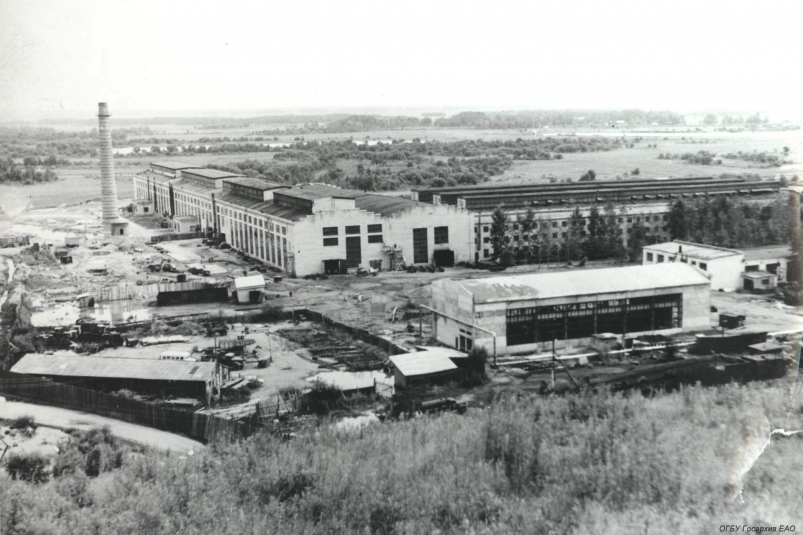
General view of the Dalselmash plant. September 1972
Photo: State Archive of the Jewish Autonomous Region
January 1, 1935
A mining and metallurgical technical school was opened in Birobidzhan. A two-story wooden barrack was built for him on Genakh Kazakevich Street (now Sovetskaya Street). Mikhail Leibovich Polgon, a native of Poland, became the director of the technical school. The mining and metallurgical technical school was popular among young people; school graduates from neighboring regions and territories went to study to become miners. And in the Jewish Autonomous Region they hoped to begin developing iron ore deposits in the near future and build a metallurgical plant. In 1939, the technical school was transformed into a railway school. After the war, it was reduced to a driver's school, and then the school no longer existed.
January 1, 1938
The Birobidzhan convoy-building plant came into operation. The first stage of the state-owned wagon plant No. 11 was put into operation at half its production capacity at the beginning of 1938. By 1937, many enterprises had already been built in the city, including large ones at that time.
In D. Weisserman’s book “How It Was” (12+), the author says that the Dalselmash production association was of great importance in the city’s economy. The history of this large enterprise began like this: in 1935, on the site of the taiga and impenetrable swamps, the construction of workshops for a convoy plant began, which was carried out in very difficult conditions. Tractors and cars got stuck in the swamp, water filled pits and washed away supports. Simultaneously with the construction of the workshops, equipment was being installed and residential buildings were being built for the plant’s employees. Young builders came from all over the country to build a plant in Birobidzhan. The young enterprise was supplied with the latest equipment at that time.
According to materials from the State Archive of the Jewish Autonomous Region, the construction of the plant was not carried out during the Great Patriotic War. And in 1956, the plant was transformed into a plant of auto-tractor trailers; the reconstruction of the enterprise was carried out only in terms of replacing outdated equipment with new ones.
Initially, the plant did not have a specific address, occupying part of the territory of the Obozny Zavod village (in 1965, renamed the village named after I.R. Bumagin).
In 1960, the plant was transformed into Dalselkhozmash, which specialized in the production of combine harvesters.
January 1, 1941
Resolution of the Economic Council under the Council of People's Commissars of the USSR dated January 24, 1941 No. 105-41 approved the act of the Government Commission on the acceptance of the Birobidzhan-Leninskoye railway line. This section of the railway has been included in the operating railways of the USSR since January 1, 1941.
In the article by railway veteran S. Pronko “Lenin branch DVJ-50”, published in the newspaper “Amurskaya Niva” (12+) for 1991, it is reported:
“Construction began in 1936 along the previously laid Birobidzhan – Nizhne-Leninskoye highway. The distance is 128 kilometers. The construction was mainly done by prisoners. The working conditions were extremely difficult, because the road went through swampy, impassable places, through large rivers and small streams, through high and low hills. Throughout the entire route, 35 barracks were built every 5-6 kilometers. for track crews, and across the rivers – 10 metal bridge structures, several dozen reinforced concrete bridges and pipes for draining water from the earthen embankment.
In 1940, courses for track foreman were created at the railway technical school, where 20 people were trained…”.
Currently, in connection with the construction of a railway bridge across the river. Since 2018, work on the reconstruction and modernization of this branch has been carried out on the Amur section of Nizhneleninskoye – Tongjiang.
January 1, 1973

Day in the history of the Jewish Autonomous Region. Photo: Photo: Regional Library
The newspaper “Birobidzhan Star” (16+) on January 1, 1973 informed its readers that the Birobidzhanstroy trust commissioned 25,527 square meters of housing in 1972, which amounted to 108% of the plan.
Information has been posted that the team of the Birobidzhan Power Transformers Plant has developed and manufactured a prototype of the Bira electric heater. The new product is designed for heating tap water. “…the first batch of Birobidzhan electric heaters is planned to be manufactured and sent to trading organizations at the beginning of 1973.”
In the “New in the New Year” section, the newspaper writes that on New Year’s Eve, climbers completed the construction of the tallest television tower in the Far East in Birobidzhan.

Panorama of the city of Birobidzhan. View of the hill. 1970s. Photo: Photo: State Archive of the Jewish Autonomous Region
“…its height, based on the level of city streets and squares, is 336 meters. This is 36 meters higher than the Eiffel. At the beginning of 1973, specialists from the construction and installation department No. 166 of the Radiostroy trust will complete the installation and configuration of antenna-feeder systems, and then the new relay complex will go into operation.”
The newspaper further reported that in the new 1973 on the northern railway line of the Far Eastern Railway (Izvestkovaya – Kuldur section) a new station will come into operation“with the commissioning of the station, the throughput of the section will increase.”
18+. Information agency EAOMedia, registration number IA No. FS 77 – 83168 dated 05/12/2022, registration authority – Federal Service for Supervision of Communications, Information Technologies and Mass Communications.