Tudor Chirilă, Loredana and 300 other artists challenge the Government ordinance that shakes the music industry

More than 300 artists, authors and professionals from the music industry, including Tudor Chirilă, Irina Rimes, Loredana Groza, Adrian Despot and Damian Drăghici, signed a letter of protest against a draft Emergency Ordinance that would amend the Copyright Law.
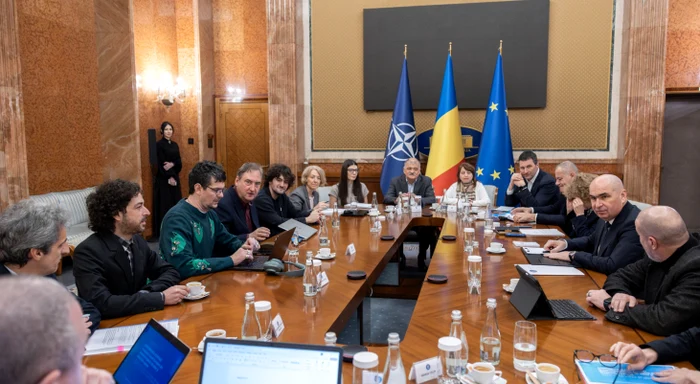
Prime Minister Bolojan met with artists' representatives in December PHOTO: Gov.ro
Several well-known Romanian artists, including Tudor Chirilă, Irina Rimes, Adrian Despot, Dan Bittman, Marius Moga, Damian Drăghici or Loredana Groza signed a letter of protest against the promotion of an emergency ordinance that would amend the Copyright Law (Law no. 8/1996).
The document warns that the proposed changes would affect the collection and payment of rights for music broadcast in public spaces such as restaurants, bars, hotels, malls or means of transport.
The authors of the letter claim that the draft GEO “It is desired to change the way of collecting the rights of the owners of the environment – by eliminating the extensive collective management – also in such a way that they no longer fully benefit from the rights that are due to them”. They show that the measure would eliminate extended collective management, the mechanism through which collective management bodies centralize the proceeds and distribute them including to holders who are not members of these bodies.
The artists argue that, in practice, giving up extensive collective management would turn the payment of rights into a process “ineffective and easy to evade“: “Payment of rights becomes optional in practice”, warns the artists in the letter. They explain that in a scenario without extensive collective management, a user could declare direct contracts with one or two authors and still distribute any repertoire, without actual verification of uses by collective management bodies.
The signatories also point out that, under these conditions, “Authors (…) cannot be transformed into hunters of the uses of their own music” etcand that, on the other hand, the proposal to create a “single collector”,
fed from the amounts that should reach the artists, would generate additional costs and risks for the holders. “The law must protect the rights holders, not create the framework to avoid or reduce the payment of their rights”, the document states, and the signatories also conclude that “no European directive proposes to diminish the rights due to artists”.
The letter requests the maintenance and regulation of the extended collective management for ambient music and, if a single collector is still decided, the request that it be designated from among the already existing bodies, not constituted as a new entity financed from the sums intended for the artists.
The Ministry of Culture justified the changes by the need to transpose a European directive and, according to previous statements by Minister Andras Demeter, the aim would be to grant “more freedom to rights holders”. The minister stated: “Each author can manage their own compositions in several ways,” listing direct management, management through collective bodies or mixed solutions.
What is management or extended collective licensing
Users, i.e. restaurants, bars, hotels, malls, transporters and other ambient music venues, need licenses to use audio-video recordings. Because they could not make individual contracts with each artist they broadcast (practically impossible) they conclude a collective contract with the OGC (the collective management organization of copyrights such as UCMR-ADA in Romania) and a single license that also covers the rights of artists who are not members of the organization and who can decide by law (law 8/96) to renounce and collect their rights themselves. This extended license also covers international artists whose collective management societies have entered into partnerships with those who collect on their behalf in Romania.
Where can its repeal lead?
Repealing extended collective management and replacing it with a mechanism based on the obligation of users to declare direct contracts with rights holders creates an inefficient and easily circumvented system, where the payment of rights becomes optional in practice. Although the law introduces a formal presumption of application of the extended license in the absence of declarations, the mechanism is based solely on the good faith of the user and provides no real means of control over the music actually broadcast. A user can enter into one or two minimal individual contracts, declare them to avoid the application of the extended collective license, and then distribute any other repertoire, without the collective management organizations having any technical or legal means of verification.
What is the unique collector
Currently, rights holders are collected from the environment separately for authors, performers and producers. To simplify the relationship with users, it is proposed to be a single collector to collect on behalf of all. The Ministry of Culture proposes the establishment of a new joint collection body, to be financed including from sums due to the owners, which we do not agree with.
What the artists propose
“Our proposal is that this single collector be one of the existing management bodies, appointed by them, and that its financing be made exclusively from the administrative commission, which, cumulated with the commission retained by the collective management bodies, cannot be higher than 15% of the amounts distributed to each rights holder, as currently provided in Law 8/1996. It is not justified and is harmful for the rights holders to create a new entity, as the said joint collection body, which would involve new financial resources, human, technical and logistical, so new costs much higher for rights holders”the letter states.
On December 15, Ilie Bolojan and the representatives of the associations that promote the rights of artists in Romania had consultations on the topic of amending the legislation in the field of copyright and related rights, in the sense of harmonizing the national legal framework with the European one, as well as to simplify and improve the currently implemented mechanism, but it seems that the discussions did not lead to any conclusion.