Zero tables, full warehouses. This is how Putin plays sanctions. But this game has its price. We reveal shocking data

Russia has repeatedly concealed important information – but now it has taken it to a whole new level.
Everything indicates that the authorities in Moscow are trying to cover up the traces of “gray” imports in order to avoid further sanctions against suppliers of strategic products – especially those used by the Russian military-industrial complex.
This is the biggest purge in Russian statistics in years. We reveal the results of The Insider's investigation.
Russian authorities have previously managed to hide data of significant public importance:
- Unified State Register of Legal Entities in Russia EGRUL — limited access to information about owners of enterprises deemed “strategically important”;
- The institution maintaining the register of land, buildings and apartments, Rosreistr – blocked access to the real estate register of corrupt officials;
- Russian State Library – prevented access to controversial, potentially plagiarized diploma theses of prominent politicians.
The new restriction from 2025 means the first time a state deletes data, that directly undermine the credibility of official statistics.
This phenomenon can be observed particularly clearly in the case of companies that previously specialized in narrow product groups, for example microchips. Instead of showing high turnover in another category (e.g. declaring microchips as “matches” or “nails”), these companies simply disappeared from customs radars.
Meanwhile, the database of the Federal Tax Service does not indicate that these enterprises are liquidating, limiting their activities or significantly reducing their turnover.
2024: sanctioned imports on a massive scale
In 2024, Russia imported goods subject to sanctions with a total value of approximately USD 22 billion. [ok. 79 mld zł] — in sectors such as machinery, electronics and metallurgy.
And there is no indication that this stream will dry up at the beginning of 2025.
These products are used for both civilian and military applications, and the border between one and the other can be very fluid in practice. Even if they are formally classified as civilian goods and reach the commercial market, in the realities of the Russian war economy they are often quickly absorbed by the arms sector. As a result, goods that on paper have nothing to do with the military in fact supply the Russian defense complex and its technological base.
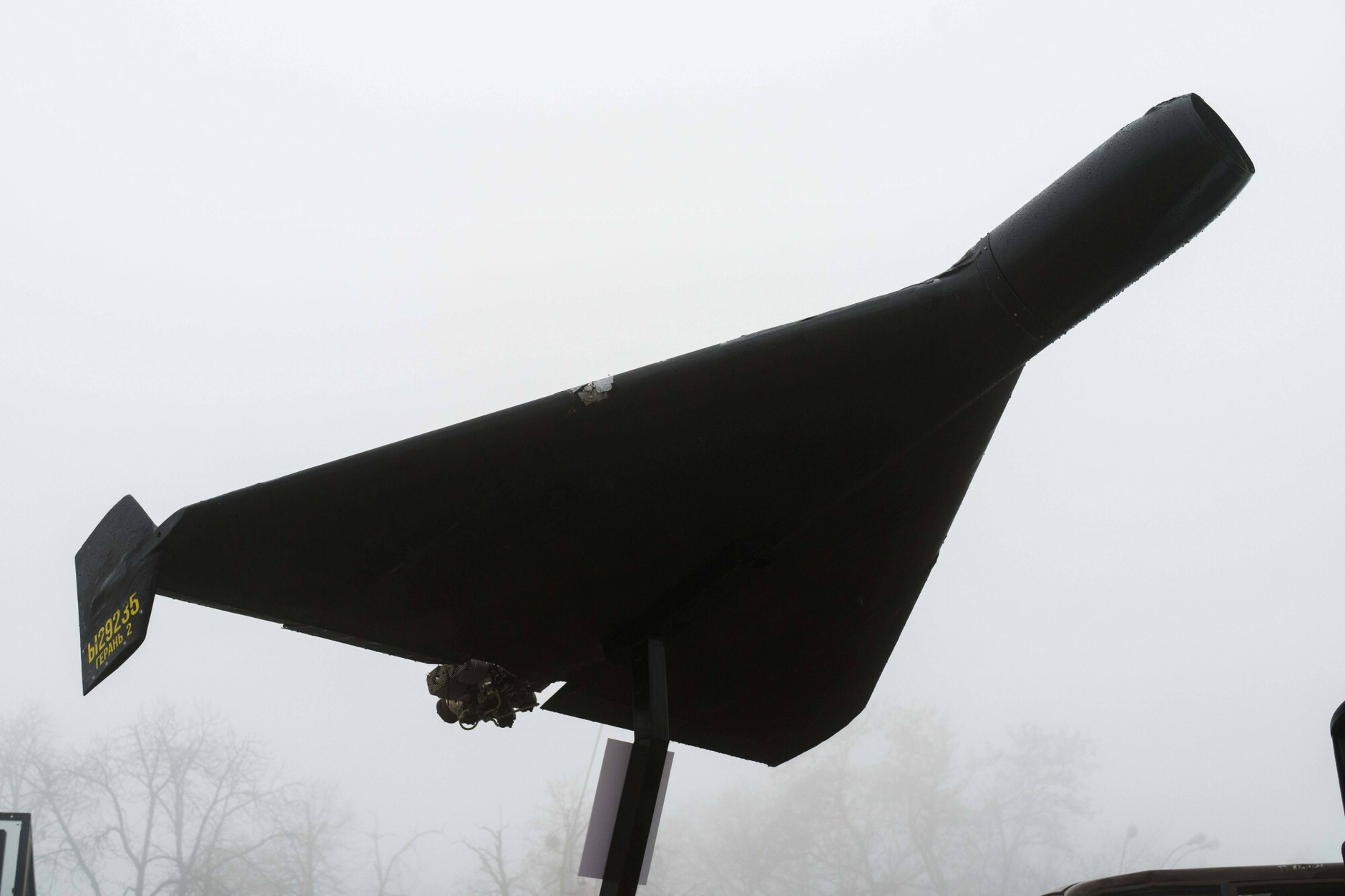
Shahid-class drone, Russian Geran-2, Kiev, Ukraine, November 23, 2025.Andreas Stroh/Imago Stock and People/East News / East News
Lithium-ion batteries are a good example. Although commonly associated with consumer electronics or energy storage, in times of war they have become an element of key military importance. They are what power drones used on the battlefield, making a seemingly civilian product one of the foundations of modern military operations.
Complex devices imported from abroad, such as machining centers or lathes, also go primarily to military-industrial plants.
2025: import data purge
This year, Russian import it no longer shows many previously dominant products in the statistics – even:
- computer hardware units,
- routers and integrated circuits,
- video cameras and electronic components,
- frequency generators, radars and navigation devices,
- electric motors,
- machines for the production of integrated circuits,
- and many other electronic goods.
Even drills, industrial furnaces and many types of specialized equipment disappeared – about 180 items in total. On paper, all of these customs statistics tariff codes are now zero, even though they are still under EU or US sanctions.
Despite this, only in the first three months of 2025, Russia imported sanctioned goods worth approximately USD 5 billion and 600 million. [ponad 20 mld zł].
Manipulation in the customs register
Monthly customs reports suggest that tariff codes stopped appearing in the “mirror database” used to compare and verify official customs data at the end of 2024.
Three key features can be identified:
- 1
changes occurred simultaneously;
- 2
companies – especially those focused on a single product – are still actively operating;
- 3
transactions involving these codes in 2025 are recorded as zero.
This all together points to conscious, extensive manipulation of data in Russia's customs register.
Most likely, when codes for sanctioned goods are entered in customs documents, this information is not recorded on central customs servers. Meanwhile, goods described with other codes still appear normally in the database.
Hiding data comes at a cost
While hiding data may help authorities in Moscow reduce the risk of further sanctions in the short term, this strategy has serious side consequences.
First of all, it undermines the possibility of a reliable analysis of the condition of Russian industry and makes it difficult to sensibly forecast its further development. When key information disappears from statistics, decisions about investment, production and economic policy must be made based on incomplete or distorted data.
In practice, this means managing the economy “in the dark”, which over time may bring more harm than benefits, even from the point of view of the state itself.
As a result, such “anti-sanctions” policies will have to be faced by:
- Russian scientific institutions conducting economic research,
- ministries and other offices responsible for planning and analysis,
- as well as the Federal Service of State Statistics itself, which may again be accused of data falsification.