The “good cop and bad cop” method applied by Trump in Iran. A Stanford expert explains the American strategy and its success

America is about to achieve its goals in Iran, believes Victor Davis Hanson, a well-known analyst and professor at the famous American university Stanford. Hanson explains that while Trump uses aggressive “crazy” rhetoric, JD Vance embraces his role as a “rational” diplomat to force furloughs on the Iranians.
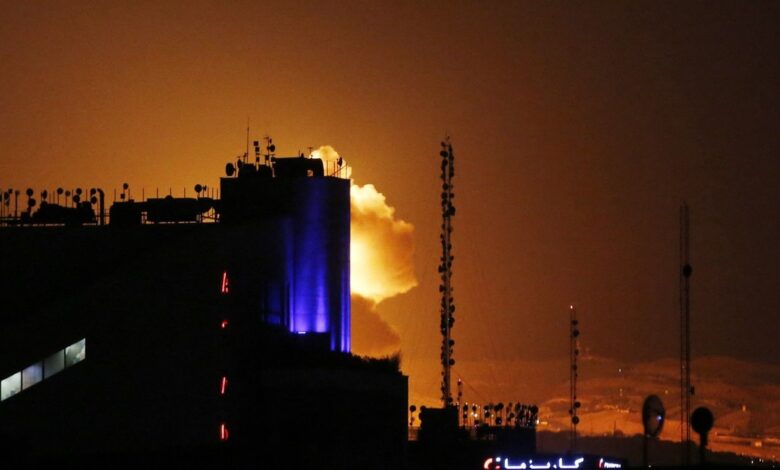
Explosions consume Tehran. PHOTO: Profimedia
Victor Davis Hanson, a leading figure among self-proclaimed conservative analysts, is convinced that the US action in Iran has so far been a great success. In a special podcast produced by GB News, the UK equivalent of Fox News, Hanson lists Trump's achievements.
If some political and military analysts believe that the Americans were wrong to launch this offensive, he talks about how Trump was able to “neutralize” the Iranian threat with a 5-week air campaign without using ground troops. It's about minimal costs, Hanson also says, and underlines the asymmetry of this conflict: the US would have lost only 13 soldiers, while Iran's military and command infrastructure was almost completely destroyed.
Now the US would be close to restoring order: Hanson says that before this intervention, Iran was close to producing 11 nuclear bombs and controlled the sea routes (Red Sea), but now it is “a shadow of what it was”.
From endless war to decapitation blows
His statements mark a real paradigm shift in conservative discourse: the shift from so-called “endless wars” (nation-building) to “punitive strikes”. Likewise, Victor Davis Hanson remains an advocate for a strong America that no longer feels compelled to play by the rules of traditional diplomacy if they harm its national interests.
Furthermore, Hanson sees the world through a harsh, historical lens, and in his view, surgical violence is sometimes the only way to prevent a larger world war. Last but not least, if Trump's rivals on the political left, mainly socialists, consider Trump a dictator, Hanson sees him as a corrective to a global system that has become too soft and dependent on American money, but refuses to provide its own defense.
The central argument of the expert is that the US has not repeated the mistakes of Iraq or Afghanistan. In his opinion, the infrastructure of the Revolutionary Guards was destroyed in 5 weeks, which crippled Iran's ability to finance groups like Hezbollah or Hamas.
A terrible blow to China
“Well, China buys 80% of Iran's oil, and they've broken all the sanctions. They're doing it illegally, but they're doing it. And now they're in trouble because Venezuela's supply has been cut off. Venezuela has the third-largest oil reserve in the world, and they could probably pump 5 million barrels. The Chinese thought that was a concession, but they lost. They probably lost control of the Panama Canal, and they're not getting out of here very well, as I said. So they were putting pressure on for Iran to open the strait so they can go in and get oil. That's what they want. And the United States, I think, is in a position of strength because if they cheat, if they send missiles, the U.S. can just say, “You know what? We're going to shut down all your electricity in one day and see how you like it. And then you spend the next $500 billion fixing it, instead of buy weapons”. Or take their oil out. The US has all the assets. The reason they open the straits is because they have no alternative,” Hanson claims.
He compared Trump's policy to that of Democrat Joe Biden and spoke of the failure of previous diplomacy and the success of the “Trumpist” one. In his view, the appeasement policy of the Democrats allowed Iran to come within a step of a nuclear weapon and block the Red Sea through the Houthi rebels.
This runs counter to Trump's trademark firm actions, he claims. Peace will be achieved not through treaties, but through the show of brute force that has convinced the regime in Tehran that their survival is at stake.
“Apparently, after the fact, we realized that they had missiles that were reaching Europe, they had closed the Red Sea through intermediaries, they had caused October 7th, and they can't do that again, at least for the foreseeable future. And if I think they're going to try, I or any future president can stop them at minimal cost. That cost about $50-$60 billion. That's about a quarter of what was stolen in California under the Newsom regime in welfare fraud. And we lost, tragically, 13 soldiers in one day, coming out of Afghanistan. So if everyone keeps calm and looks at the real data and who wins and who loses, I think in two months nobody will be talking about it.”he states.
“You can get results without the permission of France and Germany”
Moreover, the expert also says, the claims that the US lost the war in Iran would be “manufactured” by the left and Trump's enemies and imported to Europe and everywhere.
“And I think the left … they've said it over and over again, that we've lost the war and we're headed for a depression and the economy is going to collapse. That's not going to happen. It's just not going to happen. The economy will recover in three or four weeks (…) And that can happen again very easily. And when it does, Trump will be the person who 'puts the bell on the cat.' All the mice said they must be warned when the cat comes, but none was willing to ring the bell”Hanson expressed.
The advice that his Romanian adviser from the first term would give to Trump. “This is really unfair for Romania”
Europe, on the other hand, is out of a different movie, says the Stanford analyst. The US no longer needs the permission of France and Germany to impose its own policy: “Trump has shown that you can get results without the permission of France or Germany. Let's face it: Europe needs the American security umbrella much more than we need their air bases for a 5-week mission. The fact that China intervened only shows that they were desperate not to lose the flow of oil. It's not diplomacy for the sake of peace, it's economic panic.”
The good cop and the bad cop
Victor Davis Hanson also addressed Donald Trump's language and controversial statements. The Trump administration would play cat-and-mouse with the Iranians and thus pressure Tehran to give in. Trump would be the “bad cop” and Vice President JD Vance and US foreign policy chief Marco Rubio would be the “good cops.” Hanson explains why Trump uses words like “total destruction.” It is not necessarily an intention, but a method to make opponents believe that the president is unpredictable and capable of anything.
“It's very similar to the Yam Kipper War in 1973, when Richard Nixon sent Kissinger to negotiate and told him as he had during the bombings in Vietnam in 1973. It was, 'I'm the crazy one and you're the good cop.' So I'm going to say all kinds of things like “I'm going to bomb Vietnam for Christmas.” I will let the Third Army, the Egyptian Third Army perish in the desert. Then you go and tell them I'm crazy and they better be careful. So it's good cop, bad cop. In this case, JD Vance was assigned or assumed the role of emergency diplomat. And that's obviously because he wants the megabase to see that there are people in his administration who quietly, quietly, implicitly, don't want things to go on. So Vance goes to tell the Iranian negotiators, whoever they are, or the allies, that Trump is a bit off“, is the expert's comparison.
Incidentally, the role of JD Vance and Marco Rubio is extremely important. They are presented as the “rational” elements emerging immediately after Trump's threats to offer Iran a negotiated way out, but from a position of absolute strength.
The result would be, says Hanson, us seeing “the end of the era of Iranian blackmail” in the Middle East.
Criticism of NATO allies and European “passivity”.
Hanson also raises a major issue of global strategy and touches on the subject of the transatlantic rift. Visibly irritated by the fact that countries such as Spain, Italy and France have banned US planes from flying over their territory en route to Iran, the Stanford professor refers to the asymmetry of the Alliance, which, he argues, has become a “one-way street”. He recalls that the US has always helped Europe (in the Balkans, Libya or Ukraine), but that when the US needed support to eliminate a terrorist threat (Iran), the Europeans withdrew, citing “international legality”.
“The international order you speak of is, in many ways, a fiction that subsidizes European passivity. When Spain or Italy deny access to airspace for a mission targeting a regime sponsoring global terrorism, they are not defending 'order', they are protecting their own short-term commercial interests with Iran.” Trump understood that this order has turned into a mechanism by which allies can block necessary US actions while relying on us for protection against Russia or China. It's an unsustainable model,” it's the expert's opinion.
He believes that Trump is not only not the “aggressive isolationist” painted in the darkest colors by socialist Europe, but is precisely the one who makes up for the obvious weaknesses of the Europeans.
What does Romania lack to go in the right direction? A political scientist from the USA puts his finger on the wound: “In Turkey, in 2004-2005, highways were science fiction for Romania”
“Isolationism” vs. strategic unilateralism
“It's not isolationism, it's strategic unilateralism. The difference is crucial. An isolationist would have withdrawn completely and let Iran dominate the region. Trump intervened massively, but he did so by his own rules. He sent a clear message: 'We will work with you if you are real partners, but we will not let you handcuff us while our enemies sharpen their knives.' This clarity, though brutal, is far more honest than the facade diplomacy of recent decadesi”, he concludes.
Thus, Hanson goes on the idea that Trump may consider NATO useless and move to bilateral relations only with countries that actually contribute, giving the examples of Portugal or Poland.
Great Britain did not escape his criticism either. He compares this country to an NGO run from London. “There is great disappointment, albeit a polite one. Washington looks at London and sees a military that has shrunk to the point where it is almost symbolic. When the US asked for logistical support or at least a joint statement of support, London hesitated, worried about the 'backlash of the international community.' Trump values loyalty above all else. If Britain wants to remain the 'special partner', it must start behaving like a military power, not a London-based NGO.”
In other news, the American says that the conservative agenda is moving forward and argues that, despite the war, Trump has managed to “systematically dismantle” the ideology of DEI (Diversity, Equity, Inclusion) in universities and secure the southern border to a level of close to zero illegal crossings.
Last but not least, military success against Iran will validate the entire conservative movement, proving that “the world fears America again,” is Victor Davis Hanson's core idea.