Alarm on the energy market. Russian oil still on the West's drip. “This is complicity in war crimes.” We disclose data


The introduction of sanctions against Russia is undermined by the speed and ingenuity of those who try to circumvent them. Many companies are finding alternative ways to do business with Moscow.
When the United States introduced new sanctions targeting the Russian oil sector in early 2025, banning US citizens from providing drilling services to Russian entities, it was expected that the energy giant SLB [wcześniej Schlumberger]will finally withdraw from the market – just as he announced three years earlier.
However, documents obtained by a Dallas analyst firm reveal that the company — formerly known as Schlumberger — continued to transfer its advanced drilling technology to Russian producers until February 2025.i.e. a few weeks after the new restrictions come into force.
As Oleh Savitsky, strategic advisor at the Ukrainian energy organization Razom We Stand, said:
By continuing to provide technical, logistical services and equipment to Russia's oil operations, Western companies like SLB help sustain oil production that directly funds Russia's war of aggression against Ukraine.
– This undermines the sense of the US sanctions regime and is contrary to US interests – he added.
The disclosed materials include engineering drawings of specialized mining equipment, confidentiality agreements and production contracts between SLB's Russian subsidiary and local manufacturers.
These materials, dated February 2025, detail the transfer of rotor and stator designs to electric submersible pumps – key components that keep oil production running smoothly from deep wells.
Schlumberger Limited (now SLB) logo and models of an oil rig and oil barrels, Kiev, Ukraine, August 19, 2021.NurPhoto / NurPhoto via AFP / AFP
Ukraine went a step further than Western governments by including SLB on the list of international sponsors of the war. Already in 2023, the National Agency for the Prevention of Corruption determined that “the American company SLB plays a key role for the aggressor state, controlling about 8 percent of the Russian oil services market.
The agency also pointed out that SLB itself admitted that it contributed over $4 billion to the Russian economy. [ok. 16 mld zł] in taxes and employs 11,000 500 people in factories and service centers throughout the country.
Profitable business in Russia
In 2024, SLB generated approximately USD 1 billion 400 million from Russia. [ok. 5 mld zł] revenue, which amounted to approximately 4%. global company sales – for corporations with assets of almost USD 50 billion. [ok. 179 mld zł] this may be relatively small, but it means that the Russian energy sector – the main source of financing for the war – still has access to advanced Western technology.
Sawicki warned that this was not about minor failures in compliance with sanctions, but about lasting support.
At some point, such actions cease to be mere evasion of sanctions and begin to bear the hallmarks of complicity in war crimes – which can result in serious legal consequences.
– noted the expert.
Professor Oleksiy Plastun from Sumy University said in an interview for Kyiv Post that for companies there is always a balance between risk and profit.
— When profits prevail, companies are often willing to suffer reputational damage and external pressure. But if that pressure becomes strong and persistent enough, the balance could shift — and then companies could change their decision to stay in Russia, he said.
Political pressure versus real action
The world's largest oil industry services company has repeatedly attracted the attention of US lawmakers. In 2023, Senator Bob Menendez demanded clarification on SLB's continued investments in Russia, and in 2024, over 50 members of the House of Representatives called for tougher sanctions against the Russian oil sector.
Despite repeated assurances that the company is “gradually limiting” its activities in Russia, SLB – according to an August 2024 report by the investigative organization Global Witness – has strengthened its presence in the country. The report indicated that in December 2023, SLB's Russian subsidiary signed a new contract with the state-owned petroleum research institute VNIGNI to support geological modeling of future fossil fuel extraction.
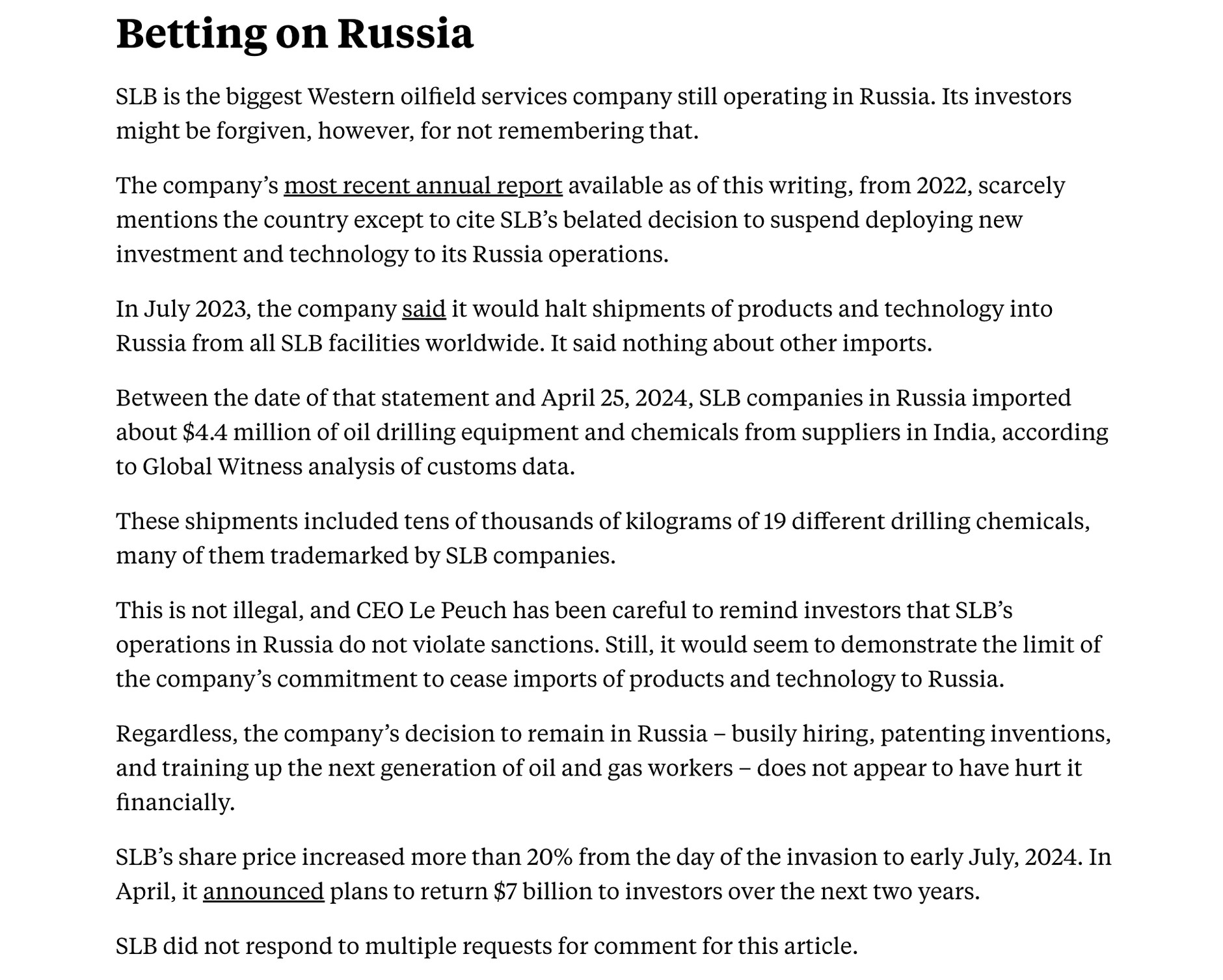
A screenshot from an August 2024 report by the investigative organization Global Witness examining SLB's involvement in the Russian oil sector.Global Witness / Own work / Global Witness
The company is aggressively recruiting young engineers from Russia, doubling its activity at university job fairs between 2023 and 2024 and advertising more than 100 job offers in Russia – which analysts say indicates that SLB is preparing for a long-term presence in the country, not withdrawal.
Plastun also noted that SLB “simply exploited the gap left by the withdrawal of Western competitors such as Halliburton and Baker Hughes,” taking advantage of a regulatory environment in which many prefer not to see companies circumventing sanctions.
Sanctions enforcement gap
SLB operates through a complex corporate structure spanning multiple continents, and its Russian division is formally subordinated to its European subsidiaries. This foreign structure makes it difficult to directly enforce U.S. sanctionseven though the January 2025 sanctions expressly prohibit U.S. citizens from providing drilling services to Russia “directly or indirectly.”
In January, SLB CEO Olivier Le Peuch said the company was “analyzing new sanctions” and argued that voluntary steps such as halting shipments of products and technology from global facilities to Russia were “in line with the new restrictions.”
Despite the new rules, enforcement has become noticeably looser. As Treston Wheat, head of geopolitics at consulting firm Insight Forward, noted, intense scrutiny of SLB activities is unlikely under the Trump administration, mainly due to changes in law enforcement priorities, corporate lobbying and greater tolerance for ambiguity in sanctions compliance.
According to him White House lowered the profile of aggressive prosecution of sanctions violationslimiting structures such as the special Task Force KleptoCapture at the Department of Justice and focusing instead on broader strategic and economic goals. This institutional weakness reduces the ability to conduct detailed investigations in gray zones such as SLB operations in Russia.
Sawicki added that “any gap in sanctions enforcement makes it easier for Russia to repair damaged infrastructure and maintain the flow of oil.”
Without Western technological and maintenance support, many of Russia's oil facilities would quickly wear out – a process accelerated by continued Ukrainian drone attacks. However, the force of these strikes is most effective when combined with tough Western sanctions, so that when Ukraine damages its infrastructure, it is not Western companies that help restore it.