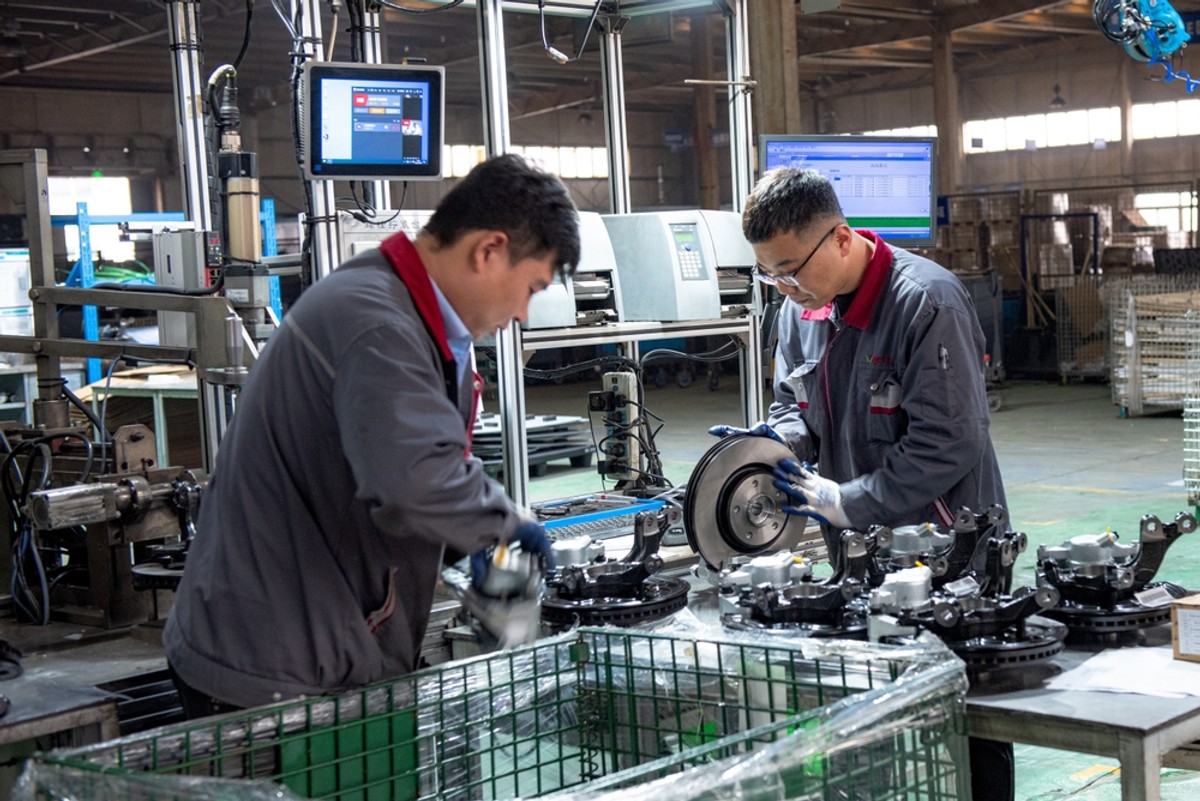
“Profits at Chinese industrial companies fell at the fastest rate in more than a year in November” – reports Reuters. The agency indicates that weak domestic demand has offset the resilience of exports, another sign of a stalling recovery in the world's second-largest economy.
The rest of the article is below the video
Chinese economy. What about industry?
Reuters reports calculations by the National Bureau of Statistics (NBS) published on Saturday, which show that profits of Chinese companies fell by 13.1% in November. year to yearaccelerating compared to a decline of 5.5%. in October. The sharper decline came despite better-than-expected goods exports and against a backdrop of persistent factory deflation, keeping pressure on authorities in Beijing to take action to address chronically low household consumption.
Xu Tianchen, senior economist at the Economist Intelligence Unit, said the earnings data were consistent with an overall slowdown in economic activity in the fourth quarter, mainly driven by weakening weak domestic demand.
Xu said it remains cautiously optimistic about the prospects for industrial profits.
See also: European Union under pressure from China. The tariff war is gaining momentum
In the first 11 months of 2025, industrial profits increased by 0.1%. compared to the previous year, which means a regression compared to 1.9 percent. growth in the period January–October.
Reuters notes that the growth dynamics Chinese economy worth approximately $19 trillion. weakened towards the end of the year, although the authorities have not yet introduced a new support policy.
The Chinese authorities still believe that the official economic growth target of around 5%. for 2025 is still achievable, and a ceasefire in the US-China trade war has also helped ease tensions.
Chinese economy. How is he doing?
The Chinese economy grew only 2.5%. up to 3 percent in 2025 – estimates the think tank Rhodium Group, quoted by Reuters. This is about half as much as official data suggests. The reason was the collapsing level of investment in fixed assets in the second half of the year.
See also: They don't care about US sanctions. China imports it from Russia massively
At a meeting earlier this month, policymakers pledged to maintain “proactive” fiscal policy next year to support both consumption and investment.
The government has repeatedly promised to increase employment, increase household consumption, raise prices and stabilize the real estate market, which has been in crisis for a long time.