Agata Szkup notes, citing a famous essay by Linda Nochlin, that for a long time there were no outstanding female artists “for similar reasons that there were no outstanding tennis players among the indigenous inhabitants of the Arctic.”
— This was primarily due to the lack of conditions, or rather opportunities, to exist in the world of art. There were no social, political or cultural conditions for female artists to develop. Access to education has been significantly limited for many centuries, Agata Szkup emphasizes in an interview with Business Insider Polska.
The rest of the article is below the video
The largest Polish auction house has therefore launched a project that is intended, on the one hand, to emphasize the role of women who have achieved success in art, and, on the other hand, to promote new artists and, for example, attract investors.
— The “Women's Art” platform aims to increase the visibility of women in the art world, regardless of what stage of their creative path they are at. Part of this project is a website that aggregates inspiring content prepared by our team of specialists, but in a broader sense we also understand this platform as a series of events related to women in art. These include: exhibition and auction events, as well as an educational program to draw attention to women artists. In this program, we organize meetings with artists, curators, collectors, art historians, and we pay attention to literature about women artists, she says.
Szkup adds that a lot has changed in recent years. — If we look at contemporary art on the auction market, the most popular export artists are often women. After all, Magdalena Abakanowicz and Alina Szapocznikow are very famous, flagship names in the canon, he says.
The role of female collectors is growing
— We are undoubtedly observing the international phenomenon of Ewa Juszkiewicz. But also such names as Aleksandra Waliszewska or Agata Kus are currently igniting the imagination of collectors not only in Poland, but also around the world. So we want to draw attention to this phenomenon. We also want to emphasize the role of collectors and their brave decisions. For a long time, art collecting and patronage was perceived as the domain of men. But we have more and more collections in which women play key roles. A few years ago, for example, we organized an auction project with Grażyna Kulczyk – the head of the DESA Unicum house tells us.
— When asked why she sold part of her collection, she answered directly that she wanted to slightly change her collector's profile. She intended to focus on women's art and began working on such a collection program for her museum in Switzerland. Then other big names appeared on the collecting scene, including Sylwia Kurpa, who creates an excellent semi-private collection and runs an open museum in Wrocław, and Anna Pawelak. To sum up, we want to present various aspects of women's functioning on the art market, says Agata Szkup.
However, women artists are still on the margins of the global art market. — In 2022, the global market recorded that the turnover from works by women artists was slightly over 9%. the entire art market. My guess is that sales of Picasso's own work outstripped the total sales of works by women. But let's look further. In the National Gallery in London, female surnames constitute less than 1%. all objects. In turn, in schools, the compendium of knowledge is still “The Story of Art” by Ernst Gombrich, the first edition of which was published in 1950. This textbook is invariably the starting point for learning in all fields related to the history of art. Imagine that not a single woman's name appears in it. Women artists have been extremely marginalized by art history for years, and the art market follows suit. So we really have a lot to catch up on. That is why we focus so much on education, because it is fundamental to us in the DESA Unicum strategy. We have long strived to be the largest private cultural institution in Poland. We organize approximately 170 auctions and 100 exhibitions annually. These exhibitions are open to the public and do not require tickets. Our goal is also to educate about restoring women to both history and the art market, she adds.
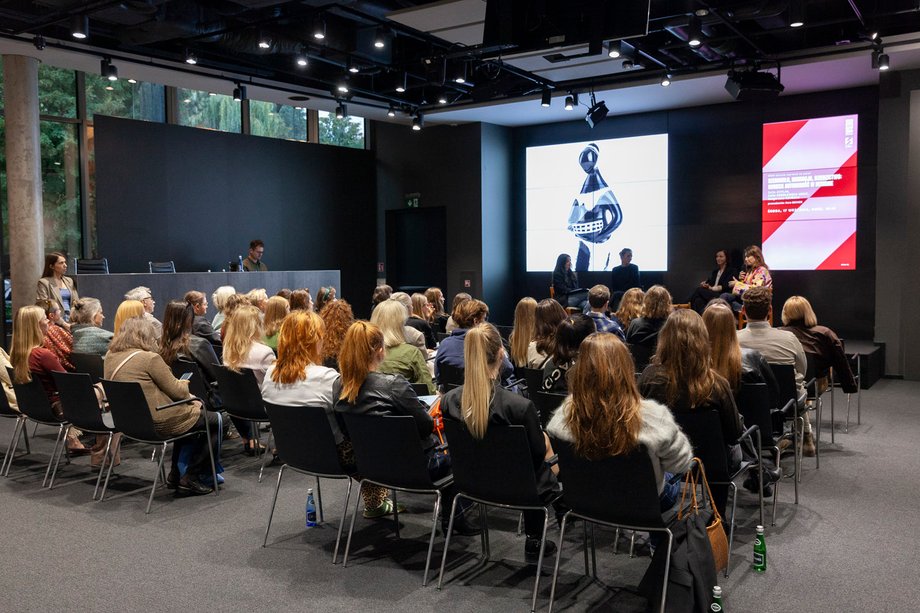
One of the meetings as part of the project
|
Marek Krzyżanek / Desa Unicum
More and more women are also buying art. —Definitely more and more. Modern women are clearly focused on broadening their horizons, and art is a very interesting area here. I admit that I am not a supporter of generalizations regarding “feminine” and “masculine” approaches. However, it can be noticed that women are slightly more cautious when making investment decisions. This is not due to risk aversion, but rather to the need to have full knowledge before making the decision to make the first purchase. So this first purchase usually comes a little later for them than for men. What's more, many women come to us with a clear vision of their collection, often knowing well the names of artists who could be included in it – we hear from Agata Szkup.
See also: We know who bought the monumental Mitoraj. Behind “Tindaro” is one of the richest Poles and his new project
The president of DESA Unicum also tells “Women's Art” that there are no rigid time frames yet. — When designing the platform, we assumed that it should be long-term and cover more and more events, says Agata Szkup. He announces that next year educational programs and webinars will be organized as part of the platform.