


HotNews graphics/Ion Mateș
2025 was not a good year for the salary income of Romanians, according to the study done by an international consulting company. After years of wages rising above productivity, in 2025 our wages have fallen in real terms. 2026 is coming.
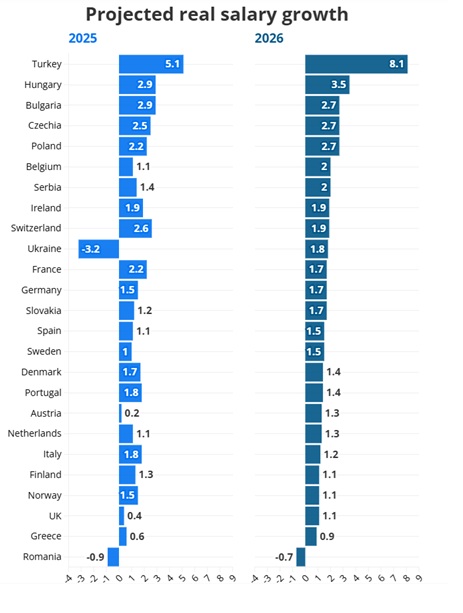
Romania is the only one of the 25 analyzed European states for which a decline in real incomes is estimated in the following year as well, of -0.9%, according to the study on salary trends for the period 2025-2026 by Employment Conditions Abroad (ECA), cited by Euronews.
Thus, our country is at the tail end of a hierarchy opened by Turkey, where an increase in wages in real terms by 8.1% is forecast.
“Turkey stands out from other countries in Europe because wages are rising and inflation levels are much higher,” ECA's Steven Kilfedder told Euronews Business. “But Turks are still far from the purchasing power they used to have,” he added.
In the projections for 2026, Turkey is followed by Hungary (3.5%), Bulgaria (2.7%), the Czech Republic (2.7%) and Poland (2.7%).
Despite the estimates for Romania, according to the ECA International report, “it is generally expected that Eastern European economies will once again outperform Western European ones, benefiting from faster economic growth and higher productivity,” the report states.
Wages in Romania decreased in real terms in 2025 as well
In real terms, Romanians' salaries also decreased in 2025, by -0.9%, according to the same study. The only country that still registers a decline from this point of view is Ukraine, with -3.2%. Instead, in 2026, an increase is estimated for the neighboring state.
Turkey is also the country with the highest wage growth in real terms and in 2025, with 5.1%. It is followed in the ranking of the ECA study by Hungary (2.9%), Bulgaria (2.9%), Switzerland (2.6%) and the Czech Republic (2.5%).
In the euro area, real incomes have largely recovered from the sharp decline in the period of high inflation from 2022, according to the European Central Bank. Nominal wages have risen at a faster rate than prices, meaning that purchasing power has risen. Therefore, real wages in the euro area are close to the levels recorded before the increase in inflation from the end of 2021.


