Why did the Dacians build a lot of temples. Unknown sanctuaries come to light and intrigue scientists


The remains of at least 20 temples have been uncovered in Dacian citadels, and the latest archaeological discoveries complete the long line of religious edifices from Antiquity. However, the religion of the Dacians and the role of their sanctuaries remain fraught with controversy.
Mysterious building unveiled at Piatra Roșie. Photo: Daniel Guță
The Dacian fortresses of Sarmizegetusa Regia, Costești and Piatra Roșie have returned to the attention of scientists in recent years, with the discovery of supposed temples, unknown until recent excavations.
Dacian religion remains controversial and has often given rise to fanciful interpretations, despite the large number of religious settlements unearthed over time.
Among the conclusions most often made by scholars regarding the religion of the ancients is that the Dacians were polytheistic, as evidenced by the large number of their temples and their concentration in the Dacian cities. But even this conclusion has sparked debate in the scientific world.
Instead, the purpose of the temples, the rituals in them and the deities for whom they were erected remained unexplained.
Sarmizegetusa Regia, the fortress with at least eight temples
In Sarmizegetusa Regia, the number of religious buildings currently known has reached eight, after the discovery of the ruins of a temple built on the 9th terrace in Antiquity and also destroyed by fire.
Archaeological research in the area of the edifice began in 2017, and as the site was expanded, new elements appeared that support the idea that an important temple had been erected here in Antiquity, which, after being consumed and collapsed, was followed by the construction of a new cult edifice. From the old Dacian temple, the remains of a collapsed wall with a width of about three meters, which had been decorated with paintings during the Dacian times, have been preserved.
The later phase temple included 60 limestone bases, some of them preserved, arranged in five rows of twelve rows.
Apart from the temple (or temples) on the 9th terrace, spread over an area of about 350 square meters, in Sarmizegetusa Regia, archaeologists discovered in the last century seven other supposed cult edifices (two circular and five quadrangular), located on the 10th and 11th terraces.
“Only a small part of the structure of the temples remained, as they were destroyed during the wars with the Romans. However, the architectural elements that have been preserved speak for themselves about a monumental religious architecture, unique in the Dacian world. Most of the temples were provided with bases (plinths) made of limestone or andesite, which supported wooden columns”. informs the National History Museum of Transylvania.
The 10th and 11th terraces are supported by walls that had an unusually high height in Antiquity, at least 10 meters in some segments, archaeologists showed.
The fifth temple in Costești
The Dacian fortress of Costești has been known since the 19th century and was intensively researched by archaeologists in the 20th century. Its most spectacular buildings are two “dwelling towers”, luxurious residences of its ancient rulers. But the number and appearance of the supposed ancient temples and sanctuaries are not to be neglected either.
The ruins of four quadrangular temples, of the columnar type, were discovered inside or near the fortification.
“Three of the temples are located on the terraces on the eastern slopes of the hill, protected by the fortifications here, the fourth being located on a terrace on the northern slope, near a tower. Of the cult edifices, only the limestone plinths on which the wooden columns were raised” have been preserved. informs the National History Museum of Transylvania.
The fifth temple of the Dacian fortress of Costești was identified following archaeological excavations in the period 2024–2025.
“At Costești-Cetățuie, two limestone bases of a temple unknown until now were discovered in situ. The vestiges of the new building were identified on one of the terraces on the south-western side of the hill, in the place called Mălăiște, crossed by the ancient road. The first “rows of stones placed in strict order on carefully arranged areas” were found in the Dacian fortress here during the excavations coordinated, starting in 1924, by the professor from Cluj DM Teodorescu. After a century, the discovery of a new alignment, the fifth, boosts the resumption of the subject related to the constructions with a religious purpose from Costești-Cetățuie, but also from the rest of the capital area of the Dacian Kingdom”the National History Museum of Transylvania showed.
Archaeological research will be extended to document the planimetry of the temple, its chronology, the construction technique and, last but not least, to obtain information regarding the activities carried out in its perimeter, the MNIT representatives added.
Dacian fortresses, full of temples
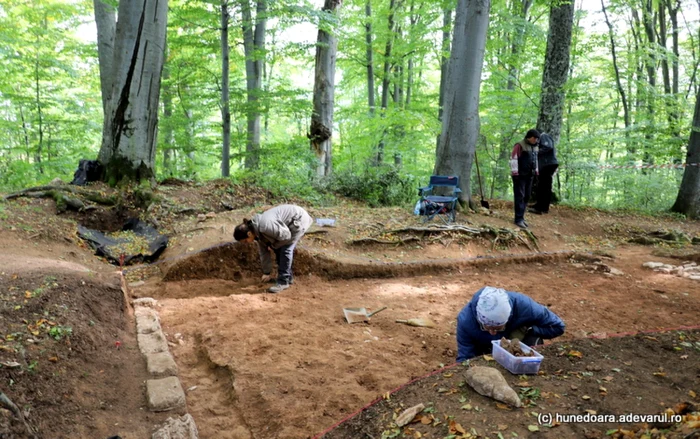
Another Dacian temple was recently discovered at Piatra Roșie, also located near the Sarmizegetusa Regia and Costești fortresses. Archaeological research in the Dacian citadel Piatra Roșie was resumed in 2021 and led to the discovery of a supposed ancient temple, a place that would have housed the famous iron discs, decorated with images of animals and used, according to some historians, in religious ceremonies.
The recently discovered ruins belong to a spacious building with an apse-shaped porch, surrounded by the remains of a “stone circle”, similar to the great circular temple of Sarmizegetusa Regia.
“The apse building on the first terrace was built of beams placed on stone bases. The discovery, in the semicircular room, of the wrought iron disc (the “Red Stone shield”), richly decorated, could suggest the religious functionality of the edifice. The specificity of ritual activities in Antiquity often shows that there was not always a clear distinction between the two sides of existence – the sacred and the profane”informs cetati-dacice.ro.
The first fragments of an iron disk were discovered in the mid-20th century, but in the 2000s, at least seven Dacian iron “shields”, linked to the supposed religious edifice, were illegally extracted by treasure hunters from Red Stone and then trafficked on the antiquities black market.
In the same Dacian citadel, the bronze mask of a female figure (known as “Bendis from the Red Stone”), very likely of Celtic origin, was also discovered, in which a deity was identified. However, many artifacts were lost over time, the settlement being intensively hunted by treasure hunters since the 19th century.
At least three sanctuaries would have functioned in Antiquity at the Fețele Albe citadel, two others in the vicinity of the Costești-Blidaru citadel, and the remains of some religious edifices have been identified in the Dacian settlements of Căpâlna, Bănita, Pustiosul (video) and in other sites close to the Dacian capital in the Orăștiei Mountains.
The religion of the Dacians, full of mysteries
Despite the large number of these edifices, their appearance, role, how they were built and used in Antiquity, as well as the religion of the Dacians continued to create controversy.
“Modern man has only to make conjectures about the religion of the ancient Dacians, without imposing any particular opinion, at least until other definite information or archaeological discoveries really telling about its character are found.” asserted the archaeologist Ion Horațiu Crișan, after four decades of research into the Dacian fortresses, in the volume The Spirituality of the Geto-Dacians (1986).
According to the historian, the vast majority of researchers who have dealt with the religion of the Geto-Dacians believe that it is of an individualistic polytheistic character, of the Greek type, found among the Thracians, Romans, Celts, Germans and numerous Indo-European peoples.
“The Geto-Dacian pantheon consists of several divinities, headed by a supreme god and goddess, to which are added: a god of war, a god of the sun, a divinity protecting hearth and home, a god of health, a god of fire and metals, and very probably many others. There is no doubt, however, that other forces of nature were honored, that the mythology of our ancestors was also populated with other divinities difficult to identify on the basis of archaeological materials, the only sources at our disposal”, concluded the scientist.