The psychology behind the racist attack on the Asian supplier. From digital conspiracy to criminal acts


Asked by a reporter if he had reason to attack the Asian deliver in Bucharest, Cosmin Tudoran replied that a was manipulated “pRin the online content, by a third party. ” The statement raises a simple question: How do conspiracy memes and narratives come to push online indignation in offline violence? The phenomenon has neurological, psychological, social and historical explanations. But also a solution: the responsibility shared between family, school and … each of us. We discussed all this with Andreea Ștefiuc, clinical psychologist and psychotherapist with training in the experiential therapy of the child, the couple and the family.
“The way in which exposure to digital content influences the increase in aggression is the subject of many studies in recent years and for good reason. Because we are complex beings, nor the answer to this question is not a simple one. There are several angles from which we can look at the phenomenon,” He explains, for the truth, Andreea Stefiuc.
On the one hand, at the neurological level, repeated exposure to information loaded with negative emotions reduces the activity of the prefrontal cortex (the part responsible for self-control and critical analysis) and excessively activates the limbic system, ie the area of gross emotions. “This means that we live more intense emotions such as fear, frustration and anger, and the ability to control them decreases. The reward system is involved: when aggressive behaviors receive likes, shares and positive reactions, the brain secretes dopamine, which makes us repeat that behavior. What reduces sensitivity to the suffering of others ”, the psychologist continues.
Vulnerabilities that are inherited
In fact, online aggression does not start from scratch. There are genetic predispositions for impulsivity, low self -control or tendency to feel negative emotions, says the specialist. Therefore, a person with such vulnerabilities becomes much more exposed when they come into contact with aggressive content. Thus, the transition from emotion to violent behavior is easier, especially in the absence of self -control.
But genetics is not the only factor. It matters enormously the early experiences. “The way we react to the online content depends a lot on what we have lived in the relationships in the family of origin. If I learned that” you are not important, you cannot be loved “, then a mixture of shame, guilt, fear, feelings of inadequacy and rejection are formed. emphasizes the psychologist.
From shame to anger, through the digital mirror
There is also an unconscious mechanism by which these unresolved experiences are poured on the others. “An unconscious mechanism by which we try to manage these experiences is to make others feel what we feel inside. Unfortunately, this leads to even more rejection and relational failure, deepening the old wounds. they get to feel part of a group that confirms their way of life ”, opines Andreea Ștefiuc.
Social platforms play a major role. Algorithms create the so-called “echo rooms”, where users see only similar opinions. “Which radical beliefs and reduces difference tolerance. Memes and clips become more than entertainment, turn into propaganda tools that normalize hatred, justify violence and dehumanize the “opposing camp”. From this moment, anger is no longer only personal, but it acquires the size of a collective mission ”the psychologist believes.
In his opinion, from a somatic perspective, indignation does not remain in mind. Specifically, the body feels through muscle tension, increasing heart rate, feeling “inner pressure”.
“Without adjustment mechanisms, this energy is looking for an exit. Aggressive comments, participation in extremist groups or even violent action become ways in which the body discharges the accumulated tension”, adds the specialist.
Responsibility begins at home
Online aggression cannot be put exclusively on account of platforms. “The responsibility for how we use social networks and the way we manage aggression not only belongs to digital platforms. It starts in the family, continues at school and is reflected in the way each of us chooses to post in the virtual environment.”she points out.
In the family, parents have the decisive role. Children learn to regulate their emotions from the first years of life. Anger, for example, is not bad emotion. It sends a clear message: “You violated a limit “,” I was hurt “,” I need space “. The problem is not the appearance of anger, but the way it is expressed. The child needs to know that he can download this emotion without hurting.
The only way to model a healthy behavior, draws the psychologist's attention, is that parents are themselves examples of mature conflict management: to show self -control, to take responsibility and to bear assertive discussions. In this way, the child feels safety and learns that he can cope with the difficulties of life.
Equally important is the way parents talk about others. According to his statements, the transmitted messages should be based on understanding and empathy, but also on the clarity of consequences for inappropriate behaviors. Hate and negative labels have nothing to do with this process.
School as a protective space
The school plays an equally important role. School teachers and psychologists can support students to develop socio-emotional skills: to recognize emotions, to manage conflicts and to practice empathy, recommends Andreea Stefiuc. Ideally, school should not be just a place of accumulation of knowledge, but also a space where children learn how to relate healthy and how to protect themselves from harmful content.
As users of social networks, we have a duty to pay attention to what we post and what we choose to consume, it draws this attention. The content that is transferred is most of the time the one that arouses negative emotions. Even the educated persons can fall into the trap of distribution of harmful materials.
“In order to remain in the control of our own mind and lives, we need to consciously choose information that support the well -being, empathy, gratitude, hope and connection. A balanced nervous system automatically seeks learning, closeness and understanding, and this can also be reflected in what we choose to post online,” says the psychologist.
The reflex to blame the victim
In Reddit's discussions, on R/Romania, many users have reacted to the aggressor's behavior and his mother's justifications.
For example, a user asked: “Where (…) does this reflex (…) come up with replicas” Sure he did something “? As well as with broken women at home, half of those who hear with cretinisms like” she said something/She did something to be worth it “.
Another user's reply brings an explanation: “From the psychological desire not to confront the reality that sometimes things happen to some innocent people. It is something inherent in the human psychic, it does not belong to Romanians or Belgians or Chinese or Americans. […] You do not like to think that the daughter/sister/girlfriend/mother could be dragged into some groves and raped, so when you hear about the news you are looking subconscious to confirm that bad things do not happen to innocent people. She dressed provocatively, she was drunk, what she was looking for alone, is her fault. It can't happen to me because I don't make these mistakes. As with violence. ”
Double measure
Another user tells that have “An acquaintance who worked in Germany for 20 years. When he came to Romania he was doing only nonsense and entered the mentality of a bad Romanian. When he returned to Germany he was doing that saint and emancipate. I am glad that the boy in the clip receives this attention for his deviant behavior.
In turn another user says that: “It is called Blame Shifting and is practiced by people who cannot assume guilt, generally by people without emotional maturity. If it happens often, it is possible to have narcissistic features.”
Another completes: “I do not think there is anything Romanian. Parents, in general, have the same attitude everywhere when it comes to their offspring. It is hard to understand that the child at home is totally different from the one in society, when he is with friends, at school, etc.”
Someone else says that: “Such superprotective parents, in denial, who do not listen to a criticism of the child's behavior and take it as a personal insult, causes many long -term problems. In education, the reply” does not make my child “.
Propaganda and digital handling
“The truth is that many are manipulated by online propaganda. This problem must be discussed. We are not talking about the cancellation of the elections due to the manipulation on Tiktok, but we have been attacked for many years. I am glad that this is happening, who knows, may wake up the state and the Union to stop the attack. Otherwise we will have more fascists.”draws a user.
“From what is seen on the filming made by the” example of a child “, he takes a man on the street who had done nothing. comments another.
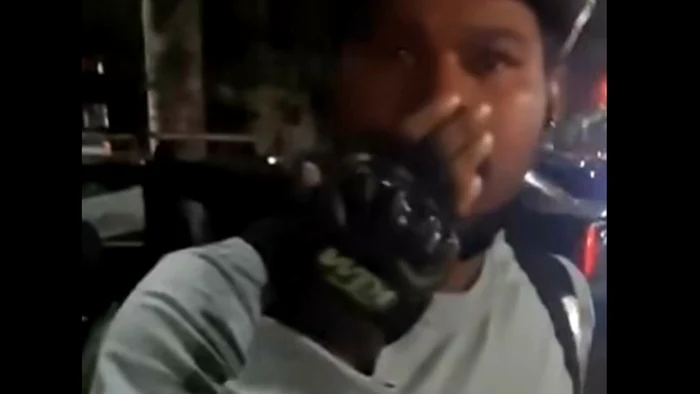
We recall that on Tuesday evening, on August 26, an Asian young man who works as a food supplier was attacked by a stranger on a street in Bucharest. While he was on the scooter, the supplier was watched by a man who, after starting the filming on his cellphone, approached and hit his fist in front, without him to react. Shocked, the Nepalese citizen asked the aggressor why he attacks him. The answer received was one with xenophobic tint: “Go back to your country, that's the problem!”, Said the man, then adding “Because you are an invader!”
The aggressor, who filmed the moment of the attack, was noted on the social networks where, on several accounts, he promoted Nazi symbols and posted pictures with him, having the face covered with masks and wearing white weapons.
After being stopped by an aggression by a policeman, Tudoran repeatedly asked to call his mother.