What the specialists say about the provisions of the new train ordinance: “It's good that it doesn't go the other way, with all kinds of populist measures”

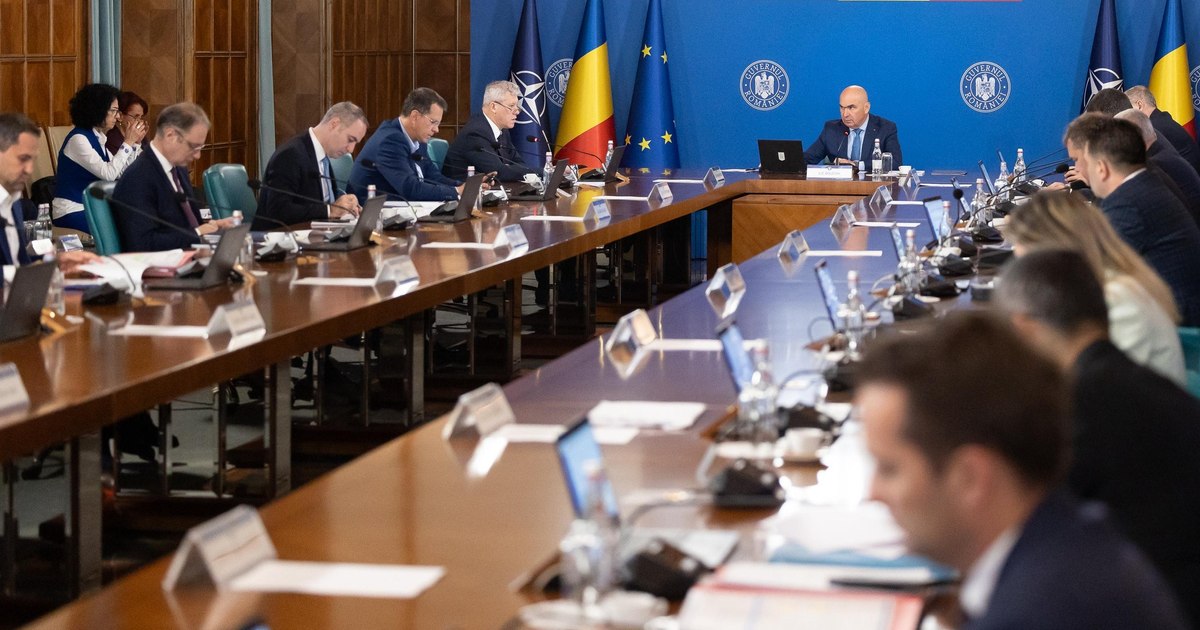
The “train” ordinance project, put up for public debate on Monday and adopted by the Executive on Tuesday evening, generates some criticism, but specialists also note some positive aspects.
PHOTO Facebook / Government of Romania
Criticism comes especially from the Energy Employers' Federation, which asked for the adoption to be postponed, accusing a lack of dialogue and consultations with representatives of the energy sector and claiming that “the business environment is again being ignored.” The Federation believes that the principles of good governance are being violated and the recent promises made by the Government in relation to employers are being ignored: “Unpredictable fiscal policies, adopted without consultation and without a coherent vision, weaken economic competitiveness and endanger energy security”.
Also, according to them, “maintaining additional taxes in the oil and gas sector and introducing new tax measures will have negative effects on the entire energy market”.
Dissatisfaction was also reported by the Romanian SME representatives, who requested, among other things, that the non-taxable amount in the case of the minimum wage remain at 300 lei. It was also requested to remove the excise tax from the turnover calculation, not only for producers/importers, but for the entire commercial chain.
“And bad news and good news”
Economic analysts, however, note measures that have the potential to positively influence the business environment. “The train ordinance brings mixed news, and bad news, but also some good news. On the good news side, we see the significant decrease in turnover tax for small companies, from 3% to 1%. It will help those who work up the courage to open a business from 2026. A windfall from a tax point of view. There are some measures, also positive, in the sense of regulating the circulation of money in the economy, in the sense of reducing tax evasion, which are welcome. But, indeed, there are also negative measures, which will affect purchasing power,” says economic analyst Adrian Negrescu.
However, the energy environment has reasons for revolt, admits economist Cristian Păun, in a statement for “Adevărul”: “Those in the energy sector were still hoping to waive the pole tax, which is an aberration and which puts a lot of fiscal pressure on energy companies, where investments should be important in the coming period, because you cannot have more and more diversified energy production, preferably from non-polluting sources with very large investments behind it, and you only tax the investments, only the assets that are the basis of these investments”.
“There are also some measures that somehow help the business environment. We are talking about the reduction of the minimum turnover tax. Of course, I would have removed it completely. It was promised that this removal would happen at the beginning of 2027, which is somewhat optimistic news. And that the value has decreased and that it will be removed. The same with the pole tax. (…)
The measures are welcome, but much more can be done for the business environment, so that production is launched in all areas, and we should obviously start with production in key areas, such as, for example, the energy sector, because on energy production all other sectors depend.” Cristian Păun also explains.
Gabriel Biriş, a lawyer specializing in taxation, states in a post on Facebook that the ordinance indicates “a change in approach”.:”We are starting to throw away the “boulders” that we have been talking about lately, not immediately, but the perspective of their elimination in 2027 is likely to make it possible to resume significant investments in Romania”
The mission of the Bolojan Cabinet, complicated
“The macroeconomic context is very complicated in Romania. We depend on a lot of options to be successful, even with these proposals that we see on the table. But it's still good that we don't exaggerate, we don't go to the other side with all kinds of populist measures, state aid, subsidies and others, you can't do it in a budget with a deficit. It's good that the emphasis is on fiscal relaxation and any type of fiscal space we have in the future we should use exactly to relax a little taxation and relax a little more these barriers that are in the area of production, so that, in the end, we have investors coming to Romania, investing in Romania, producing in Romania, because that should be the healthy way to save ourselves, to make more economic activity flourish and take place here.
The more we do this, the more we will develop and the budget will balance because these businesses located in Romania pay taxes, pay and feed the state budget and if we keep the expenses under control a little, on the other side we apply such measures, slowly, slowly the budget regains its breath and the balance it needs. For a while we must refrain from these populist measures”, Cristian Păun also explains.
Smaller cuts for politicians
Criticisms are signaled including in the case of measures for politicians, the budgets of parliamentarians and parties being reduced by lower percentages than those indicated in the case of tax increases.
“From my point of view, they should have cut contributions to parties much more drastically. My view is that these parties should be based much more on membership fees, on the idea that in politics the resources should come from those who believe in one political platform or another, because ultimately the decoupling of political parties and their agenda from the citizen also starts from the fact that citizens are not directly involved, including with resources personal, in the financing of these parties. And the financing of these parties is very much based on money from the budget, not to mention the money for the parliamentarians or the allowances that are in the system and that should have been cut a bit more drastically, not just by 10%.” explains economic analyst Cristian Păun.
On the other hand, in the case of measures that directly affect the lives of citizens, the economist emphasizes that, while in other countries the housing tax reaches 0% under certain conditions, the increase in Romania will increase the fiscal pressure: “Rather, this tax will not necessarily bring some spectacular receipts to the budget, but it is a tax that wants to be corrective or not necessarily corrective, as much as it wants to do some kind of social justice, social justice.”
“There is this general frustration related to the fact that it seems that fees and taxes have increased without any discussion, and when it came to spending cuts it was always negotiated, discussed and nothing concrete happened. The absence of a concrete plan for reforms in Romania, for restructuring, for austerity, with very clear targets and deadlines, for the population to understand is a reality”says economic specialist Adrian Negrescu.
What the ordinance provides
Among the measures provided for is the freezing of the salaries of budget officers for the second consecutive year. Also, service pensions will not be updated in 2026. Instead, the minimum wage will increase, from July 1, 2026, from 4,050 lei to 4,325 lei. The non-taxable amount of 300 lei will be reduced to 200 lei, according to the normative act. At the same time, the awards, premiums, bonuses, allowances and other rights of a salary nature, due in 2025, are kept in payment.
The measures include increasing the penalty point and extending help to pay energy bills for vulnerable people.
On the business side, a one-off rate of 1% for micro-enterprises is foreseen, and the IMCA (Minimum Tax on Turnover) will be reduced to 0.5% in 2026 and completely eliminated in 2027, while the Oil and Gas Additional Tax (ICAS) is extended by one year, to be completely eliminated from 2027. The dividend tax is also increased from 10% to 16%. And the construction tax (tax on the pole) will be applied until the end of the next year.
Last but not least, according to the measures agreed in the coalition, money for parties and money for parliamentarians decrease by 10%.
2026, “an extremely difficult mission”
After this year, the mission of the Executive led by Ilie Bolojan remains a complicated one, with economist Adrian Negrescu predicting greater spending cuts and possible redundancies: “It will be an extremely difficult mission, in 2026, for the Government to cut almost 50 billion lei from expenses, in such a way as to reduce the budget deficit within the limits assumed in front of foreign financiers”.