Putin is not winning in Ukraine. It only relies on the illusion and the fatigue of the West ANALYSIS


The Russian president is not about to win the war in Ukraine. Instead, Vladimir Putin hopes that the United States and its allies will convince themselves that Ukraine cannot hold out any longer and that support for Kiev is unnecessary. This, in short, is the Kremlin's strategy, US senators warn in an analysis published by The Washington Post.
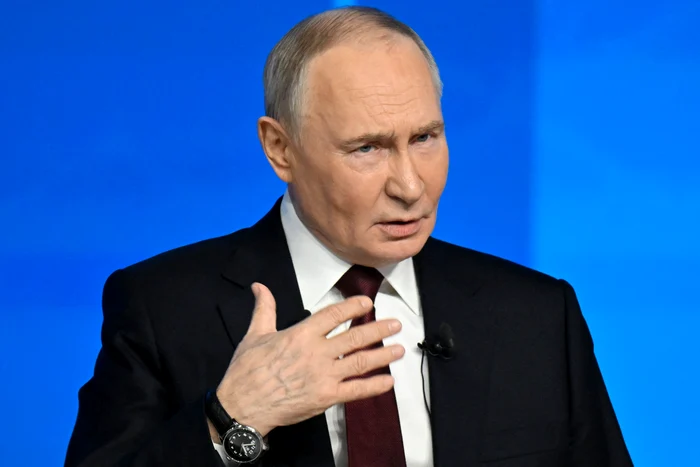
The President of Russia, Vladimir Putin/PHOTO: AFP
At the start of the Russian invasion in February 2022, the US administration's estimates were grim. Officials in Washington have told congressmen that Kiev could fall within weeks, if not sooner. The reality on the battlefield, however, quickly contradicted these forecasts.
Russian tanks sent to overthrow Ukraine's democratically elected government have been destroyed or forced to withdraw. By April 2022, Moscow had not only failed to impose a puppet regime in Kiev, but had not even consolidated its positions near the capital. On the contrary, the Ukrainian army pushed back Russian forces to the east of the country, in areas where Russia has been trying to gain ground since 2015.
After almost four years of war, the balance sheet is far from indicating a victory for the Kremlin. Russia has lost about a third of its strategic bombers and continues to lose military equipment at a faster rate than Ukraine. The human toll is estimated at over a million soldiers dead and wounded—a huge cost for a war started by Moscow itself. Those who bet, in 2022, on a rapid collapse of Ukraine were wrong then and are still wrong now.
Both Republicans and Democrats, meanwhile, have criticized the excessive caution of the Biden administration, accused of refusing to provide Ukraine with needed weapons at the very moment they could have decisively changed the course of the war. According to US senators, Kiev would have had a real chance of a clear victory and a lasting peace agreement if it had received fighter jets, modern air defense systems and long-range weaponry in time. Instead, American aid was often “too little too late.”
This hesitation had consequences beyond Ukraine. The delay in countering Russian aggression has given China, Iran, North Korea and other actors hostile to the West further reason to question the credibility and strength of the United States.
In this context, senators warn that President Donald Trump still has a chance to help end the conflict on favorable terms for Ukraine, the US and Western allies. But this requires not repeating the mistakes made at the beginning of the war.
Statements by some American officials, which present the city of Pokrovsk as a symbol of the imminent collapse of Ukraine, are considered misleading. Although relatively small — with about 60,000 inhabitants before the war — Pokrovsk was not conquered. And Russia's attempts to occupy it, spanning more than a year and a half, produced minimal territorial gains, achieved with huge losses.
The economic costs for Russia are just as high
Oil and gas revenues fell by more than 30% amid attacks on energy infrastructure. The Kremlin had to sell gold to stabilize the finances and protect the elites from the real impact of the war. About a quarter of Russian companies are already bankrupt or close to bankruptcy. Russia can't afford this war, but it can prolong it — and that's exactly what Putin is betting on.
The Kremlin's strategy is not one of force, but of attrition. Putin is stalling not because it is favorable to him, but because he is not able to achieve a decisive victory. His hope is that fatigue will divide the West.
In this game, the United States is called upon to act together with its European allies, who are investing heavily in their own defense and who, in some ways, have already come to surpass American support for Ukraine. If there are economic benefits to peace, they lie in a partnership with a Western-oriented Ukraine and a revitalized Europe, not in a partnership with an isolated and declining Russia.
The key question remains what Washington's ultimate goal is. History shows that wars end when the balance of power changes. If the US and its allies want a negotiated solution, the only proven way is to strengthen Ukraine's position, not weaken it.
Giving up Ukraine or giving Russia what it cannot win on the battlefield will not bring peace. Putin isn't just targeting the Donbas — he's challenging Ukraine's very sovereignty, and his ambitions extend to the Baltic states and other former territories of the Soviet sphere.
Bipartisan tools exist in the US Congress to increase pressure on Moscow, from additional sanctions to using frozen Russian assets to support Ukraine. Recent measures against some Russian energy giants have had an effect, but they are far from enough.
In the end, Putin is betting on the idea that the United States will convince itself that Ukraine cannot win. The experience of the last four years says exactly the opposite: Ukraine has exceeded expectations, including those of the West. Kiev does not lose, and Moscow does not win. It remains to be seen whether Washington will respond to Ukraine's decision with the clarity and firmness that the moment demands.