The guarantees offered by the United States are considered the only realistic path to peace in Ukraine. However, no matter how solid they seem from the perspective of President Volodymyr Zelensky, the reality is that the decisive influence remains in Moscow, writes Politico.
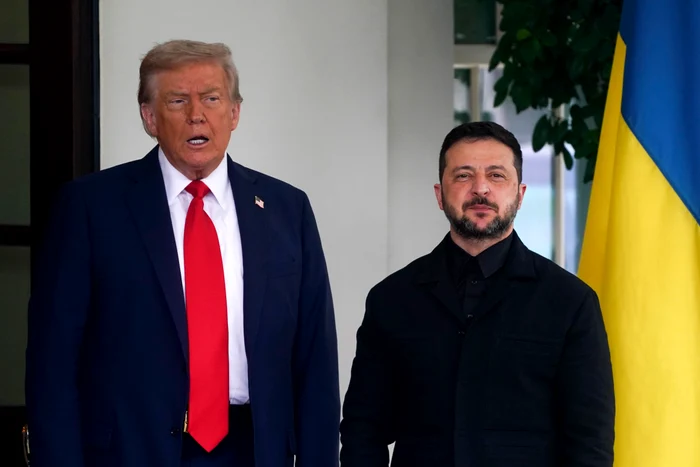
Donald Trump and Volodymyr Zelensky/EPA/EFE
At the beginning of 2025, relations between Ukraine and the United States went through a tense moment after a harsh exchange of words between Zelensky, US President Donald Trump and Vice President JD Vance in the Oval Office. Since then, relations between Washington and Kiev have oscillated, reflecting broader uncertainties about Western support for Ukraine.
Europe reacted to that diplomatic episode by stepping up efforts to support Kiev and by trying to maintain the United States' commitment. In March, British Prime Minister Keir Starmer and French President Emmanuel Macron announced the formation of a 34-nation “coalition of the willing” to strengthen Europe's role in guaranteeing Ukraine's sovereignty and security. In September, Emmanuel Macron said 26 countries were ready to send troops as part of a multinational force, which would be deployed “the day after the ceasefire or the signing of peace”.
However, regardless of the scale of the European initiatives, the decisive factor remains the security commitment of the United States — a commitment that Zelenski is now trying to achieve, even if this means compromises in other areas.
Despite European ambitions, American guarantees are considered the only viable option for lasting peace. Without US logistical support, Europe could not even deploy its own multinational force. As 2025 draws to a close, the level of Washington's commitment continues to be a central element in any attempt to move the war into a new phase and eventually to peace.
Indications that the real power is in the hands of Russia
However, there are clear indications that the real power is still in the hands of Russia.
The failure of the 1994 Budapest Memorandum still looms over the current negotiations. Ukraine then gave up its Soviet-era nuclear arsenal in exchange for security guarantees from the United States, the United Kingdom, and Russia—guarantees that did not deter Russian aggression. In this sensitive context, Zelenskiy faces several difficult decisions.
According to available information, the Ukrainian president would be willing to give up the goal of joining NATO — considered “irreversible” at the Alliance summit in 2024 — in exchange for solid security guarantees. The United States proposed what US officials described as the “highest level” of guarantees, but warned that the offer would not remain open indefinitely.
The possibility of providing Tomahawk cruise missiles with a range of about 1,000 kilometers — a type of weaponry that has so far only been offered to a very limited number of US allies — is being discussed. These would allow Ukraine to strike strategically important political and military targets in Russia, increasing deterrence. However, such a measure would not eliminate the risks of a new conflict.
Beyond the military aspects, Kiev insists that any American engagement be legally binding. Unlike the Budapest Memorandum, an executive agreement without full legal force, a treaty ratified by the US Congress would have a similar status to Washington's security agreements with Japan or South Korea. This would reduce the risk of a future president unilaterally reneging on commitments.
Credible security guarantees backed by real military force
Even so, uncertainties persist. Zelenskiy said the new safeguards would be equivalent to NATO's Article 5, but this fundamental clause is open to interpretation. Article 5 was deliberately worded so as not to automatically force the United States into another major war in Europe. Therefore, not just the letter but also the spirit of the commitment is essential.
In reality, credible security guarantees backed by real military force are rare. And Washington's record of cautious support for Ukraine, as well as its consistent refusal to allow Kiev to join NATO, raises questions about US willingness to take the risk of direct intervention.
Finally, a well-known principle in armed conflicts remains valid: the adversary always has a say. As talks between the United States and Russia continue, alongside European and Ukrainian negotiations, the position of Russian President Vladimir Putin will be decisive. Moscow wants a much broader deal with Washington on European security, and has so far shown no signs of giving up on its maximum demands.
Thus, no matter how solid American security guarantees appear in Kiev's eyes, their durability may ultimately depend on how they are perceived in the Kremlin.