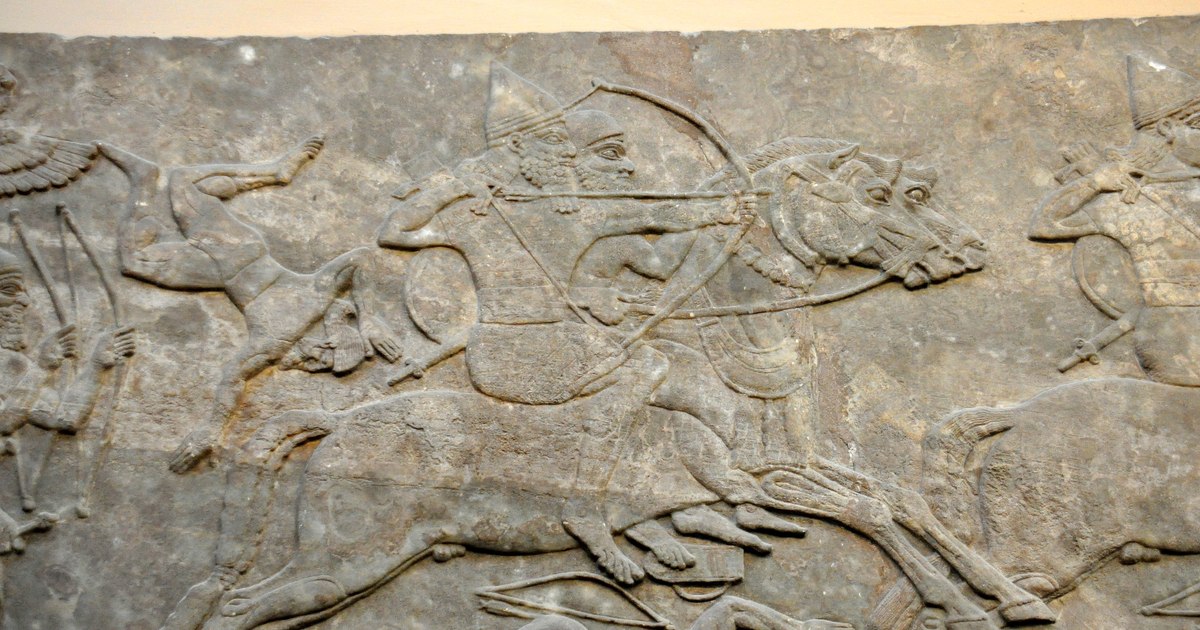
Terror as a fighting tool did not appear with modern technology, but almost 3,000 years ago. The pioneers of this tactic were the Assyrians, the first people to perfect the art of defeating the enemy through fear, laying the foundations of a cruel tradition that is also felt in current conflicts.
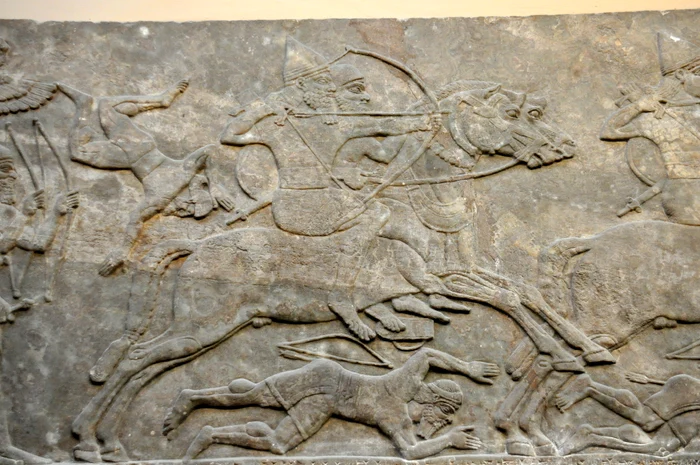
Assyrian cavalry in attack PHOTO wikipedia
Psychological warfare is an important component of military strategies. With its help, the enemy can be destabilized from the inside, even brought to its knees, before an armed intervention in force is even needed.
Psychological warfare takes many forms and has many methods of inducing confusion, doubt, terror, or chaos. And new technologies manage to take this type of war or aggression to an unimaginable level. Psychological warfare appears to be an exclusive method of modern warfare. Well, psychological warfare is almost 4000 years old.
Its first masters were exceptional warriors, the creators of the world's first organized army and the craftsmen of the first great empire of the ancient world. They lived in today's Iraq and were called Assyrians. In the ancient world they were known as the “masters of terror”, a feared people who struck terror into the enemy. Many cities surrender only with the hope of staying alive, knowing what resistance means to the Assyrians. Last but not least, the Assyrians were the first in history to use propaganda to destabilize their enemies.
From kings of tents to “masters of the world”
The Assyrian Empire was a dominant power in the ancient Near East, born in the city of Assur in Mesopotamia, in present-day Iraq, between the Tigris and Euphrates rivers. The Assyrians were known for their powerful military, advanced weapons for that era, made of iron (most peoples of the time used bronze, much weaker), extensive trade networks (especially in the Old Assyrian period), and significant cultural achievements, such as the bas-reliefs of palaces and libraries. The ancient Assyrian people had Semitic origins and occupied a territory centered on the northern part of modern Iraq and extending into southeastern Turkey, northeastern Syria, and northwestern Iran.
Initially, the emergence of the Assyrian Empire is connected with the foundation and development of its capital, the city-state of Assur. The ruins of this city are located near the Tigris River in the northern part of present-day Iraq. The city was founded around 2500 BC. Like most Mesopotamians, the Assyrians practiced agriculture enjoying the abundance provided by the Tigris. At the same time, being near the mountainous areas, they specialized in the extraction of stone and metals. All of this was an important source of wealth, opening trade routes to Anatolia, which is today's Turkey. In addition, iron ore helped them obtain weapons and military protective equipment that were much more developed and durable than most of the surrounding peoples, who still used bronze. In the area inhabited by the Assyrians, several city-states were erected, each with their own laws and kings. Important were Kahlu and Nineveh.
The latter later became the largest city of Assyria, a center of power of the Assyrian kings but also a great pole of Assyrian culture and civilization in Mesopotamia. Throughout the second millennium BC, Assyria was a vassal of Babylon, transformed by the Akkadians into a major regional power. Later, the Assyrians came under the influence of the Kingdom of Mitanni, another political structure founded by the Semites in the Syrian-Mesopotamian area. In the 14th century BC, however, Assyria became an independent power. The city-states were united under the scepter of Assyrian sovereigns. The story of one of the greatest and most brutal empires of Antiquity was beginning. With the unification and centralization of the Assyrian state, the first large organized army in history was created. The Assyrian warriors benefited from protective elements but also from superior logistics to all other peoples. That is, they developed an army sanitary service, ways of feeding the troops on the march, troops of genius specialized in crossing rivers, building ramps, and everything else that was necessary.
Not to mention siege equipment. From the 9th century BC The Assyrian Empire reached the height of its power and influence. The great Assyrian kings controlled an empire that stretched from Egypt to Iran, including territories in present-day Syria, Palestine, Israel, and Iraq. Even a part of Anatolia. They came to be mentioned in all the texts of the period, including the Old Testament. They were remembered with fear, with horror, as a divine punishment on mankind. “The Assyrians created the world's first great army and the world's first great empire. This great rule was maintained by two factors: their superior skills in siege warfare and their reliance on pure, unadulterated terror.”specified the historian Simon Anglim.
Until about 612 BC, when the Assyrian Empire collapsed due to internal conflicts and external attacks, the great kings of Assyria and Nineveh were the true masters of the known world.
The kings of terror, the masters of psychological warfare and propaganda
In addition to the extraordinary martial qualities of the Assyrians but also the superiority of weapons and military technique, the Assyrians were the first known people to use psychological warfare and propaganda against the enemy. The Assyrians were careful to create a reputation for being an extremely cruel people. Indeed they struck fear into their enemies, they sowed terror and death. So much so that many surrender only out of their own fear. They began by practicing torture against conquered peoples and prisoners of war. In addition, they horribly desecrated the bodies of those killed on the battlefield. They behaved without mercy.
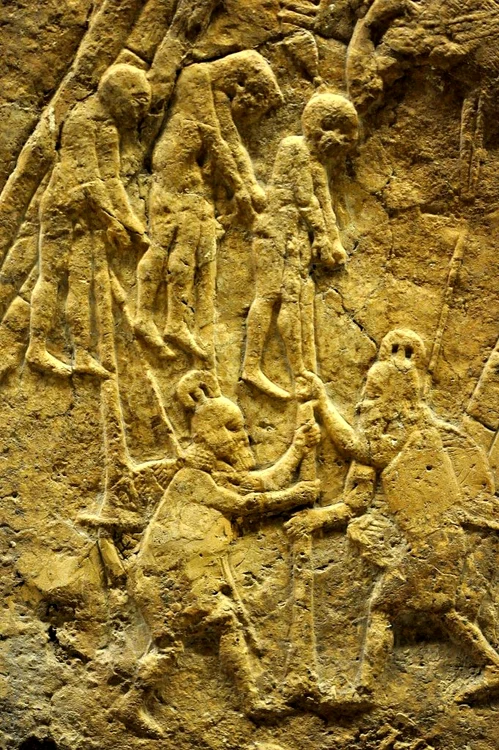
People impaled by Assyrians PHOTO Osama SM Amin
“Torture against enemies, both warriors and civilians, was practiced by Assyrian armies as a norm to force them into submission and to stabilize conquered societies. During the Neo-Assyrian period (935-612 BC), an excess of violence was applied to enemies. Torture against enemies was classified as a psychological warfare tactic to threaten and terrorize potential enemies. As a lesson harsh and overwhelming warning. Since cruelty has always been a significant method of coercing reluctant enemy states into submission, the Assyrian empire expanded its territories by employing terror tactics during empire building.”states Weijia Chen in “The Assyrian Empire:Terror Tactics as a Tool of Empire-building”, for the University of Athens.
The governors of cities and regions benefited in turn from the fame of the Assyrian terror. Residents were afraid to oppose or revolt. Often groups that could cause trouble for the Assyrians were deported. People were brought to Assyria and turned into slaves. The occupied were bound to the Assyrian rules, laws and deities. Death was the lightest punishment and torture was the worst. Based on the scenes depicted on the monuments during the reign of King Assurbanipal II (883-859 BC) we can realize the magnitude of the terror and torture practices applied by the Assyrians.
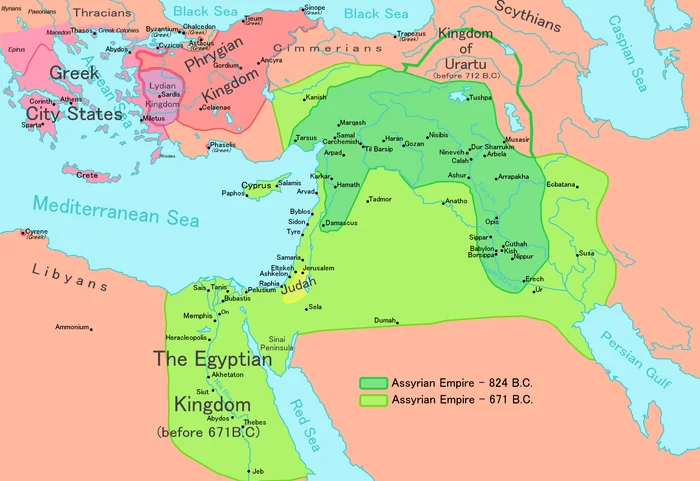
Assyrian Empire (in green) PHOTO wikipedia
Enemies, civilian or military, were effectively beheaded with the knife, left with serious wounds, exposed, for the vultures to eat their eyes. Others were gutted and left to live in agony as wild animals slowly killed them, eating their entrails alive. The massacres were horrific. There were mountains of corpses piled up in the cities, on the plains, thrown into the rivers.
If they refused to surrender after conquest, the inhabitants of the cities were severely punished. They were basically massacred. But not anyway. First tortured, then slowly killed. “The texts also indicated other forms of violence, such as burning adults, regardless of sex, and gouging out the eyes of prisoners. For prisoners, they were skinned, body parts such as hands, fingers, noses, ears were amputated and imprisoned alive in the palace walls of defeated cities. The skin flayed from prisoners was hung on the walls of conquered cities.”stated Weijia Chen in the same paper.
The Assyrians were shooting at the stake at least 2500 years before Vlad the Impaler
Vlad Țepeș did not invent the terrible punishment for which he remained famous. It was the Assyrians who invented the javelin. Prisoners were effectively impaled and left to languish in front of defeated fortresses. One of the cruelest kings was Shalmaneser III. He ordered numerous atrocities. In the defeated cities, people were actually massacred en masse, women, men, children. A significant number of prisoners suffered amputations, others were impaled. Sometimes, due to the large number of corpses, the whole land was used as a huge cemetery. Due to the large number of dead, the Orontes River could be crossed on a bridge of corpses. Moreover, the Assyrians were careful to boast of all these feats.
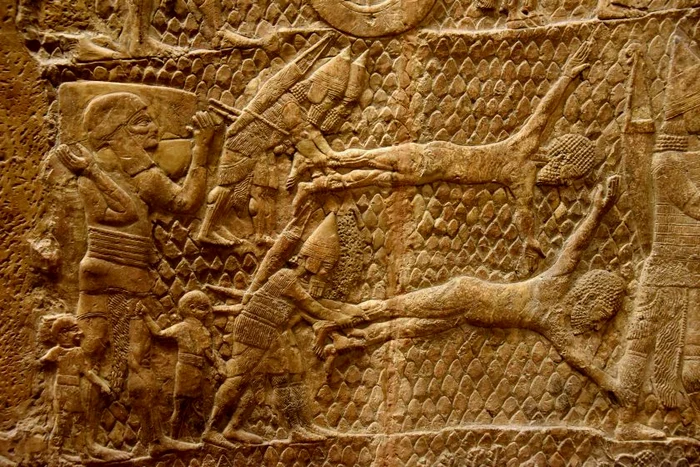
People tortured and skinned alive PHOTO Osama SM Amin
They made sure that everyone knew what could happen if they were resisted. The massacres were immortalized on the walls of the palaces, remained in the form of testimonies written on clay tablets in cuneiform alphabet or actually through macabre shows in front of the conquered cities, with the dead hanging on the walls, left to rot on spikes, through trees with their eyes gouged out and their entrails spilled. Many times the attacked cities surrender without a fight for fear of repercussions. The Assyrians managed to conquer entire lands without a fight, without exhausting resources.
“The Assyrians intentionally used terror tactics to gain a reputation for destruction through brutal military strategies and deportation policies in other parts of the Near East. And they made sure everyone knew it. When the Assyrians put their sadistic tactics into practice, they displayed their overwhelming military power with fear-inducing methods.”reads “The Assyrian Empire:Terror Tactics as a Tool of Empire-building”.
Advanced forms of psychological warfare
The Assyrians were also capable of advanced forms of psychological warfare. For example, after starting the siege of a fortress, they would take care to harvest the crops of those in the fortress. They were effectively leaving them without food. By this method, the Assyrians could mobilize the army for a much longer period, effectively using the crops of their enemies to feed their population. Not to mention the large number of slaves brought for field work, from the conquered cities, turning Assyria into an eminently militaristic state.
“I opened their barns full of food. And endless food I let my army devour”stated Sargon II in an inscription. “I burned their crops and stubble, I opened their full granaries, and let my army devour the unmeasured wheat. Like swarming locusts, I threw the beasts of my camps into her meadows, and they tore up the vegetation on which the city depended, laid waste their plains. I burned their abundant crops, opened their full granaries, and let my army devour the wheat immeasurable”shows another inscription from the time of Tiglath Palasar I (1114-1076 BC).