The story of the first Romanian ship that circled the Earth, crossing three oceans and seven seas


62 years ago, the freighter “București” was the first Romanian ship to circumnavigate the Earth by sea. This first adventure of the Romanian navy lasted 134 days. The famous ship that achieved this feat has reached scrap metal.
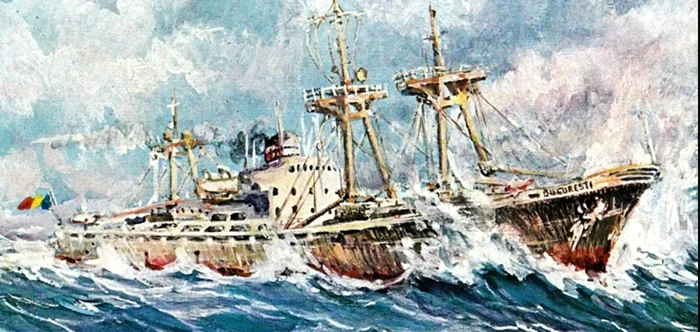
Cargo Bucharest PHOTO archive Cristian Cumpănă
Around the Earth has been the dream of every traveler, explorer or geographer in human history. This idea haunted so many adventurers that it even became the subject of a particularly famous novel, Around the Earth in 80 Days by Jules Verne.
Circumnavigating the Earth was a difficult mission in past centuries but still accomplished by many people over time. The first voyage around the world, by sea, or circumnavigation took place in 1522, the famous expedition of Magellan. The latter never got to return home, being killed in the Philippines, but the journey was completed by Juan Sebastian Elcano, between 1519 and 1522, on the ship Victoria.
And the Romanians, for their part, had such an adventure, for the first time, 62 years ago. A Romanian freighter named “București” managed the circumnavigation, in good conditions, managing to transport different loads from one port to another.
A Yugoslav ship prepared to take Romanians around the world
The story of this adventure begins in 1962 with the freighter “Bucuresti”. The ship that made the trip possible, although it bore the name of the capital of Romania, was built in the former Yugoslavia, alongside “Dobrogea”, another ship that will arrive under the Romanian flag. Both “Bucuresti” and “Dobrogea” became the property of the Romanian state at the beginning of 1963 following commercial exchanges. The freighter “București” was considered at that time one of the best-equipped commercial ships in the Romanian navy, benefiting from modern equipment for those times. Last but not least, the positioning of the central castle two-thirds of the way from the bow (the front of the ship) gave it very good stability and made it compatible for transatlantic routes. The ship was 152 meters long and about 19 meters wide.
The draft was 9 meters and reached a speed of 14 knots. In the first days of August 1963, the freighter “Bucuresti” received an order to travel to Cuba, an island in the Caribbean Sea, not far from the coast of North America, across the Atlantic Ocean. The Romanian cargo was supposed to transport tractors and the necessary equipment to build a cement factory in Fidel Castro's country. The crew consisted of 50 people led by the long-range captain, Liviu Negruț, an exceptional commander of the Romanian merchant marine. The plan was set from the start for a circumnavigation, considering the commercial exchanges that had to be made along the way around the Earth. So, initially the Romanians left with tractors and industrial equipment for communist Cuba.
With maps from Gibraltar to the land of Fidel Castro and distant China
After all four cargo holds of the ship were filled with tractors and the necessary equipment, the freighter “Bucuresti” lifted anchor in the morning of August 11, 1963. For the first time, the freighter under the Romanian flag entered the Mediterranean Sea and from there straight to the Strait of Gibraltar. At this southern point at the tip of Europe, officers also obtained the maps needed to cross the oceans. After the stopover in Gibraltar, the cargo ship Bucharest went out into the open ocean. He crossed the Atlantic without problems and finally arrived in Santiago de Cuba, where he made his first stop after crossing the ocean. Later he went to Havana, the capital of Cuba. This was the point where the entire cargo had to be unloaded, i.e. the tractors and equipment for the cement plant. In Havana, the Romanian sailors had a very good reception.
They were welcomed by the Minister of Commerce, but also by the Romanian ambassador to Cuba. Later they left for the Cuban port of Boqueron, in Guantanamo Bay. Here they stayed four days on land, while the ship was loaded with 7500 tons of sugar bound for China. After the four days in which the Romanian sailors enjoyed the Caribbean atmosphere, including many exotic fruits, the “Bucuresti” ship left for Cienfuegos, another Cuban port where 5000 tons of sugar were loaded, also for the Chinese. With the cargo full of sugar, the Romanians headed for the Panama Canal, the one through which they had to pass to the Pacific Ocean, on the other side of the world.
Passing through the Panama Canal was not that easy, especially since it was strictly controlled by the Americans. Given that the Romanian ship came from the communist bloc, the American military paid more attention to cargo checks. Finally, the freighter “Bucuresti” was given the green light and allowed to pass into the Pacific Ocean. But the command of the ship was taken over by the Americans and led to the exit of the channel to avoid accidents that would have blocked this important economic artery. Once out of the Panama Canal, the Romanians began crossing the Pacific. The first supply stop was in Honolulu, Hawaii.
They later went to Japan and then the China Sea. The “București” cargo ship was the first Romanian ship to cross the 180 degree meridian. In addition to South Korea, through the Yellow Sea, the “Bucuresti” freighter arrived in the east of China. The first stop was at the port of Xinjiang where the sugar was to be unloaded. The next stop was Shanghai where the sailors stopped to spend a few days on land. Immediately after Shanghai, the Bucharest freighter went to Dairen and Canton ports for loading. Here the sheds were filled with machinery, cast iron, pens and toys. Before leaving the area of China, the Romanian freighter made another stop in Singapore, where the ship was supplied with everything necessary for a longer journey.
Back home after three oceans and seven seas
The Romanian cargo had to return home, it had fulfilled its commercial mission. He was going to complete the geographical one, that is, to complete the circumnavigation of the Earth by sea. The Romanian cargo passed through the Strait of Malacca and went out into the Indian Ocean in the direction of Sri Lanka.
He then proceeded through the Gulf of Aden and through the Strait of Bab El Mandeb, a period with a particular reputation for piracy, directly into the Red Sea. Through the Suez Canal, the Romanian crew reached the Aegean Sea, ever closer to home. After 134 days of sailing around the world from east to west, the freighter Bucharest was returning to the Black Sea and the port of Constanța.
On December 22, 1963, the ship and crew were awaited with fanfare and all the communist officials from Constanța county. The vessel traveled over 27,000 nautical miles and managed to circumnavigate the Earth for the first time in the history of the Romanian Navy. The cargo “Bucuresti” crossed three oceans and seven seas on this trip. After another decade of service, the ship was laid up. It was later scrapped and dismantled.