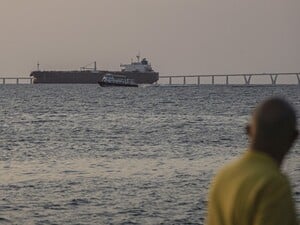
The incident occurred days after US President Donald Trump announced a “total blockade” of all tankers carrying sanctioned oil entering and leaving Venezuela. This is the second time in recent weeks that the United States has taken action against ships near the country amid the strengthening of the American military presence in the region, the agency notes.
According to the White House, the tanker was flying a false flag and was being used to illegally trade oil to finance the regime of Venezuelan President Nicolas Maduro. Caracas called these actions “an act of international piracy” and stated that they would appeal to the UN Security Council and other international structures.
The British company Vanguard reported that the vessel in question was the Panama-flagged Centuries, which was intercepted in the Caribbean Sea east of Barbados. At the same time, former investigator for the US Office of Foreign Assets Control Jeremy Paner noted that the tanker itself was not under American sanctions, which, according to him, means a further increase in Washington's pressure on Venezuela.
According to sources, the ship was carrying about 1.8 million barrels of Venezuelan Merey oil destined for China. Since the initial arrests, Venezuelan oil exports have plummeted, and many tankers remain in the country's territorial waters for fear of confiscation.
Experts warn that if the de facto embargo remains in place, a supply cut of nearly a million barrels per day could push global oil prices higher. Venezuelan authorities, in turn, say that US actions are aimed at changing power and establishing control over the world's largest oil reserves.
Context
In 2020, the US Department of Justice nominated Maduro and 14 other former and current officials of the country drug trafficking and corruption charges. In August 2025, the White House announced its readiness to “use all elements of power” to stop “the flow of drugs into the country,” in particular to concentrate ships and manpower in Venezuela.
Since September, the United States has carried out more than 20 strikes on ships believed to be transporting drugs from Latin America to the United States, CBS News reported Nov. 13. At least 80 people died.
On Nov. 11, the U.S. Navy reported that its largest warship, the aircraft carrier USS Gerald R. Ford, had arrived in the Southern Command area of operations, covering much of Latin America and the Caribbean. CNN reported that there are about 15 thousand American troops in the Caribbean region. In response to this, Venezuela announced a “mass mobilization.”
Media reported that on November 12, Trump was provided with plans for possible military operations against Venezuela in the coming days. Two days later, Pentagon chief Pete Hegseth announced the start of the US military operation “Southern Lance”, aimed against narco-terrorists, but did not say which country he was talking about.
On November 27, Trump announced ground operations against Venezuela.
On November 28, The New York Times wrote that Trump had had a telephone conversation with Maduro. He gave him a week to to get out of Venezuela, Reuters reported.
On December 1, Trump announced that the United States was closing the skies over Venezuela. On December 17, he announced a complete blockade of sanctioned Venezuelan oil tankers.