Putin's annual “circus”. The messages, direct or subtle, of the Kremlin leader regarding the war in Ukraine


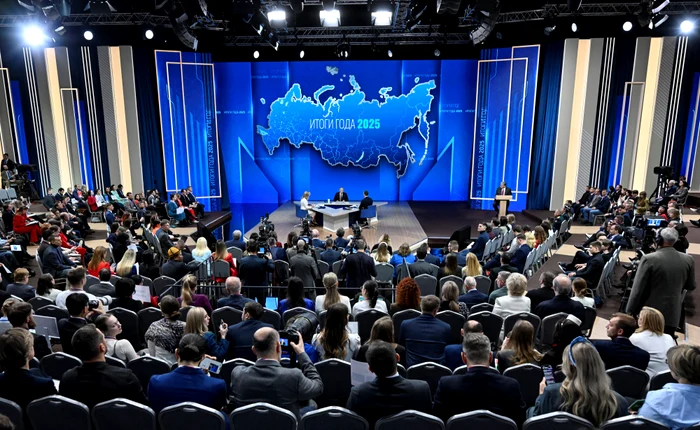
Vladimir Putin's annual question-and-answer conference is an opportunity for ordinary Russians to air their worries and problems, but the event often becomes a platform to convey the Kremlin leader's priorities to the population.
AFP PHOTO
In the context in which US President Donald Trump seems to be on the last hundred percent in negotiations on a problematic agreement that he wants to see concluded improbably by the end of the year, keeping his counterparts in Brussels and Ukraine in suspense, the geopolitical stakes have also increased considerably for Russia, and Putin could not miss the opportunity to pulsate, reports Politico,
In order to ensure the unity of the message, Friday's press conference was, according to tradition, carefully choreographed, and the questions – according to the Kremlin, reached the impressive figure of about 3 million, these being, presumably, only the carefully selected messages. It is not clear whether some sarcastic or even blunt comments were deliberately left out or slipped through inadvertently.
The Russian leader held a four-and-a-half-hour marathon conference this year as well. Politico extracted the main themes addressed by Putin, with the ongoing war in Ukraine and peace negotiations in the background
Putin is going ahead with the war
Much has happened since the Kremlin banned even the word “war” following the February 2022 full-scale invasion of Ukraine, with Russians risking prosecution for uttering it.
The proof was the very way the conference began, with an abrupt entry into the issue of the war waged by Russia.
“War or peace?”, the co-presenter directly asked a relaxed Putin at the start of the event, which began shortly after noon, local time.
The question set the tone for the rest of the nearly five-hour conference, during which the war in Ukraine was at the fore.
Taking advantage of questions in this regard from military correspondents, veterans and even the wife of a deceased soldier, Putin wanted to clarify that, from his perspective, the war is going according to plan and any problems, such as delayed payments, are only the result of “excessive bureaucracy”.
At a time when various polls show that many Russians are eager to see a peace deal materialize in one way or another, Putin is stepping up his call for the country to come together to fight the war together, political analyst Andrei Kolesnikov told POLITICO.
The message is that “victory, in the form of peace on Russia's terms, is at hand, and the population is united in supporting” the war, he said.
Peace on Russia's terms
Viewers could be forgiven for feeling like they were transported back in time to February 2022, when Putin first laid out his reasons for invading Ukraine.
Putin has apparently tried to align himself with Trump's wishes for a quick peace, signaling that Moscow is willing and ready to negotiate a deal on Ukraine.
But the language used in the speech that followed suggests the opposite. He denounced the “Kiev regime”, which he accused of coming to power through a “coup d'état”, and repeated that Russia was fighting “neo-Nazism”.
At the same time, Putin repeated Russia's conditions to stop the war: that Kiev abandon its ambitions to join NATO and withdraw from eastern Ukraine.
As always, Putin referred to the “deep causes” of the war, citing NATO expansion as justification for Russia's invasion of Ukraine.
Tough message for Europe and NATO
Putin praised close ties with China and Belarus, but had harsh words for Europe and NATO over their support for Ukraine and warnings about the threat Moscow posed to other European countries.
The Russian leader almost apologized for calling European leaders “pigs” earlier this week at a meeting with the defense ministry, defending that the words “came out” of his mouth.
On the other hand, Putin did not shy away from calling the same European leaders “thugs” for trying to reach a consensus on using frozen Russian assets to help Ukraine financially survive the war.
However, NATO Secretary General Mark Rutte, who last week warned the Europeans to prepare for a war on the scale of “your grandparents and great-grandparents”, entered Putin's sights.
“I really want to ask: Listen, what do you say about the preparations for a war with Russia?”, scolded Putin. “Can you even read? Read the US National Security Strategy.”
These comments were occasioned by the questions of foreign journalists.
Similarly, in response to a question posed by the BBC's Russia correspondent Steve Rosenberg, who wanted to know how Putin sees the future for the Russian people and whether he is considering a military escalation, possibly “new special military operations”, the Russian leader became fierce and defensive: “There will be no new special military operations if you treat us with respect and take into account our interests.”
Putin's message to the Russians
Beyond foreign policy matters, Putin also took time to address Russians' financial concerns amid a slowing economy and high inflation as the Kremlin floods its defense sector with cash.
Citing statistics, he insisted there was no cause for concern, hailing “deliberate actions” taken by the country's financial institutions to stabilize the economy.
As for the Russians' relationship with the war, Putin announced that interest in combat is high – young people are enlisting in droves and even fighting for places in the new drone units.
“They are very young guys, students, taking a sabbatical to sign a contract [cu armata] and to participate in combat operations,” he said.
Putin made the claims over an alleged enthusiasm to take part in the war while, according to Western estimates, the Russian army has suffered about 1 million casualties and those mobilized in autumn 2022 have not yet been released, suggesting that the authorities are struggling to fill the ranks.
Putin “is not concerned about the cost of continuing the 'special military operation', be it financial, human or psychological,” observed Kolesnikov, the Moscow-based analyst.
Traditional values
Although the war took center stage, Putin nevertheless slipped into his answers references to another favorite topic: “traditional values.”
He warned other countries that they risk having their assets seized by Europe because of their conservative policies. “Tomorrow someone may disagree with policies related to the LGBT community,” he said. “In Muslim and Islamic countries, there are many very strict laws that protect their traditional values, which are our common traditional values,” Putin said, suggesting the EU could target those countries under its policies and ignoring the rationale for the EU bloc imposing sanctions and freezing Russian assets.
After a 23-year-old student took the opportunity to propose to his girlfriend live, Putin praised the young man for starting to meet his partner early.
“In the Caucasus, they have a good tradition of marrying off their children at a young age. We should follow their example,” he said.
Then came the conclusion: what united all those who fought for Russia at the front were their “common values”.
Questions from the population: selected or spontaneous?
For spectators, the most interesting part of the scene was a large screen displaying text messages sent by ordinary Russians.
Some fit perfectly into the landscape of the event: “How can I contribute to the transformation of Russia into an empire?”, one message read.
Others had an entirely different tone.
“This is not a direct line, but a circus,” read a message that briefly appeared on the screen.
“Vladimir Vladimirovici, it's Friday, can we start drinking?”, wrote another.
It is unclear whether the Kremlin is deliberately allowing such messages to get through, perhaps to give the event an aura of legitimacy. Or if some Russians have simply been lucky enough to have their messages selected.