Traders propose labeling food products with two distinct expiry dates: “In Belgium there are even three”


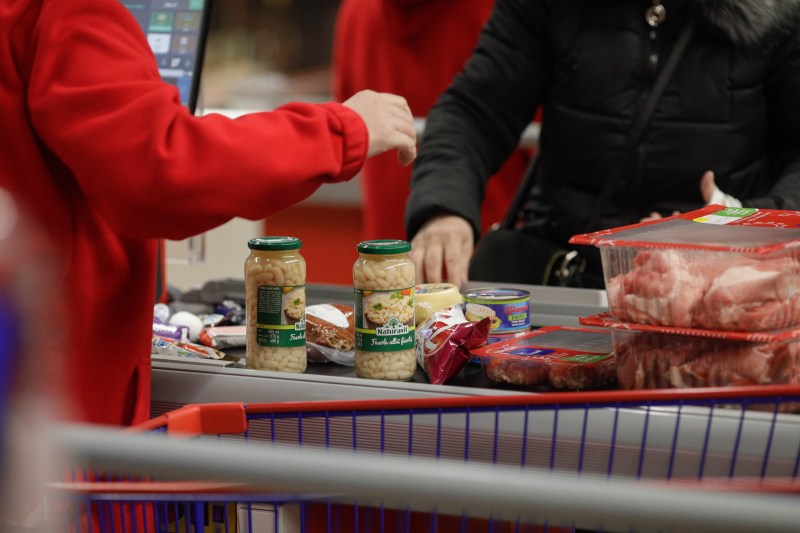
A customer prepares to pay for the food products bought in a supermarket (illustrative image), PHOTO: Inquam Photos / George Călin
The introduction of distinct terms for the marketing and consumption of food products could contribute significantly to the reduction of food waste, given that the current labeling system, based exclusively on the expiration date, limits the sale at a discount and the donation of food that is still safe for consumption, argue the specialists in the field cited by Agerpres.
“A very important element is the expiration date, where we have a longer discussion. I think that the expiration date, as we know it today, is not enough. We have on a product either the expiration date or the production date and a period of I don't know how many months of validity. I think we still need a term that represents the date until which the respective product is good for consumption,” said Feliciu Paraschiv, vice-president of the National Association of Small and Medium-Sized Retailers in Romania (ANCMMR), at the “Romania on the shelf” debate organized by CLCC Coalition for Freedom of Trade and Communication.
“The production date doesn't matter whether we put it or not. Some put it, others don't put it because a production date on a canned fish from two years ago makes the customer reluctant, although it is optimal for consumption”, he added.
“I think that the expiry date should be the deadline until which the respective product can be sold in stores,” explained Feliciu Paraschiv.
In his opinion, the labels should state: the date until which the product can be sold in stores and the date until which it can be consumed.
Retailers say people are reluctant to buy products that will expire soon
In the case of a promotion where the retailer decides, according to the law, to make a 50% discount on canned goods that expire that week or in the following days, the customer is “very reluctant” to buy them, says the vice-president of the ANCMMR.
“He'll say: 'I can't take five cans because I won't eat them all today, and tomorrow they're already expired,' and then they don't buy them anymore. They can't be donated to a nursing home, they can't be donated anywhere because the next day they're expired. When the law says you can sell them until X date, after which they're banned from sale, but they're good for consumption for another three months, then they can be donated, and their customers they can buy more products on sale and consume them during the three months. Such a measure would reduce food waste~, added Feliciu Paraschiv.
He emphasized that in Europe there are big problems with regard to food waste, a phenomenon that has become more pronounced in Romania.
The example of Belgium in food labelling
“If we had five times less food waste in the first ten years after the Revolution, now we are approaching the food waste in Europe. We are not quite there, they are at about 187 kg per year, we are at about 160 kg, but we are getting closer. Before the difference was very big between us and them,” said Feliciu Paraschiv.
For his part, Ştefan Pădure, the president of the Association for the Promotion of Romanian Food (APAR), emphasized that in Belgium there are three dates mentioned on food product labels.
“In Belgium there are three dates. (…) For example, we give 12 days from the beginning based on laboratory tests in which the product has ok properties, is suitable for consumption, half (of the period, no) is marketed and there is half of the half to give at a reduced price, and in the last part to be able to give for collective consumption, but all these are tax deductible”, explained Ştefan Pădure.