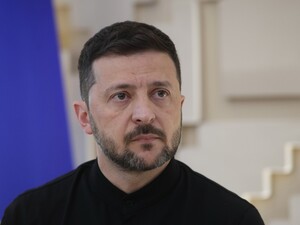
“Today, a “reparation loan” or any format calculated for the amount of Russian frozen loans (from $150 billion to $210 billion) is a guarantee of security for Ukraine, a financial guarantee of security,” Zelensky said.
He noted that the use of these funds depends on which option – plan A (end of the war) or plan B (Russian aggression continues) – will have to be implemented.
“If Plan B and Russian aggression continues, Ukraine is counting not only on bilateral packages with countries, we are counting on at least €40–45 billion a year in financial assistance, that is, a tranche of this “reparation loan,” […] which we can use to support our army (defense sector) and financial needs. […] There are also “criticisms,” of course, – infrastructure, energy – here we decide,” the president explained.
According to him, if the war ends, Ukraine will use tranches in the amount of €45 billion per year differently.
“This is a very serious injection into the macro-financial stability of Ukraine, into our recovery and, again, into the same “criticism,” but now we are no longer talking about support, but about restoring it. And this is truly part of our security guarantee,” Zelensky emphasized.
He did not rule out that “issues with the “reparation loan” may arise, and then Ukraine will count on “alternative ways.”
“Without it, there will be a shortage of everything that I said above,” Zelensky said.
Context
The European Commission proposed using €210 billion of frozen Russian assets to finance a loan to Ukraine, of which initially €90 billion over two years.
€115 billion will be used to finance Ukraine’s defense industry, €50 billion will be used to cover its budgetary needs, and €45 billion will be used to repay the G7 loan received in 2024.
But Belgium, where most of the Russian frozen funds are located, is against it. In addition, as of today, all 27 EU member states must renew the asset freeze every six months, which creates the risk of a veto from individual states, in particular Hungary. To secure the loan, the EC is now preparing a new procedure for freezing assets indefinitely.
According to Bloomberg sources, the EU plans to approve the “reparation loan” agreement at a meeting in Brussels on December 18.