A new US national security strategy published last week has caused consternation in European capitals. The document argues that immigration to Europe could lead to a “civilizational wipeout” and marks a significant shift in tone from American foreign policy in recent decades.
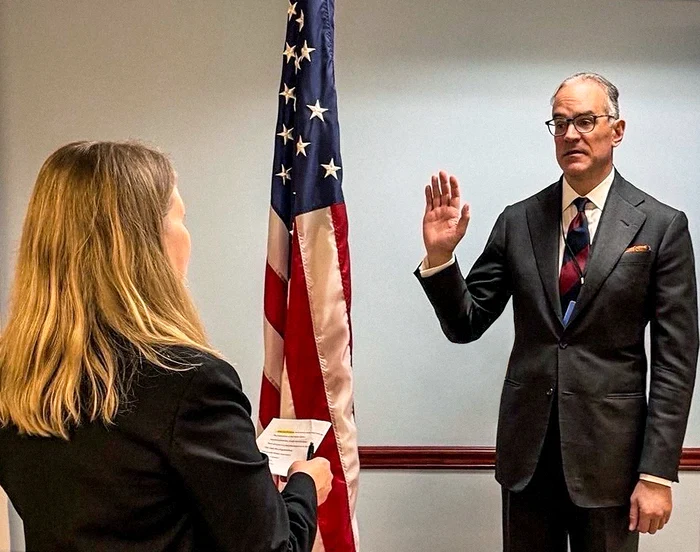
Michael Anton, prominent figure of the Maga current/FOTO:X
The question that arises is how a foreign policy manifesto takes shape for a president known for instinctive decisions rather than interest in strategic documents.
The author in the shadows
The first version of the document was drafted by Michael Anton, a prominent figure in the Maga movement who US officials say was central to the development of the new National Security Strategy (NSS). The text surprised US allies, warning that immigration to Europe represents an existential threat, reactivating the Monroe Doctrine for the Western Hemisphere and diminishing Washington's role in the global competition with China and Russia, writes The Guardian.
Anton, a former director of policy planning at the State Department, had been making headlines since 2016 when he published an essay under a pseudonym describing the presidential election as a “life or death” choice for conservatives. He argued at the time that pro-immigration positions were the sign of a society “that wants to die.”
It is therefore no surprise that the new strategy – a document that is usually technically and cautiously worded – has been perceived as a radical break. Although it went through a lengthy bureaucratic process and was unceremoniously published, some of its ideas were hardline enough that European leaders said that US Euroscepticism had, for the first time, become “official doctrine”.
A paradigm shift
“It is clear that Maga is trying to be a revolutionary movement”says Max Bergmann, director of the Europe, Russia and Eurasia program at the Center for Strategic and International Studies. “He wants to completely overturn post-war American foreign policy and change the direction of the country.”
For decades, the bipartisan consensus in Washington viewed European institutions – NATO and the European Union – as key partners in the competition with authoritarian powers such as Russia and China. The new strategy shifts the focus to immigration, identified as the main threat, and suggests rapprochement with European allies with illiberal visions.
Europe's reaction was one of concern. “It's like a divorce,” says Bergmann. “The Europeans don't want this relationship to end. They are looking for signs that the United States is still interested in the partnership. And this document seemed like confirmation that the relationship is falling apart.”
How much does the document weigh?
Critics point out that national security strategies do not set budgets and rarely dictate concrete policies. Some even wonder if Donald Trump has read the 33 pages of the document.
Traditionally, the NSS is the result of a complex interagency process that often produces a compromise text, says Daniel Hamilton, a former State Department official and professor at Johns Hopkins University. John Bolton, Trump's former national security adviser, is even more blunt: “He didn't read the strategy in his first term and nobody paid any attention to it. I don't see why it would be any different now.”
However, in a later interview, Trump repeated the document's criticism of mass immigration, suggesting that the strategy's message was fully in line with his own beliefs. “If things continue like this, many of these countries will no longer be viable,” he said, referring to Europe. “Their immigration policy is a disaster.”
A manifesto for Trump's inner circle
Although it does not contain concrete measures, the document is seen by analysts as an ideological manifesto for those close to Trump. They include JD Vance, who criticized European liberalism at the Munich Security Conference, and Stephen Miller, the White House deputy chief of staff, who considers immigration a major national security priority. The chapter dedicated to Latin America reflects, in turn, the vision of Secretary of State Marco Rubio.
The downsizing of national security structures and the marginalization of the National Security Council contributed to the emergence of a less refined document, but also more difficult to put into practice, observers say.
However, there are signs that the spirit of the strategy is already being implemented. US embassies in Europe and other Western countries have been instructed to collect data on crimes committed by immigrants. A recent human rights report harshly criticized Germany but softened the wording on Israel and El Salvador.
Michael Anton left the government months before the document was published, frustrated, according to some diplomats, with the limited influence he still had. But in conservative circles, the NSS is already being discussed as a project for the future.
“As a guide for the rest of Trump's term, the document may be overrated“, the Wall Street Journal recently wrote. “But he can't be ignored. He reflects the vision of those who want to shape American politics long after Trump ends his term. And those ideas matter.”